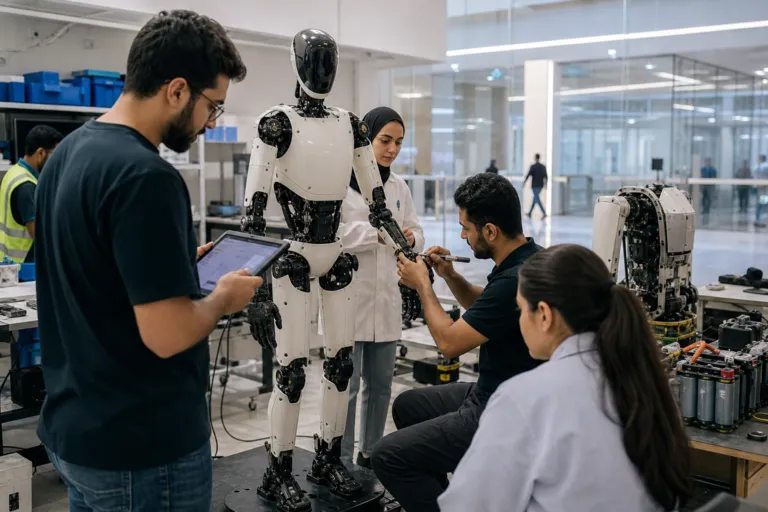
Dubai’s robotics story is shifting from spectacle to strategy. In late 2022, Sheikh Hamdan bin Mohammed bin Rashid Al Maktoum launched the Dubai Robotics and Automation (R&A) Program, with a stated goal of raising the robotics sector’s contribution to Dubai’s GDP to 9% within the next decade. The same program aims to provide 200,000 robots over the next 10 years to improve efficiency in industrial, logistics, and service sectors. The plan focuses on five strategic areas: Production and Manufacturing; Consumer Services and Tourism; Healthcare and Connected Mobility; and Logistics. It is built on governance, support for R&D, and active technology adoption, positioning Dubai to compete for a place among the top 10 global cities for robotics and automation.
Logistics is one of the clearest test beds for this shift. DP World has partnered with DGWorld to introduce Autonomous Internal Terminal Vehicles (AITVs) at Jebel Ali Port, rolling them into existing ITV fleets in multiple phases to streamline operations and move toward a digitalised supply chain standard. UAE-based Micropolis Robotics has also showcased heavy-duty industrial automation, unveiling an Autonomous Logistics Platform built on a 400V high-voltage battery architecture. The platform is described as carrying 4–5 tons of payload and operating for up to 18 hours on a single mission cycle in controlled environments such as factory corridors and secured industrial zones. In retail logistics, the BFL Group announced the deployment of 156 robots at its JAFZA facility in early 2022 to automate warehouse operations and support e-commerce logistics.
From GDP Targets to Factory Floors: The Economic Blueprint
Dubai’s automation push sits inside wider national industrial goals. Operation 300Bn, led by the Ministry of Industry and Advanced Technology, targets more than doubling the industrial sector’s contribution to the UAE’s GDP to reach AED 300 billion by 2031. Alongside it, the Dubai AI 2031 vision mandates that 40% of all government services must be AI-driven, adding urgency to adoption. The same policy environment is paired with the “Make it in the Emirates” campaign, which highlights 0% corporate tax in specialized Free Zones and a regulatory framework positioned as best-in-class. Together, these programs frame robotics not as a standalone tech purchase, but as an “enabler” designed to drive sustainable, measurable gains in productivity and output.
Examples of digitisation-linked value are already being used to justify the acceleration. Industry research cited in coverage of Dubai’s smart automation notes that manufacturers that fully digitize operations can achieve productivity gains of 30% to 50% while reducing waste by up to 40%. Emirates Global Aluminium (EGA) is presented as a flagship case: the company produces 4% of the world’s aluminium and built a “digital factory” with over 80 customized use cases, delivering a combined financial impact exceeding $123 million. Investment announcements also signal capacity ambition. A report on Lianhe Sowell International Group describes a $200 million commitment toward a specialized industry robotics headquarters in the UAE, targeting an annual production capacity of 50,000–80,000 robots.
Dubai’s bet also plays out against global robotics momentum, and that context matters for the UAE humanoid robotics market conversation. Robotics statistics citing the International Federation of Robotics state that around 4.3 million robots operated in factories worldwide as of 2023, a 10% increase from the prior year, while annual installations exceeded 500,000 in 2024 for the third consecutive year. On the market side, one compilation cites a global robotics market estimate of $94.54 billion in 2024 and notes a projected CAGR of 14.7% from 2024 to 2034. Locally, Ken Research values the UAE AI-powered retail robotics market at USD 1.2 billion and notes that deploying a single AI-powered robot can exceed AED 200,000, while integration complexity can reach AED 100,000. These constraints help explain why Dubai’s program emphasizes governance, R&D support, and adoption, not only hardware rollouts.
What is Dubai’s stated target for robots under its Robotics and Automation Program?
How is Dubai linking robotics to GDP impact?
Which real deployments show robotics adoption in Dubai logistics and retail operations?
What does Operation 300Bn aim to achieve for the UAE’s industrial GDP contribution?
What figures in the sources help frame the UAE humanoid robotics market question in context?