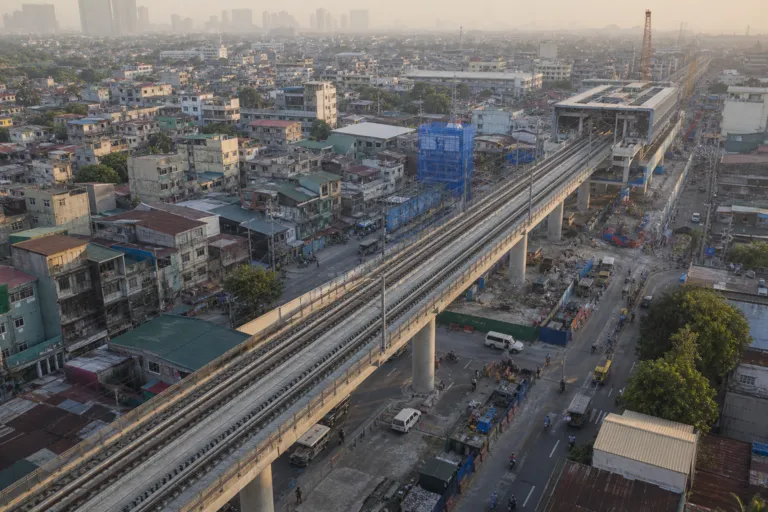
Manila’s congestion problem is being met with a rail-first answer that reaches beyond the capital. The Philippines North-South Commuter Railway is designed as a 147-kilometer electrified standard-gauge corridor from Clark, Pampanga, to Calamba, Laguna, aimed at boosting commuter capacity, reducing congestion, and strengthening productivity. Government planners estimate the line could carry up to 800,000 passengers per day. That scale matters because it reframes where “access” comes from: not just inside Metro Manila, but across Central Luzon, Metro Manila itself, and into southern Luzon corridors.
The NSCR also sits inside a wider rail modernization push that includes the Metro Manila Subway, which is set to integrate with NSCR at FTI (Food Terminal Interchange). The subway is a ₱488.47 billion project spanning 33.1 kilometers with 17 stations from East Valenzuela to NAIA Terminal 3. Official groundbreaking happened in 2019, tunneling started in 2022, and as of mid-2025 multiple stations are under active construction. Phase 1 from Valenzuela to FTI is projected to be partially operational by 2029, with full completion shortly after. Together, these links are positioned to make cross-city trips more predictable, a key factor buyers and tenants often price in.
The 500-Meter Rule: When Rail Becomes a Pricing Map
In 2026, property positioning around future rail stations is shifting from speculation to measurable behavior. One market observation is that properties within 500 meters of future stations are outperforming comparable properties a few kilometers away as partial operations for major lines approach. Urban planning studies commonly define 400–500 meters as a comfortable 5–7 minute walk, and that walkability can translate into lower parking dependency and stronger tenant appeal. This is why being “near” a station is starting to matter less than being genuinely walkable, particularly in areas where buyers want direct CBD access and reduced commute uncertainty.
The NSCR expands this station-area premium beyond Metro Manila because the corridor’s connectivity equation is regional. In 2026, residential properties near confirmed stations in Bulacan, Pampanga, and Laguna are attracting buyers who previously limited searches to Metro Manila, reflecting a shift from “location inside the city” to “connectivity into the city.” In Central Luzon, one market view is that announced infrastructure can lift nearby asking prices by about 5% to 15%, but the larger and more durable gain usually comes after daily travel times, jobs, and rental demand actually improve. It also highlights a common buyer mistake: paying for the infrastructure story while buying too far from the actual station or access roads.
There are still execution risks that shape timing and sentiment. Budget documents cited in reporting show several major rail projects, including NSCR, were shifted to unprogrammed appropriations starting with the 2024 national budget cycle, where releases depend on conditions such as loan availability or higher-than-expected revenues. The Department of Transportation’s programmed allocation was reduced from P106 billion in 2023 to P73.3 billion in 2024, far below the P214.3 billion originally proposed in the National Expenditure Program. Even so, the direction is clear: as station infrastructure becomes physically visible and operational milestones firm up, rail connectivity becomes tangible—and that tangibility is increasingly being priced into both congestion expectations and real estate decisions.
What is the planned route and length of the Philippines North-South Commuter Railway?
How many passengers could the NSCR carry each day?
What is the “500-meter effect” in rail-adjacent real estate?
How does the Metro Manila Subway connect to the NSCR?
Why do some analysts warn against buying too far from an NSCR station?