Malaysia’s data-centre boom has moved from a real-estate and investment story to a grid story. By the end of 2024, there were 54 operational data centres across Malaysia, and the number is expected to rise to 81 by 2035, according to a government statement to parliament cited by the South China Morning Post. Investment momentum has been strong too. From 2021 to mid-2025, the Malaysian Investment Development Authority approved 144.4 billion ringgit (US$36.3 billion) in data-centre and cloud-computing investments, linked to landmark pledges from hyperscalers including Microsoft, Google and Amazon Web Services.
That growth translates into a heavier, steadier load on the power system. Malaysia’s Energy Commission said data centres consumed 9.28% of the country’s total electricity in its latest reading, and its chief executive officer Siti Safinah Salleh said usage has been climbing steadily as digital infrastructure expands and cooling loads rise in warm conditions. The same update noted that several more data centres are expected to begin operations in November, which should lift consumption further by year-end. For policymakers, this changes approvals from being mainly about attracting projects to also checking energy and water availability.
Gas Rises Fast as Johor Becomes the Load Center
On the supply side, Malaysia is leaning more on gas-fired generation to keep server farms running around the clock. The South China Morning Post reported that electricity for Malaysia’s data centres increasingly comes from gas-fired turbines, even as the trend clashes with clean-energy goals. Grid System Operator data cited in the report showed gas-fired power generation surged 50.5% year on year in April, the fastest annual pace in at least eight years, reaching a record 5.54 TWh. This is the kind of near-term ramp that can match fast-moving demand, but it also underscores why the electricity mix has become part of the data-centre debate.
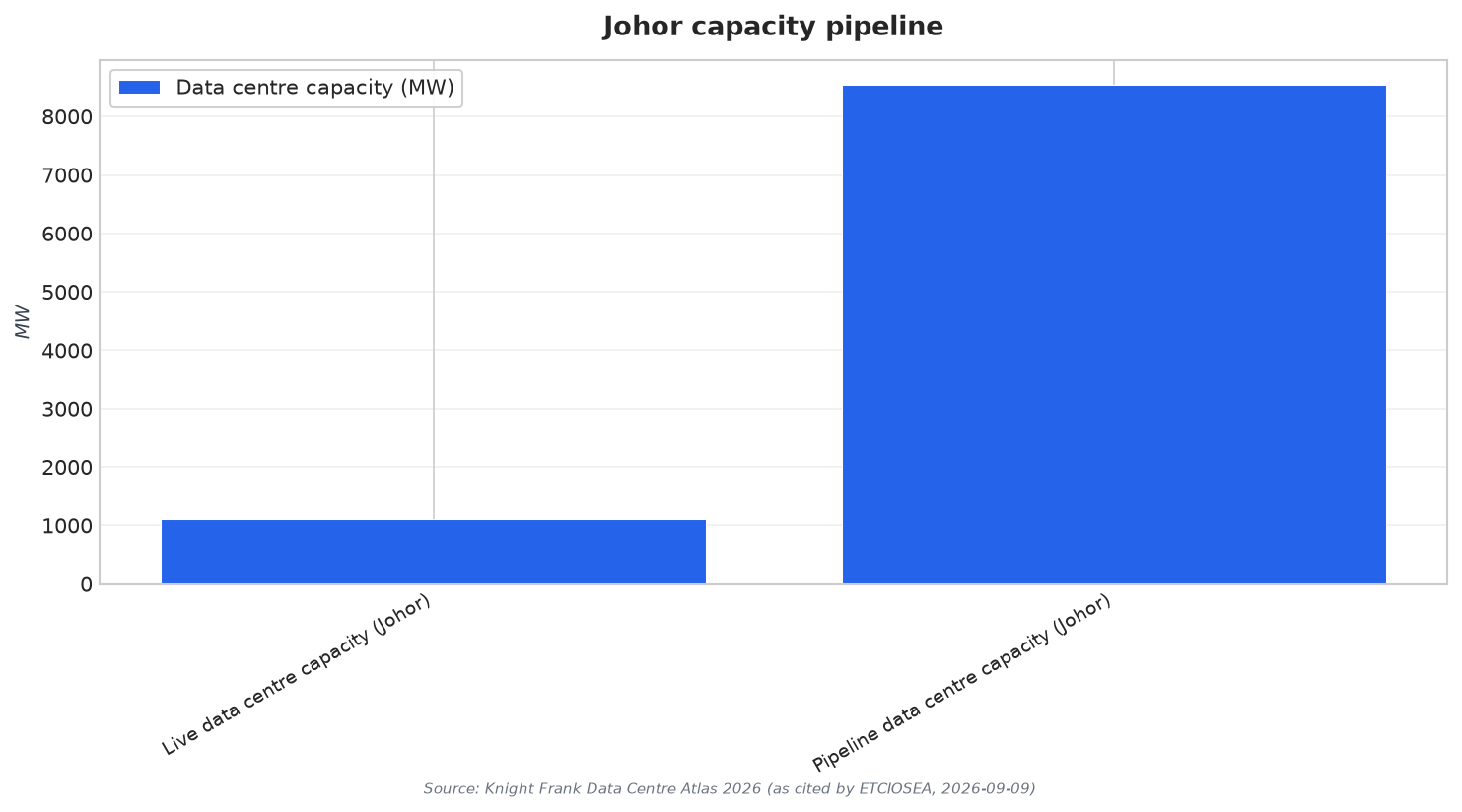
Johor is where the scale of future demand is easiest to see. The Knight Frank Data Centre Atlas 2026, released in July and cited by ETCIOSEA, put Johor’s live data centre capacity at 1,110 MW, with another 8,542 MW in the pipeline. Pinsent Masons also described Johor as the dominant hub, accounting for 76 of Malaysia’s 187 operational and planned data centres. The same ETCIOSEA report noted that Malaysia Investment Development Authority data showed RM95.8 billion in data-centre and cloud-computing projects in the first half of the year alone, reinforcing why planners are now focused on generation, transmission, and local resource constraints.
Research coverage in Malaysia is already mapping what a longer-term power strategy could look like. BusinessToday cited Kenanga Research as saying that bridging the supply-demand gap would require aggressive greenfield development, strategic power purchase agreement extensions, and eventually a transition toward nuclear baseload generation. In that framing, natural gas is positioned as a key transition fuel. The same report said Petronas is developing Regasification Terminal 3 (RGT3) in Lumut and Gas Malaysia Berhad is advancing an offshore regasification terminal in Yan. For Malaysia data center power supply planning, these steps point to a two-track approach: expand gas-backed flexibility now while keeping nuclear baseload on the policy horizon.
How many data centres does Malaysia have, and what is expected by 2035?
How much of Malaysia’s electricity do data centres use today?
What does Johor’s data-centre capacity pipeline look like?
What is happening to gas-fired generation as data centres expand?
What is the outlook for Malaysia data center power supply as demand rises?