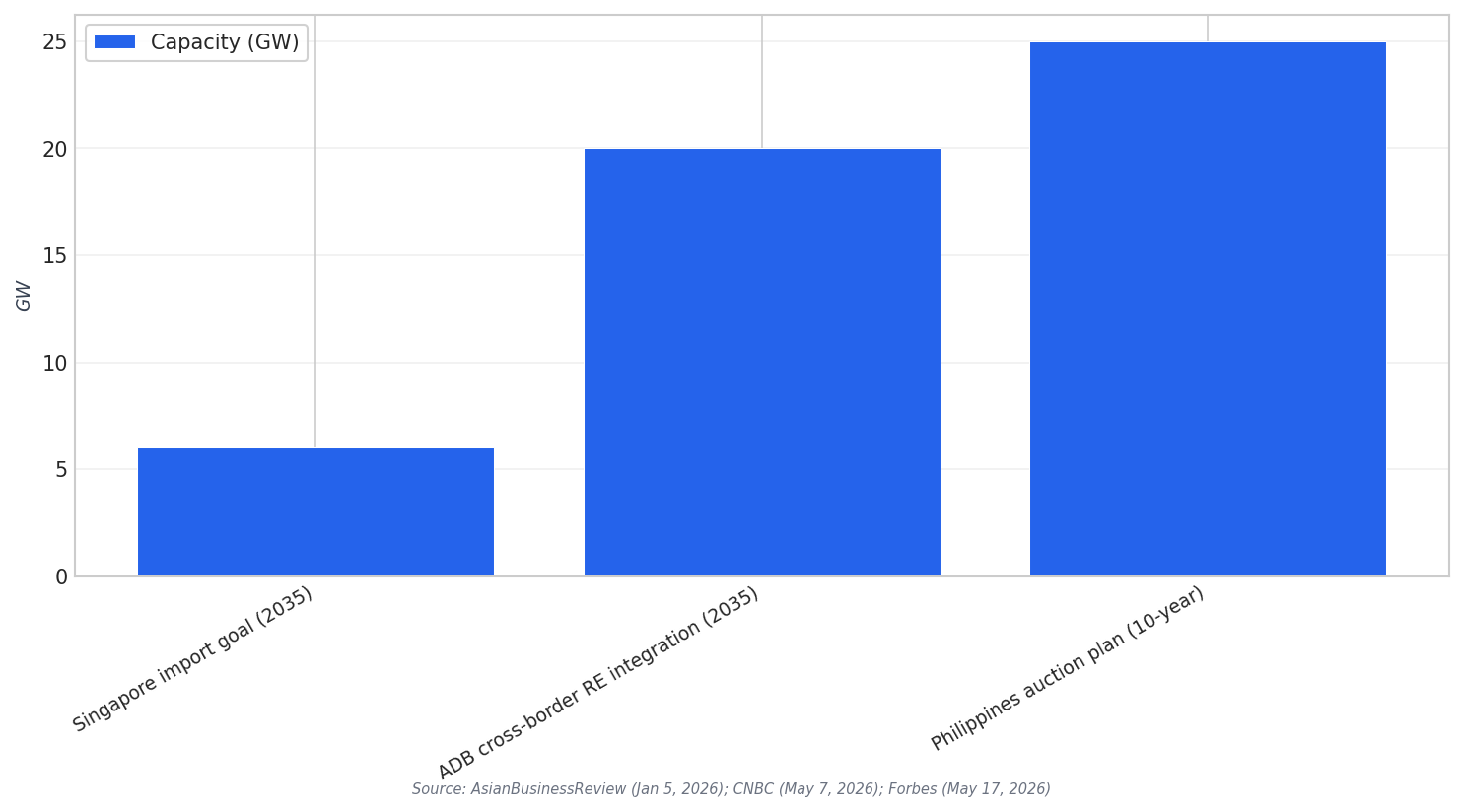
The new story of Southeast Asia’s clean power shift is not only about more solar capacity. It is also about moving electricity across borders. Singapore is a clear example. As demand rises and the city-state eases reliance on gas, momentum has built around imports of solar, wind, and hydropower, alongside large grid-interconnection projects. The Energy Market Authority (EMA) has issued conditional approvals to 11 projects to import low-carbon power from Australia, Cambodia, Indonesia, Sarawak in Malaysia, and Vietnam. Singapore is working toward importing about 6 gigawatts of low-carbon electricity by 2035, reflecting how system flexibility and regional supply are becoming core priorities.
This regional push matters because solar growth collides with land, intermittency, and grid constraints. Singapore’s system relies heavily on natural gas, which accounts for approximately 95% of power generation. Even with higher domestic ambition, its solar limits are explicit. EMA analysis cited in industry reporting says solar can realistically contribute only up to around 10% of Singapore’s projected energy needs by 2050. Yet Singapore has raised its 2030 solar target to 3 GW, and separate analysis reported it is on track to reach 3.2 GW by the end of this decade. These numbers reinforce why cross-border solutions are being treated as essential infrastructure for Southeast Asia solar grid integration.
Developers are now designing projects around cables, storage, and export contracts. In Indonesia, developers are advancing utility-scale solar-plus-storage projects and subsea cables designed to supply a meaningful share of Singapore’s future clean electricity. A specific example is the 900 MW solar and 1.2 GWh battery project in Indonesia being developed by Equator Renewables Asia and CRE International, with 400 MW (AC) slated for export to Singapore. Singapore also conditionally approved a 1 GW hydropower import project from Malaysia, and DBS described a separate EMA conditional award to import 1 GW of hydropower from Sarawak as potentially catalytic for the broader ASEAN Power Grid vision.
Why Grids, Not Just Panels, Are Driving the Solar Boom
Regional institutions are pushing the same logic at scale. The Asian Development Bank’s $70 billion plan includes a pan-Asia power grid initiative, and it aims to integrate nearly 20 gigawatts of renewable energy across borders and link 22,000 circuit-kilometers of transmission lines by 2035. Industry voices argue this is designed for markets with abundant hydropower and fast-expanding solar and wind, but limited cross-border capacity to move clean power to major demand centers. In parallel, project developers are emphasizing system-level integration. Envision Energy said the future is shifting toward system-level integration and intelligent operations by integrating wind, solar, and energy storage at scale to enhance grid stability and flexibility.
On the demand and investment side, Southeast Asia’s power demand is rising by 2.6% annually, based on the International Energy Agency’s latest World Energy Outlook. That growth is colliding with energy security concerns and pricing realities that favor firm renewables in some use cases. In the Philippines, weekly inquiries for rooftop solar surged by more than 500% during an energy crisis, and the country’s 10-year auction plan to procure 25 gigawatts of renewable capacity signals an ambition to function as a major node in an integrated market. Across the region, developers also see value in pairing storage with solar to participate in peak-valley arbitrage and ancillary service markets.
The cross-border grid push is therefore not a side project. It is becoming the enabling layer for solar growth, balancing, and financing. Singapore set up Singapore Energy Interconnections Pte. Ltd. in April to develop and operate cross-border transmission infrastructure. Lenders describe the ASEAN Power Grid as a longer-term play, but an important one for investment financing. Meanwhile, regional trade in renewables is already tangible. Laos has begun exporting wind power to Vietnam under a 25-year power purchase agreement, supporting ASEAN power grid connectivity goals by demonstrating cross-border electricity trade. In practice, Southeast Asia solar grid integration is emerging as the shared mechanism that turns scattered clean resources into reliable power.
What does “Southeast Asia solar grid integration” mean in practice?
How much low-carbon electricity is Singapore aiming to import?
What is ADB targeting for cross-border renewable integration?
Which cross-border projects link Indonesia and Singapore?
Why does Singapore focus on imports and flexibility instead of only building more local generation?