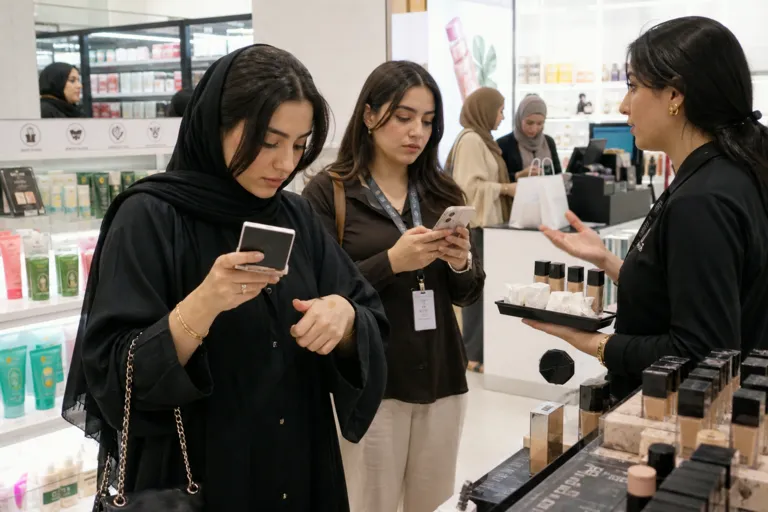
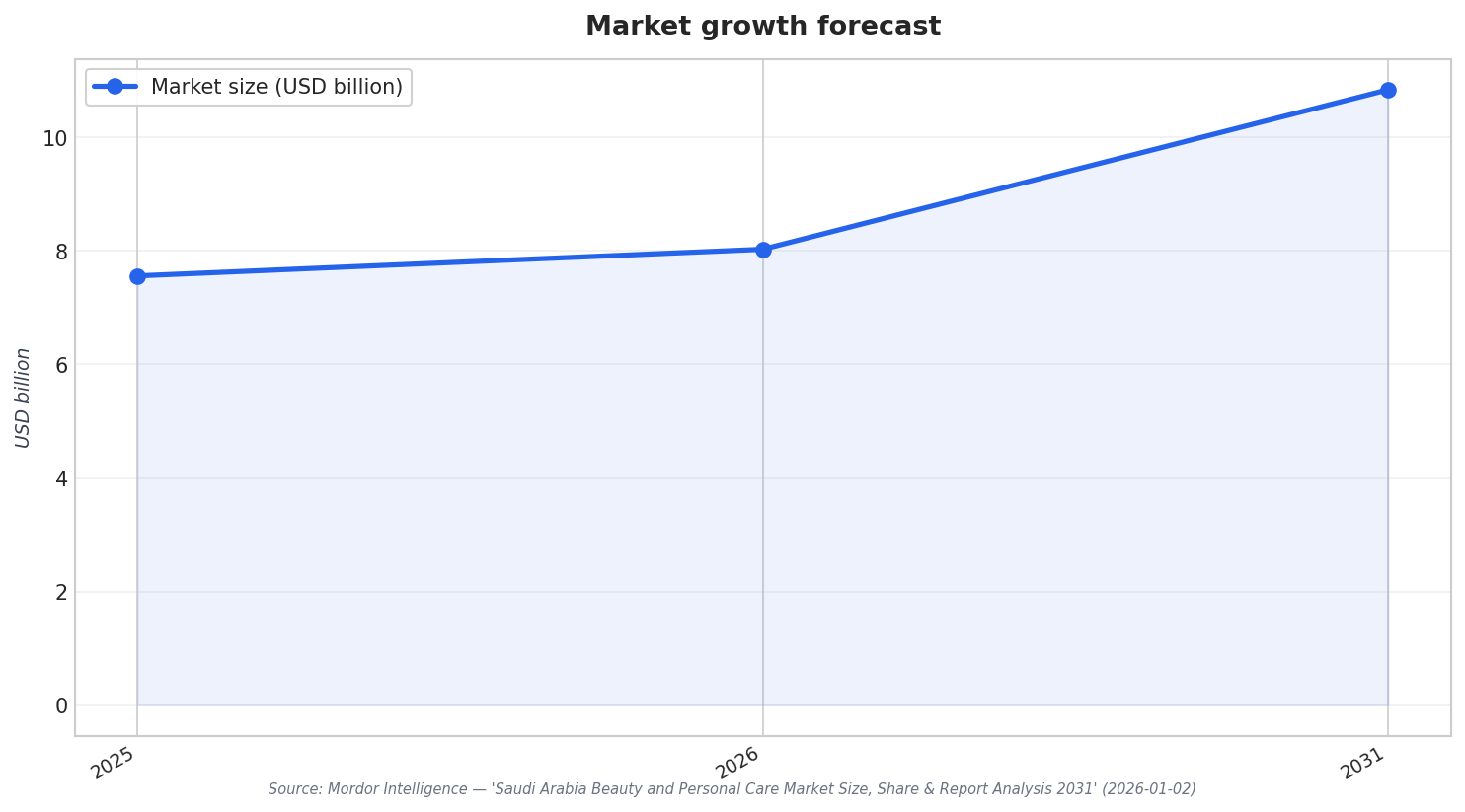
Saudi Arabia’s beauty and personal care story is increasingly tied to lifestyle change. Mordor Intelligence expects the market to grow from USD 7.56 billion in 2025 to USD 8.03 billion in 2026, and forecasts USD 10.84 billion by 2031, at a 6.17% CAGR over 2026–2031. That momentum sits alongside social liberalisation and Vision 2030 priorities that are changing daily routines and shopping habits. Vision 2030 has also lifted female workforce participation from 17.4% in 2017 to 36% by the first quarter of 2023, surpassing the program’s original 30% target. As more women work, professional grooming and makeup use broaden, pushing demand beyond basic replenishment and into experimentation.
Under the surface, category mix explains why the market feels so dynamic. In 2025, personal care held 86.64% of Saudi Arabia’s beauty and personal care market share, according to Mordor Intelligence. Yet the faster momentum sits in beauty statements and trade-up behavior. Cosmetics are projected to expand at a 6.61% CAGR through 2031, and premium offerings are set to grow at a 6.62% CAGR to 2031, even as the mass segment still accounted for 60.78% of market size in 2025. Ingredient preferences also show an inflection point. Conventional formulations retained 71.88% share in 2025, but natural products are forecast to climb at a 6.72% CAGR over 2026–2031, reflecting demand for claims that align with skin-health and cultural expectations.
Digital Discovery, Retail Shifts, and the New Rules of Trust
Digital influence is no longer a side channel in the Kingdom. Futurism reports 36.84 million internet users in Saudi Arabia, representing 99.0% penetration, and 35.10 million social media users comprising 94.3% of the population. That reach helps explain why influencers and online communities shape purchasing decisions daily, and why social commerce can compress brand-building cycles. Channel data reinforces the shift. Specialty retailers controlled 56.77% of 2025 sales, but online retail is projected as the quickest-rising channel at a 7.65% CAGR through 2031. MarkWide Research adds that social commerce integration and trial-size sampling are expanding reach into secondary cities, while specialty stores and pharmacies support premium price realization through consultation-assisted selling.
Regulation and standards are also part of the growth engine, because compliance signals safety and authenticity. MarkWide Research highlights SFDA registration requirements and halal certification protocols administered by accredited Islamic bodies, covering ingredient permissibility, labeling accuracy, and import clearance. It also points to SASO technical regulations for product safety and the Saudi Green Initiative’s emerging sustainability standards reshaping packaging specifications and documentation requirements. Mordor Intelligence similarly notes stringent halal certification as a demand driver. Regionally, Mordor Intelligence reports Saudi Arabia leads the Middle East and Africa beauty and personal care products market share at 25.20% in 2025, and says the SFDA streamlined cosmetic import procedures through the new GHAD system in 2024, requiring prior approval for shipments.
The boom is not only about women’s beauty. Men’s self-care is widening as social acceptance grows. Mordor Intelligence puts men’s grooming at USD 802.35 million in 2023 and anticipates a 6.08% CAGR to USD 1.29 billion by 2031. At the same time, Vision 2030 is strengthening the ecosystem behind the shelf. Futurism reports that female workforce participation contributed SAR 18 billion (USD 4.8 billion) to GDP in 2022, supporting a professional grooming category that “barely existed a decade ago.” It also notes the government’s establishment of the Halal Products Development Company through the Public Investment Fund, positioning the Kingdom as a global halal beauty hub that attracts international brands and local manufacturers.
What is driving Saudi Arabia beauty market growth right now?
How large is Saudi Arabia’s beauty and personal care market, according to recent forecasts?
Which product areas are gaining momentum in the Kingdom?
How is e-commerce changing beauty shopping in Saudi Arabia?
What does the data say about men’s grooming in Saudi Arabia?