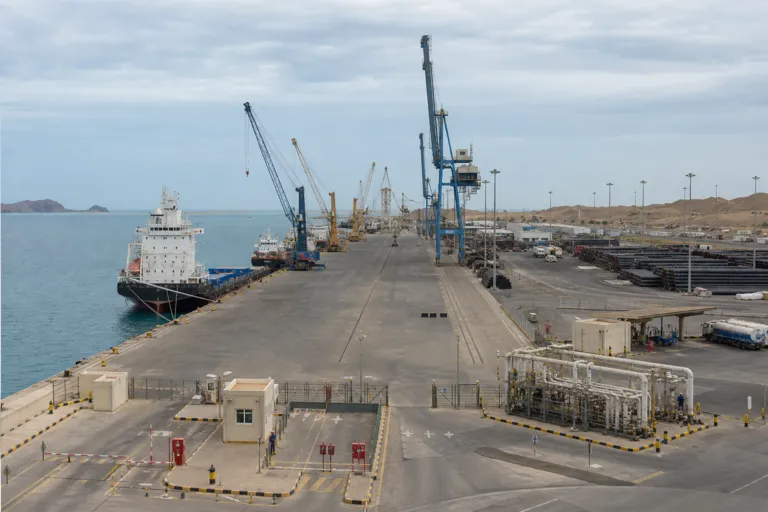
Oman’s port of Duqm has been built by deliberate state planning, not organic, market-led port growth. The aim has been to turn a once-remote coastal settlement into a multipurpose industrial and logistics site that supports economic diversification under Vision 2040. A core part of the strategic case is geography: Duqm sits outside two of the region’s most volatile maritime chokepoints, the Strait of Hormuz and the Bab Al Mandab. That positioning is often described as offering relative insulation from some disruptions, and it has pushed international firms and policymakers to treat the port as part of a broader supply-chain risk conversation rather than just another coastal project.
The institutional vehicle is the Special Economic Zone at Duqm (SEZAD), established in 2011. SEZAD integrates a deep-water commercial port, dry dock facilities, industrial land, and energy infrastructure under one regulatory framework. The zone is described as encompassing an area three times the size of Singapore, a scale that signals long timelines and heavy coordination demands. This structure is intended to reduce coordination failures, but the sources stress that it does not guarantee commercial viability on its own. Duqm’s trajectory still depends on sustained policy execution, external demand, and investor confidence, especially given the fiscal constraints and implementation bottlenecks typical of state-led development models.
A Resilience Play With Real Exposure
Recent conflict dynamics have sharpened attention on Duqm. The sources cite a military strike by Iran on Duqm amid the ongoing US–Iran war, underscoring both the port’s vulnerabilities and the relative resilience of Oman’s infrastructure in a highly volatile environment. Another analysis argues that Oman’s strategic shift has been an attempt to decouple its economy from the Strait, noting that the country has poured billions into Duqm on the Arabian Sea. The same report highlights that India significantly increased its naval footprint in Duqm in late 2025 and early 2026, tied to protecting mission-based deployments and bypassing a high-cost, high-risk Persian Gulf.
Commercial and industrial build-out is also part of why the port is gaining strategic weight. OQ, Oman’s state-owned integrated energy company, is described as the industrial foundation of the Duqm zone and has executed a USD 10 billion investment program to develop a downstream energy cluster outside the Strait of Hormuz. The primary asset is the Duqm Refinery (OQ8), a joint venture between OQ and Kuwait Petroleum International. OQ8 is listed with a processing capacity of 255,000 barrels of crude oil per day, and it has exported over 560 product shipments since achieving commercial operations. In practice, this couples port logistics to large-scale downstream throughput and steady export activity.
Duqm’s value proposition is also being reinforced by wider portfolio choices inside Oman. One source quotes a former director general at Oman’s Ministry of Energy and Minerals arguing that Oman recovered swiftly because major ports such as Salalah and Duqm are outside the Strait of Hormuz. The IMF projection cited in that same source puts Oman’s 2026 growth at 3.7% versus 2.4% in 2025, while noting infrastructure was largely unaffected and export terminals kept operating during the conflict. The same source reports port revenue rising from USD 110.33 million to USD 131.94 million across the period it discusses. For decision-makers weighing Duqm port investment, the story is less about immunity and more about designing resilience that can keep trade moving, even under direct threats.
Why is Duqm positioned as an alternative to regional chokepoints?
What is SEZAD and why does it matter for Duqm’s development?
What major energy asset anchors the Duqm industrial cluster?
How does conflict risk factor into planning for investment in Duqm’s port?
What signals have supported the case for Duqm port investment recently?