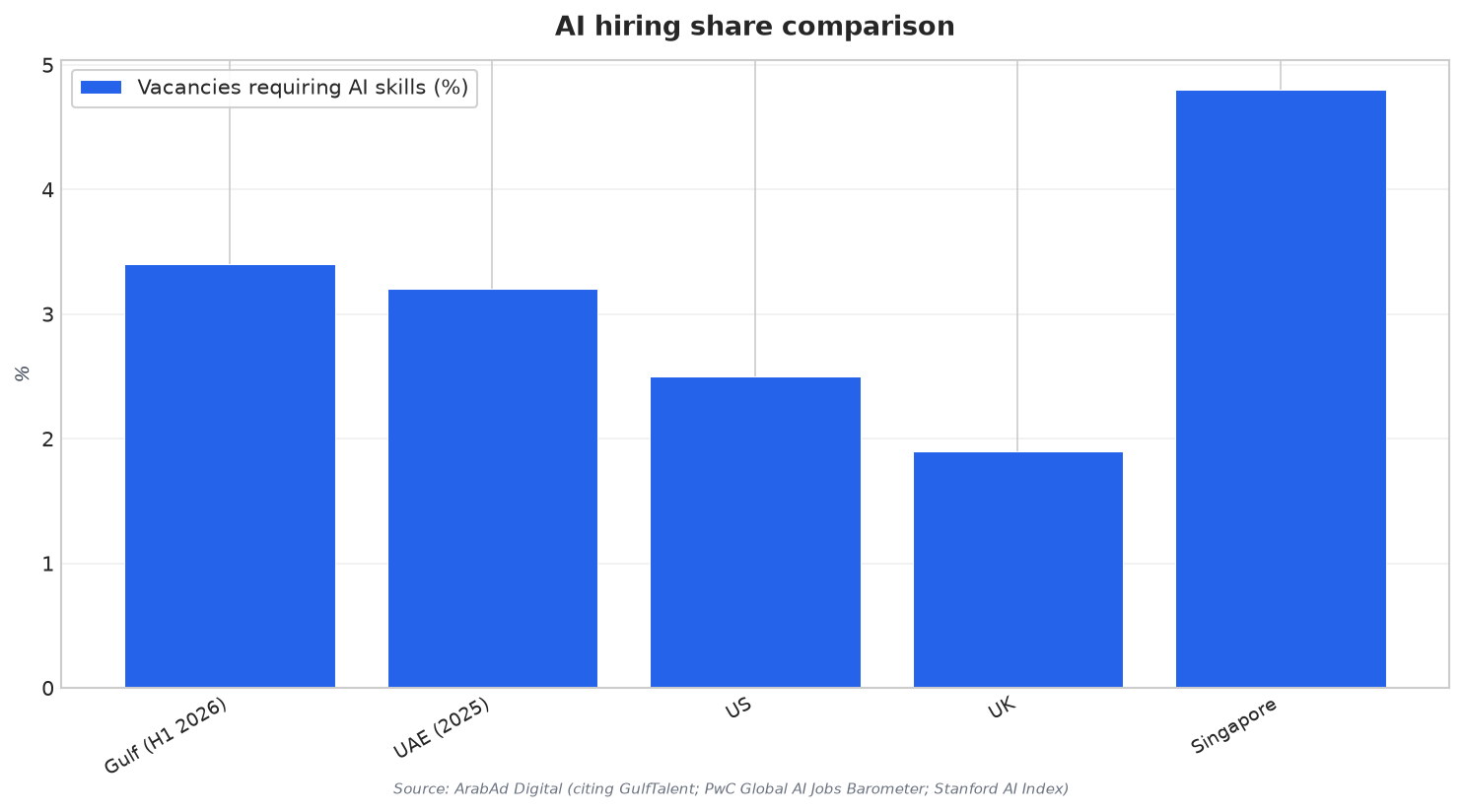
In the first half of 2026, AI-related duties, skills, or tools appeared in 3.4% of professional vacancies advertised across the UAE, Saudi Arabia, and Qatar, according to GulfTalent analysis covering 118,000 direct employer postings between January 2022 and June 2026. That is up from 1.2% in 2022, meaning the share has nearly tripled over four years. The result is a hiring market where employers increasingly expect candidates to be comfortable using AI, implementing it, or selling it, even when the role is not an “AI job” in the traditional sense.
The rise is not evenly distributed, which is one reason the Gulf AI talent shortage feels more acute than a single headline metric suggests. GulfTalent data cited in regional coverage shows the technology sector leads by a wide margin, with nearly one in three vacancies requiring AI-related skills or responsibilities. Banking and audit follow with approximately one in 15 openings referencing AI. Elsewhere, the signal drops sharply: oil and gas and real estate each reference AI in roughly one in 30 vacancies, while construction, retail, healthcare, manufacturing, education, and hospitality mention AI in just one in 100 vacancies or fewer.
Why Demand Is Moving Up the Org Chart and Out of Tech
AI hiring demand also increases with seniority. GulfTalent’s research found around one in every 30 non-supervisory roles involves AI, compared with roughly one in 12 senior leadership positions. Employers are signalling that executives are expected to lead AI strategy, adoption, and business transformation, not just approve budgets. Meanwhile, job design is shifting: around a third of AI-related vacancies involve using AI in day-to-day work, another third focus on implementing AI solutions within organisations, and about a quarter relate to selling AI products and services. Fewer than one in 10 are dedicated to building or training AI models.
Compensation is reflecting the squeeze. Average salary growth is running at around 4.1% in the UAE and 4.6% in Saudi Arabia, but AI, technology, and finance specialists are seeing increases above 10%. Salary inflation for senior developers has been reported at 15–25% annually in the two markets. Recruiters also point to gaps between supply and demand across a wider cluster of capabilities, including data science, artificial intelligence, leadership, analytical skills, project management, engineering, software development, sales, and finance, with shortages concentrated in areas such as business analysis, AI implementation, and digital marketing.
At the same time, enterprise readiness is not keeping pace with ambition. People Matters Global reports that 44% of respondents say their organisations lack the AI-skilled talent required to operationalise their initiatives, highlighting a widening gap between AI ambition and enterprise readiness across the GCC. Korn Ferry data cited in the same report says more than half of talent leaders across the Gulf plan to introduce autonomous AI agents into their teams during 2026, which raises the stakes for governance, job redesign, and accountability. For employers competing for senior AI engineers, ML infrastructure specialists, and data leaders, fast decision cycles, realistic compensation benchmarking, and a credible project story are repeatedly framed as the difference between closing candidates and losing them.
How fast has AI hiring grown across the UAE, Saudi Arabia, and Qatar?
Which sectors show the highest concentration of AI requirements in Gulf vacancies?
Are most AI-related Gulf vacancies about building AI models?
How is pay changing as the Gulf AI talent shortage intensifies?
What evidence shows an AI readiness gap in Gulf organisations?