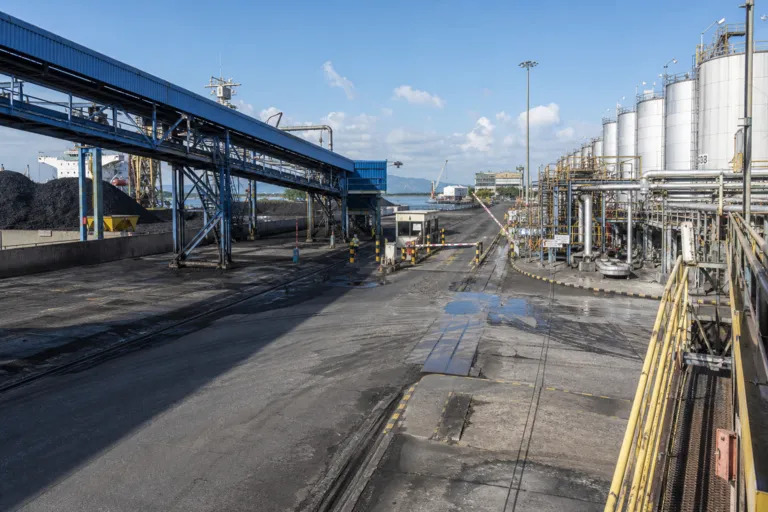
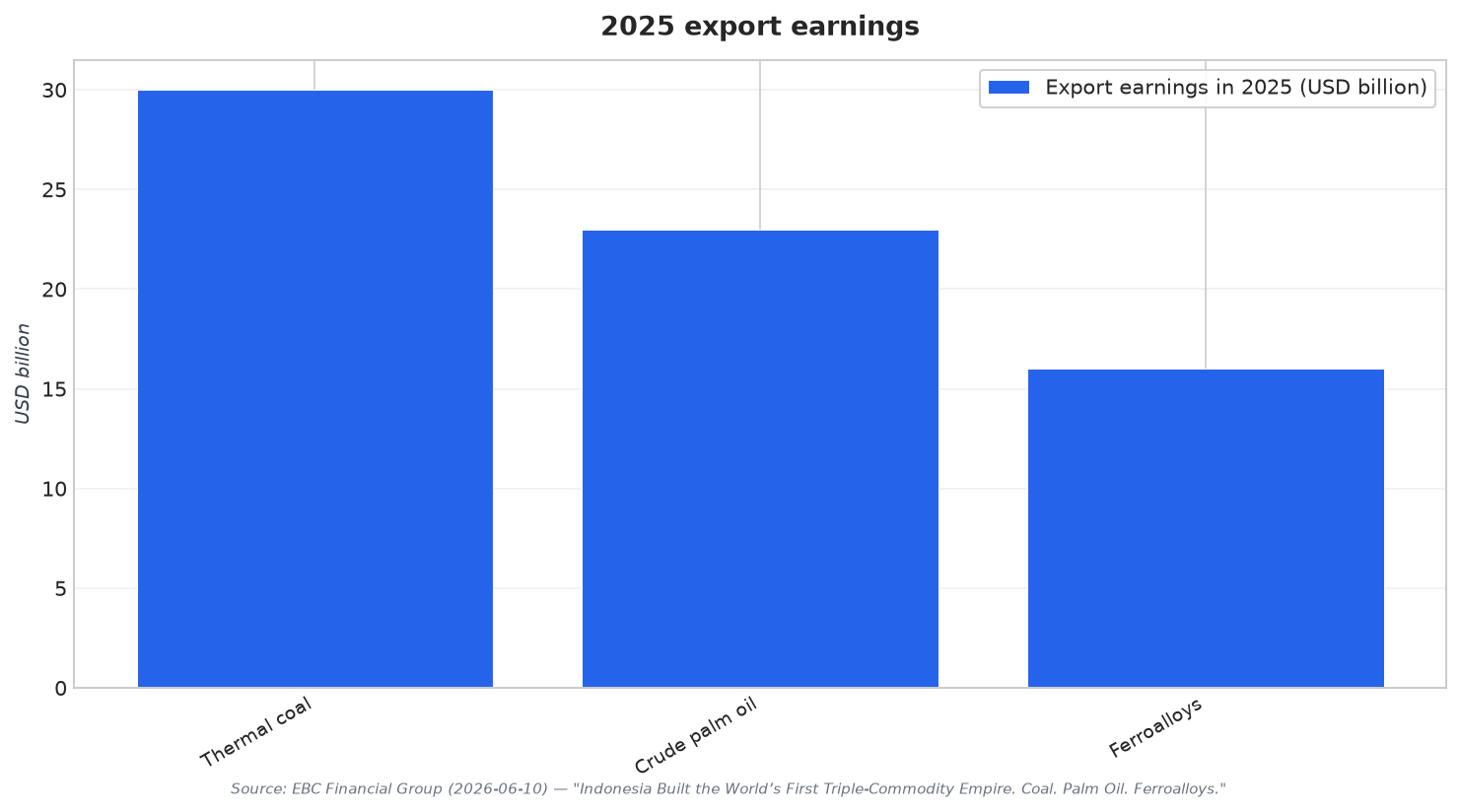
On 1 June 2026, Indonesia began routing its three largest commodity exports—thermal coal, crude palm oil (CPO), and ferroalloys—through a single state entity, PT Danantara Sumberdaya Indonesia (DSI). President Prabowo Subianto told parliament on 20 May that the three commodities earned $30 billion, $23 billion, and $16 billion, respectively, in 2025, for a combined haul of over $65 billion. Another breakdown put coal at $26 billion, with the same $23 billion for palm oil and $16 billion for ferroalloys, totaling around $65 billion and described as close to 23% of Indonesia’s exports. The policy is positioned as a response to under-invoicing and lost revenue.
DSI itself is new. It was incorporated on 18–19 May 2026, and Government Regulation No. 24 of 2026 took effect on 1 June. During the transition window, exporters can keep selling abroad on their own but must report every shipment to DSI through the customs CEISA 4.0 platform. By early 2027, DSI is expected to gradually assume control over the export chain, including payments and shipping arrangements. That is why buyers are watching not only the political announcement but also the operational handover, including who becomes the contractual counterparty and how terms will be standardized across different grades and routes.
What Changes for Buyers: Counterparty, Pricing, and Cash Flow
For overseas buyers, the key change is that DSI is set to become the sole counterparty, holding export rights for these commodities. Industry and analysts have flagged uncertainty around the margin DSI may charge, described as undefined for now, and around pricing rules. Coal buyers are particularly sensitive because quality varies by calorific value, sulfur content, ash levels, moisture, mining location, freight costs, and end-user specifications. Reports also said several Chinese coal buyers postponed shipments in June while seeking clarity on how the single-gateway system will function. In palm oil, one analysis contrasted short, time-bound disruptions with an “indefinite restructuring of the pricing mechanism,” which buyers cannot hedge with inventory alone.
Indonesia’s broader foreign-exchange measures also matter to procurement teams. A rule taking effect on 1 June forces natural resource exporters to park foreign earnings in state-owned banks: 100% for 12 months for palm oil and ferroalloys, and 30% for three months for coal. The policy sits in a currency backdrop that includes reserves falling from $156.5 billion at end-December 2025 to $144.9 billion at end-May 2026, the lowest level since June 2024, with much of the drawdown attributed to intervention and external debt repayment. Around early June, the rupiah was trading around 18,150 per dollar, and it broke past 18,000 per dollar for the first time on 4 June.
Indonesia’s scale in these markets amplifies the impact of any new gatekeeping. One report said Indonesia ships roughly half of the world’s seaborne thermal coal and close to 60% of globally traded palm oil, and it dominates the ferronickel-based ferroalloy market. That market weight is part of the government’s argument that it can move from taking global reference prices to shaping them, with officials noting that palm oil benchmarks are quoted in Malaysia and Rotterdam and coal references are assessed in offshore hubs. For buyers navigating Indonesia’s commodity export policy, practical due diligence now includes tracking the phase-in schedule, the reporting and documentation workflow, and how DSI will handle grade-based pricing and shipment execution at scale.
What commodities are covered by Indonesia’s new single-gate export regime?
How large is the export value routed through DSI?
Why are some buyers delaying shipments under the new system?
What foreign-exchange retention rules apply to exporters under this regime?
How does Indonesia’s commodity export policy affect pricing risk for global buyers?