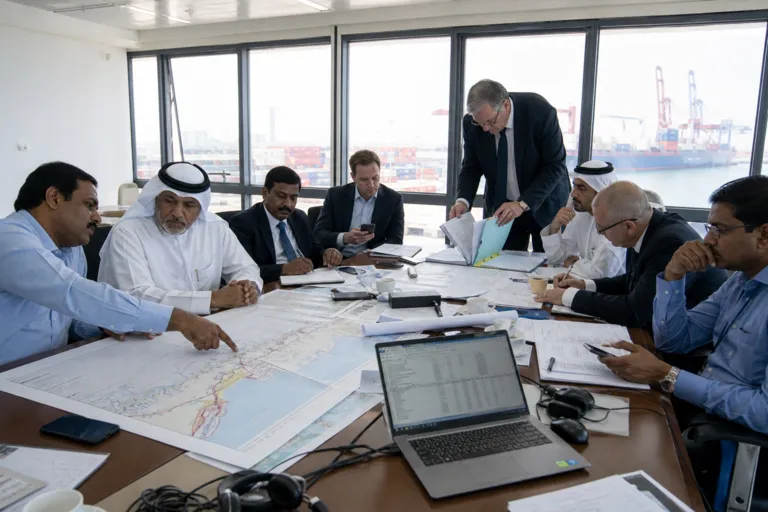
The India–Middle East–Europe Economic Corridor (IMEC) was unveiled during the G20 Summit in New Delhi in September 2023. It was presented as a major initiative linking India, the Gulf, and Europe through rail, ports, energy, and digital infrastructure. It was also framed as a strategic alternative to China’s Belt and Road Initiative, with goals that included improving supply-chain resilience and reducing shipping times by almost 40%. Initial feasibility work cited the possibility of cutting shipping costs by approximately 30%. The original concept included an Eastern Corridor connecting India to the Gulf via the UAE and Saudi Arabia, and a Northern Corridor linking Saudi Arabia through Jordan and Israel to European ports such as Piraeus in Greece.
Two years after the announcement, multiple pressures have slowed progress. TRENDS Group describes IMEC’s momentum as having decelerated amid the resurgence of conflict in the Levant, financial limitations along the Jordan–Israel border, and rising trade tensions between India and the United States. That source highlights Washington’s 2025 decision to impose extra tariffs on Indian products as part of the uncertainty. In parallel, MEI notes that as of May 2026 the implementation of IMEC remains doubtful, with no firm funding commitments or construction timelines. Wikipedia also characterizes the 2023 Memorandum of Understanding as a broad declaration of intent that still lacks a detailed overarching funding plan or concrete implementation mechanism.
Why 2026-27 Looks Like the Decision Point
Several threads converge in 2026-27, which is why the period is being described as make-or-break for restarting work. The Atlantic Council argues for renewing momentum in 2025 and using US leadership in the 2026 G20 process to establish and shape an IMEC coordinating structure. It describes deliverables that could run through 2026, including a communiqué outlining a road map, intent to form a coordinating body through G20/G7 sherpa processes, and formal entry of regional partners alongside nonsignatory observers. Separately, AEI points to an institutional calendar that could sharpen EU focus: Cyprus holding the presidency of the Council of the European Union in the first half of 2026, and Greece holding it in the second half of 2027. Together, these steps outline a narrow governance-and-diplomacy runway for IMEC corridor revival 2026 discussions to turn into operational coordination.
Yet the same period also exposes the corridor’s most practical constraints. MEI flags Israel’s current port capacity as a limiting factor and calls Haifa a key bottleneck, describing it as the smallest node on the route “by a significant margin,” with annual capacity of roughly 1.5 million TEU. Politics are another friction point. MEI cites a Washington Institute finding from early 2026 that 99% of Saudi respondents view normalization with Israel negatively, and it adds that internal Likud politics have stalled discussions on IMEC rail through Israel. These constraints matter because the intended route relies on a sequence of handoffs, including links between Gulf infrastructure and the Levant before reaching European ports.
The economic case for alternatives, however, has been sharpened by shipping risk. Discovery Alert describes the Red Sea crisis as extending into its 18th month by April 2026 and lists specific impacts: insurance premium increases of 300–500% for Suez Canal transit routes, container shipping delays averaging 2–3 weeks, and Cape of Good Hope diversions adding 14–20 days while increasing logistics costs by 15–20%. In that same source, current India–EU trade is described as approximately $120 billion annually, with projected 15–20% increases within five years through corridor operations. Whether IMEC itself advances or spurs competing trans-Middle Eastern routes, MEI argues that regional stakeholders are likely to keep building infrastructure aimed at a more interconnected future.
What is IMEC designed to connect, and how is it structured?
Why is IMEC described as “on pause” by 2026?
What makes 2026-27 a make-or-break window for the corridor?
What are the key bottlenecks on the proposed route?
How does the Red Sea crisis strengthen the case for overland alternatives linked to an IMEC-style corridor?