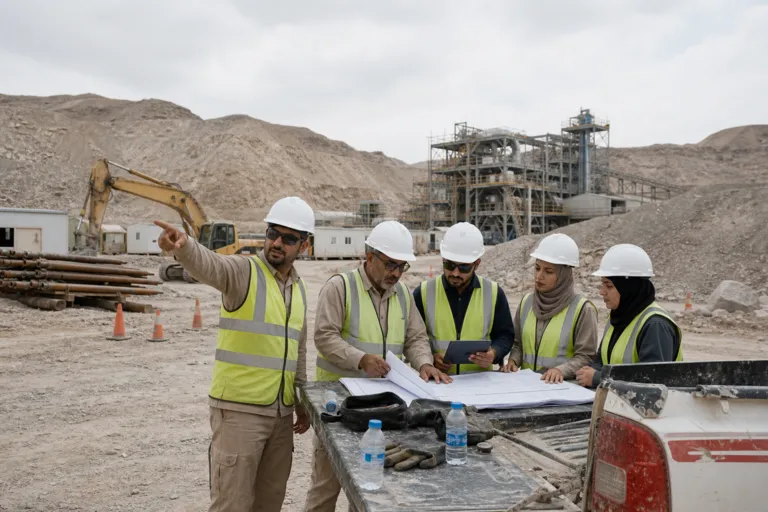
Oman’s copper story is shifting from history to restart. In early 2025, Minerals Development Oman (MDO) exported copper concentrates from its Lasail Mine for the first time, a milestone that marked a revival of copper mining after a 30-year hiatus. The activity at Lasail, in Wilayat of Sohar in the kingdom’s Block 4 mining area, followed an exploration drive that laid out plans to redevelop Lasail and two other mines in the area: Al-Baydha and Mazoon. This revival sits inside Oman’s wider push to diversify beyond hydrocarbons under Vision 2040, which builds on the earlier Vision 2020 framework.
Financing is now a central signal of how serious the restart has become. Qatar-based Ahlibank raised an OMR154 million (USD 400 million) loan for state-backed MDO through a mix of conventional and Islamic financing. One source describes the Mazoon Copper Project as Oman’s largest copper concentrate operation, framing it as part of strengthening the country’s non-hydrocarbon industrial foundation and its position within global critical minerals supply networks. The same coverage also highlights a dual-currency structure, designed to align parts of debt service and costs with different operating exposures, while noting that USD and Omani rial exchange-rate movements can affect obligations and costs.
From Contracts to Concentrate: What’s Driving Momentum
Before the USD 400 million loan was reported, the buildout was already moving. In May 2025, MDO subsidiary Mazoon Mining secured USD 270 million from local and regional banks and signed several construction and service contracts with Omani contractors to begin developing the project. This is the practical engine behind the Oman copper mining Mazoon project narrative: capital, contracts, and a development timeline that links the Block 4 copper district’s mine redevelopments to a broader national strategy. Separately, MDO’s wider footprint spans 14 concession areas across Oman, and the company has found almost 500,000 tonnes of chromite, 111 million tonnes of high-purity silica, and 242 million tonnes of dolomite.
Oman’s copper push is also being shaped by broader market dynamics, even when those numbers are global rather than local. One industry report values the global copper market at USD 248.2 billion in 2025 and projects it will reach USD 388.8 billion by 2033, with a CAGR of 5.9% from 2026 to 2033. The same report says the UAE and Oman are developing metal trading hubs to capitalize on growing demand for copper and other critical minerals, while Middle East countries including Saudi Arabia, the UAE, and Oman are investing in copper-intensive projects to diversify beyond oil. For comparison on downstream investment elsewhere, it cites Freeport Indonesia inaugurating a USD 3.7 billion copper smelter in Gresik in June 2024.
On the ground in Oman, the operational environment around processing and technology is evolving alongside project development. A report on Oman’s mineral processing equipment market says manual installations represented 45.13% of the market in 2024, while fully automated systems are set to rise at a 4.82% CAGR through 2030. The same report points to large-scale developments such as Al Hadeetha’s copper venture and the Yanqul Copper Project as examples of how Vision 2040 has revived dormant resources and attracted external capital. Together, these signals help explain why Mazoon’s financing, contracting, and national-policy alignment are being watched as a test of whether Oman’s copper comeback becomes sustained and scalable.
How did Oman’s copper revival begin after a long pause?
How much financing has been reported for Mazoon’s development?
What mines are linked to the Block 4 redevelopment plans?
What is the Oman copper mining Mazoon project aiming to represent nationally?
What global context is cited for rising copper demand?