Morocco is now positioning itself as a major global green hydrogen producer, with a strategy that ties industrial growth to decarbonised exports. As of March 2025, it had approved $32.5 billion in projects to produce ammonia, steel, and industrial fuel. The country’s export framing is explicit. It aims to capture 4% of global hydrogen demand by 2030, targeting exports to Europe. A dedicated “Morocco Offer” supports this. It provides 1 million hectares of land to investors and sits within a national green hydrogen roadmap designed to integrate domestic use with export ambitions.
This bid sits inside a broader energy-transition and diplomatic posture. Morocco hosted UNFCCC COP22 in Marrakech in 2016 and contributed to development of the Paris Agreement rulebook. It is chair or co-chair for continent-wide climate initiatives including the African Adaptation Initiative and the African Renewable Energy Initiatives. It has also joined the Powering Past Coal Alliance, committing to phase out coal power by the 2040s. Casablanca is emerging as a regional center for green bonds in Africa, and Morocco has sought to export renewable energy to Europe through undersea interconnectors while piloting green hydrogen production for European markets in collaboration with Germany.
Industry and logistics are central to whether Morocco green hydrogen exports can scale beyond pilots. Morocco has diversified exports into higher value-added manufacturing, with the automotive sector representing about 25% of total goods exports. By 2024, industrial zones near Tanger Med hosted 1,400 firms employing 130,000 people across sectors including automotive, aeronautics, textiles, agri-food, and renewable energy. This export ecosystem matters for hydrogen derivatives too, because it pairs port-linked manufacturing zones with a track record of building supplier networks and producing for European markets.
Ports, Power Targets, and the Export Chokepoints
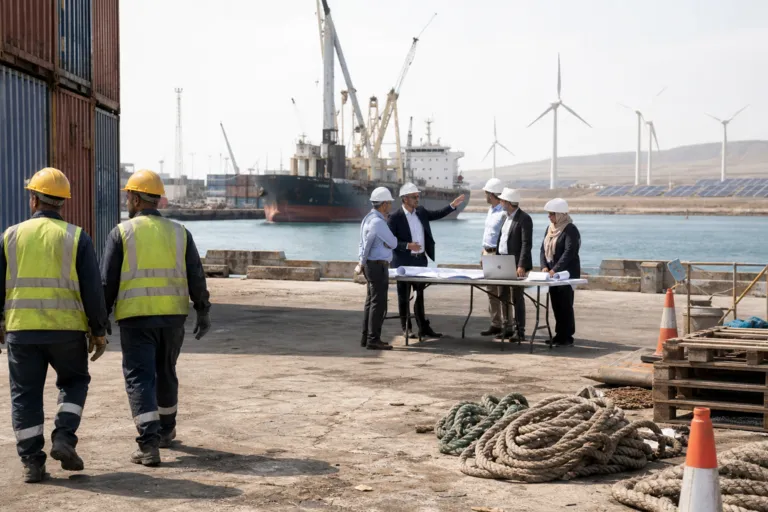
Ports are being designed with hydrogen exports in mind. Reuters reported that both Nador and Dakhla ports will include quays dedicated to exporting green hydrogen once production begins. Morocco is also considering building a port in Tan-Tan on the Atlantic in partnership with green hydrogen investors, with studies underway to decide the appropriate size. The Dakhla port is described as a $1 billion facility, surrounded by 1,600 hectares for industrial activities and 5,200 hectares for farmland irrigated by desalinated water. Nador is also positioned as an industrial platform, with an offer of 800 hectares for industrial activity and plans to expand to 5,000 hectares.
Electricity supply and renewable build-out are key inputs for hydrogen production, and Morocco is tying its industrial narrative to national targets. A feasibility exercise on offshore wind development was supported by a $2.1 million grant from the European Investment Bank, and the work is spearheaded by MASEN. MASEN is tasked with achieving a national target of sourcing half Morocco’s electricity supply from renewable energy sources by 2030. In a separate view of the power shift, CleanTechnica reported that today about a quarter of Morocco’s electrical energy comes from renewables, and that the country expects to get more than half from renewables by 2030 and 80 percent by 2050.
The ambition is also shaped by Europe-facing connectivity and regional energy corridors. CleanTechnica described a plan to send solar power to Germany via a 4,800 km undersea cable, reinforcing a Europe-oriented export posture. At the same time, an intergovernmental agreement is expected to be signed this year on a planned $25 billion Nigeria-Morocco gas pipeline, with first gas from initial phases expected in 2031. That project is framed as helping Morocco position itself as an energy bridge between Africa and Europe. In hydrogen, Morocco’s roadmap, investor land offer, and export-ready ports show a similar “bridge” logic, but aimed at decarbonised trade.
What is Morocco’s approved investment pipeline for green hydrogen-related industry?
What is Morocco’s stated export goal for hydrogen by 2030?
How are ports being prepared for Morocco green hydrogen exports?
What is the “Morocco Offer” for hydrogen investors?
What renewable electricity targets are linked to Morocco’s hydrogen plans?