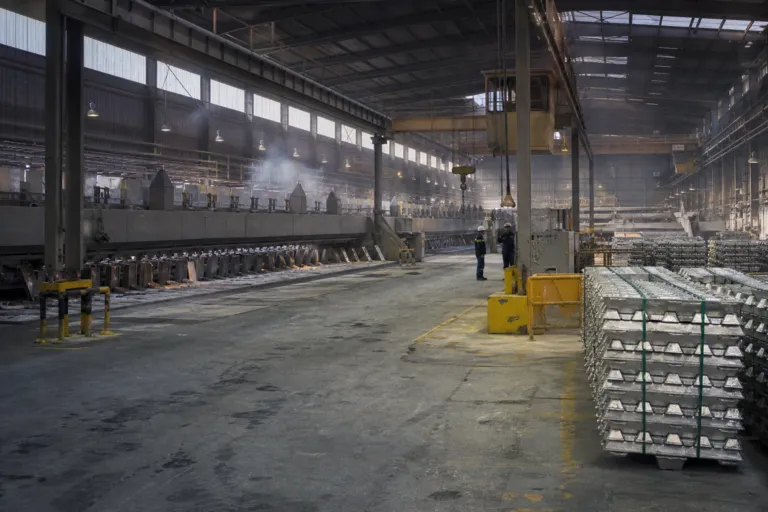
Saudi Arabia still imports more aluminium than it makes, but policy and capital are pushing toward a fully integrated, mine-to-market system. Maaden’s Ras Al-Khair platform links the Al Ba’itha bauxite mine to refining, smelting, and semi-fabrication on a single industrial site. The stated chain runs from a 4 million tonne-per-year bauxite mine to a 1.8 million tonne alumina refinery, a 740,000 tonne-per-year primary aluminium smelter, and a 380,000 tonne flat-rolled mill. Total invested capital across that value chain has run above USD 10.8 billion since first metal in 2013, and Maaden’s July 2025 buyout of Alcoa’s minority stake consolidated 100% Saudi ownership of those assets.
The financial case has been amplified by a strong pricing and cost spread in 2026. In Q2 2026, Maaden’s aluminium segment revenue rose 49% year-over-year to roughly USD 1.01 billion. Segment EBITDA more than doubled year-over-year to about USD 411 million, translating to a 41% EBITDA margin. The same quarter showed a realised aluminium price of USD 3,915 per tonne against all-in costs of USD 1,800 to 1,950 per tonne. For context on broader pricing, the London Metal Exchange spot range in mid-September 2026 was USD 3,236 to 3,352 per tonne. These figures help explain why an integrated operator can post commodity-linked earnings that look unusually resilient during a tight regional market.
From Ras Al-Khair to Yanbu: Integration Meets Demand Pull
Expansion is also being framed as industrial policy rather than a short-cycle bet. One analysis describes more than USD 20 billion in committed sovereign capital spanning two integrated complexes: Ras Al-Khair and a new Yanbu greenfield that has broken ground. On the demand side, the same source links consumption momentum to the confirmed 2034 FIFA World Cup infrastructure pipeline, including 15 new stadiums, alongside Lucid Motors’ 155,000-vehicle EV plant and a 30-million solar panel frame facility at Sudair. Together, these are presented as catalysts pulling aluminium consumption toward Maaden’s 1.6 to 1.8 million tonne domestic consumption target by 2030.
There are also clear risk markers, and they sit in volume assumptions and market normalisation. Independent forecasters project 2.9% to 6.8% CAGRs to 2030, which one analysis contrasts with Maaden’s implied 80% volume growth, arguing the gap may be resolved by downstream fabrication capacity data expected in 2027 and 2028. Meanwhile, a projected 24% year-on-year drop in GCC aluminium production in 2026 is described as a meaningful component of Maaden’s current premium, with the same analysis warning that margins may compress as Strait of Hormuz shipping routes stabilise. In short, the buildout narrative is strong, but the timing and margin profile may change as regional disruptions ease.
The next leg is not only primary metal; it is also circular supply and product mix. A Maaden aluminium recycling plant at Ras Al-Khair was greenlit in 2024, with planned capacity described as in the high tens of thousands of tonnes per year of secondary aluminium. Separate market context shows the global recycled metal market was valued at USD 70.23 billion in 2024 and is expected to reach USD 129.33 billion by 2033, at a 7.02% CAGR. On the domestic market lens, one forecast values the Saudi Arabia Aluminum Market at USD 8.4 billion in 2026, projecting USD 13.83 billion by 2035 at a 5.70% CAGR. The strategic thread is consistent: integration from ore to semi-fabrication, plus recycling, aims to turn domestic demand deadlines into an investable, industrial-scale ecosystem.
What assets make Maaden’s aluminium value chain “integrated” at Ras Al-Khair?
How profitable was Maaden’s aluminium segment in Q2 2026?
What demand catalysts are cited for Saudi aluminium consumption toward 2030?
What is a key risk to near-term aluminium margins in the Gulf region?
How is the Saudi aluminium industry adding recycling capacity?