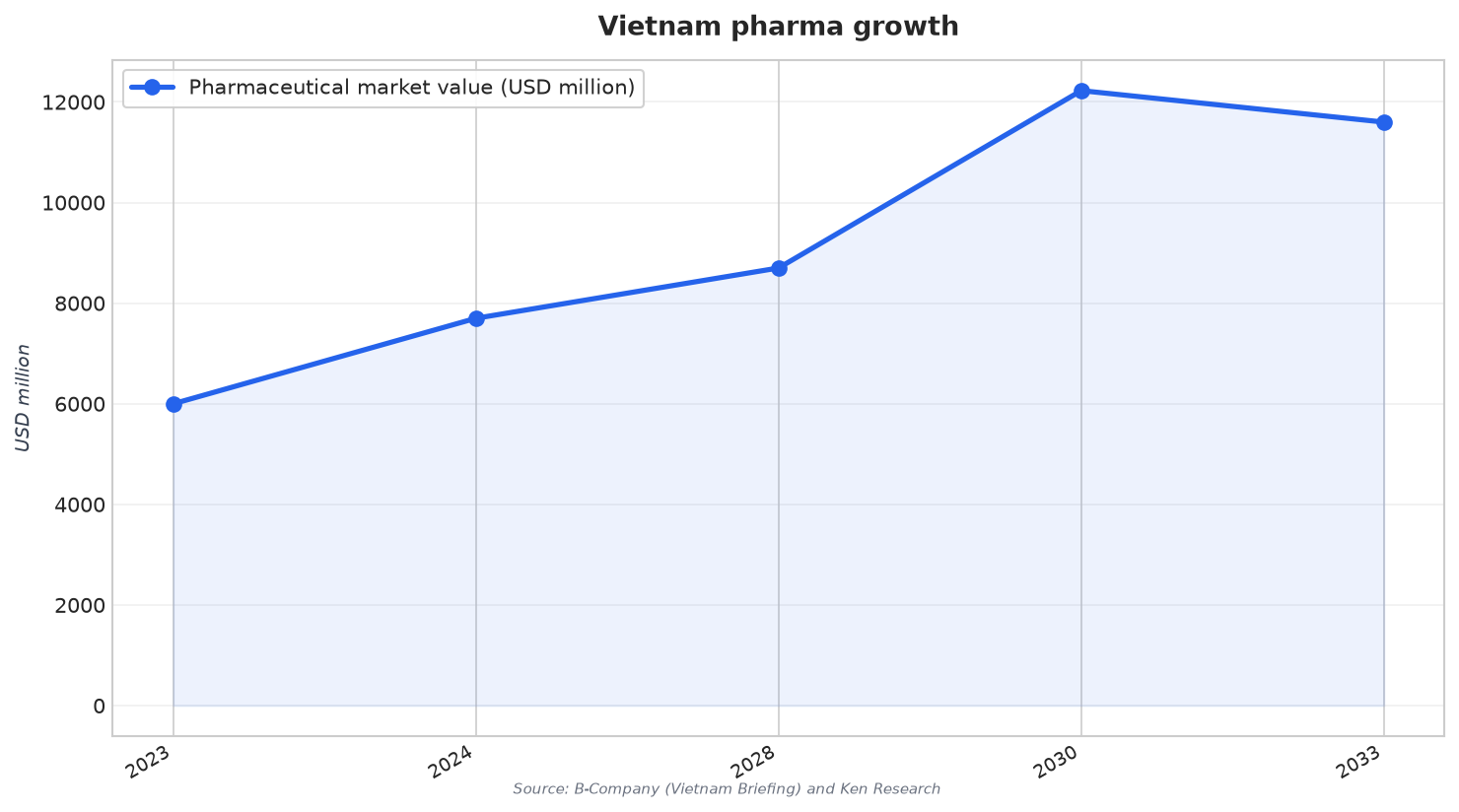
Localisation is becoming a practical supply-chain strategy in Vietnam’s drug market, not just a policy theme. Vietnam’s pharmaceuticals market was valued at about USD 6 billion in 2023, with projections of USD 8.7 billion in 2028 and USD 11.6 billion by 2033, according to a Vietnam Briefing analysis. Another market view pegs 2024 at USD 7,700 Mn and forecasts growth toward approximately USD 12,226 Mn by 2030. Across these outlooks, the direction is consistent: demand is expanding, and manufacturers and importers must fit into a hospital-led, reimbursement-sensitive model where tenders and compliance shape volumes.
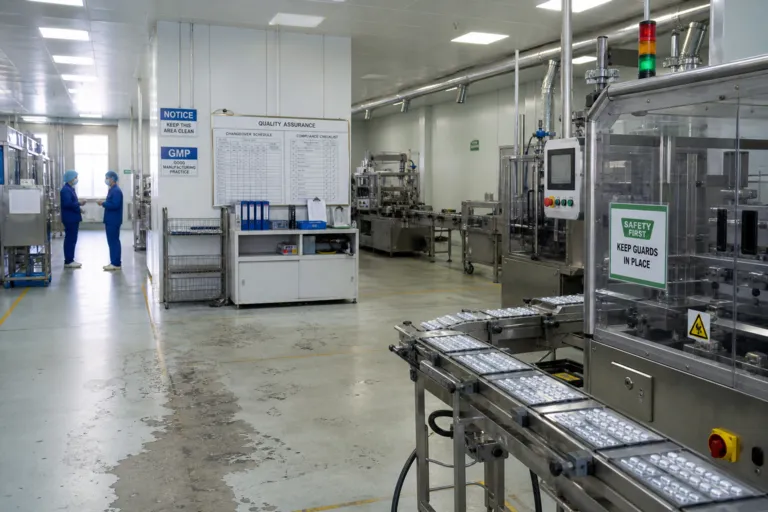
Regulation directly influences how value flows through the chain. Under Vietnam’s WTO commitments and current regulations governed by the Law on Pharmacy and Decree 09/2018/ND-CP, Foreign-Invested Pharmaceutical Enterprises (FIEs) are generally permitted to import pharmaceuticals and raw materials, but they are prohibited from exercising the right to distribute them directly within Vietnam. A key exception applies to finished drugs that the FIE manufactures locally in Vietnam. In practice, this pushes foreign companies toward local production or toward partnerships with registered local wholesalers and domestic partners for distribution into hospitals (ETC) and pharmacies (OTC).
Where Demand Concentrates, Supply Chains Follow
Vietnam’s purchasing reality reinforces localisation pressure because the core revenue pool sits in hospitals. In 2024, health insurance coverage reached 94.2% of the population, and the ETC channel accounted for about 76% of market revenue, based on a Vietnam market outlook. Ho Chi Minh City also concentrates operating density, with city health authorities reporting 43 drug manufacturing factories, 1,512 wholesalers and pharmaceutical raw-material trading facilities, and 8,387 pharmacies in 2023. For supply-chain design, that clustering can shorten replenishment cycles and make distributor selection and tender readiness as important as production itself.
Product mix is another driver reshaping sourcing decisions. Vietnam’s market is heavily skewed toward generics, increasing from 58.1% market share in 2023 to 62.4% in 2029, and the generic segment was forecast to grow at about 9.7% CAGR from 2024–2029. At the same time, Vietnam still depends heavily on imports for original brands, biologics, and vaccines. Vietnam Briefing notes that France, Germany, and the US consistently rank among top suppliers of finished drugs, while India and China dominate the supply of generic drugs and APIs. That split forces companies to manage dual tracks: local formulation and compliant tender supply for high-volume essentials, plus globally integrated sourcing for complex inputs.
Because capabilities are uneven across the value chain, partnerships are becoming a default operating model. IndexBox describes a landscape where global players partner with local firms for distribution and regulatory facilitation; local manufacturers partner with API suppliers for input security or with CDMOs for technology transfer; and companies work with CROs to manage bioequivalence study workloads. Meanwhile, exporters are emerging from the local base. Data cited by The Investor, referencing the Drug Administration of Vietnam, says Vietnam currently has 67 companies exporting medicines and pharmaceutical ingredients, with total export turnover reaching $312 million in 2025. Put together, these forces are steadily redefining what “Made in Vietnam” can mean for medicine supply, and which nodes of the chain capture margin.
How are localisation rules changing foreign pharma go-to-market models in Vietnam?
Why does the hospital channel matter so much for supply chain decisions?
What does Ho Chi Minh City’s pharma cluster look like in practice?
How is Vietnam pharmaceutical manufacturing tied to the shift toward generics?
What evidence is there that locally produced medicines are reaching export markets?