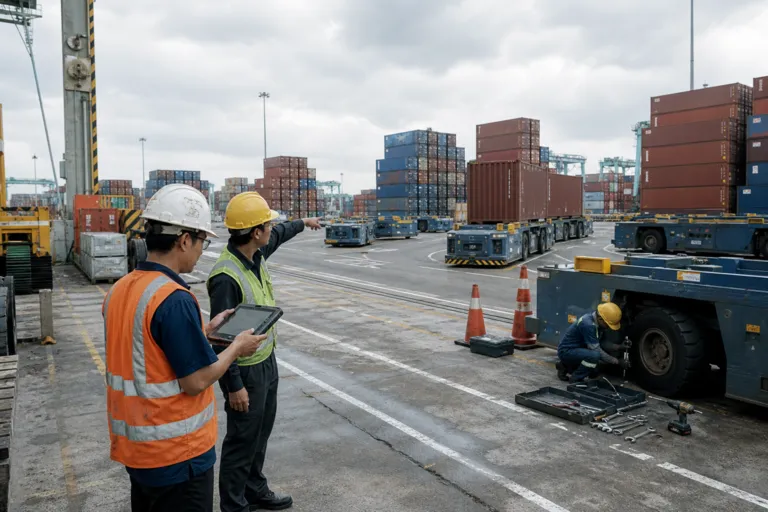
Singapore is using Tuas to show what modern port logistics can look like when automation and ecosystem planning move together. Tuas Port is set to be the world’s largest fully automated port, capable of handling 65 million teu annually when fully complete in the 2040’s. That ambition is not just about cranes and yards. It is also about stitching together nearby logistics, distribution, and supply chain services so cargo can flow with fewer breaks in the chain. This is why “Singapore Tuas Port automation” is increasingly discussed as a benchmark, not simply a local upgrade.
Signals of momentum also show up in the broader Port of Singapore. In 2025, Singapore posted record performance of 3.22 billion gross tonnage (GT) of vessel arrivals and 44.66 million TEUs of container throughput, a 3.5% and 8.6% increase from 2024 respectively. These figures underline why reliability matters. When vessel arrivals and container moves grow, the cost of friction rises. Automation is often framed as labour saving, but ports also need throughput stability and predictable operating costs, while keeping human oversight embedded in the system.
Automation at Tuas Extends Beyond the Terminal
Near-port logistics investment is increasingly tied to Tuas. PSA broke ground on PSCH in October last year as it moves beyond simply offering terminal operations. PSCH will span more than 2 million sq feet, sit in the Free Trade Zone next to Tuas Port, and is scheduled to start operations in 2027. The facility will integrate container freight stations, a regional distribution centre, cold store, and dangerous goods handling. In parallel, Cosco and PSA agreed to expand their relationship beyond terminal operations, reflecting a push toward integrated supply chain solutions and regional cargo connectivity.
Maersk is building complementary capacity in the same orbit. It opened a $150 million automated distribution facility in Singapore called World Gateway II. The 102,000 sq metre site is located near Tuas Port and targets growing demand from companies using Singapore as a regional and global distribution base, facilitating onward distribution across Asia Pacific. The warehouse integrates automation systems including multi-Shuttle and automated storage and retrieval technologies, alongside autonomous robotics. The stated goal is to increase throughput, accuracy, and fulfilment speed while reducing manual intervention. The development has reached around 70% occupancy.
Resilience also depends on greener and more digital coordination beyond port gates. In 2025, Singapore established two new Green and Digital Shipping Corridors with India and the Republic of Korea, and elevated the corridor with China to the national level, bringing the total to nine. Planned projects for 2026 include developing common emissions-reporting protocols, enhancing digital exchanges, and conducting fuel trials. Operational safety and control are evolving too. An industry proposal call referenced a remote operations centre to integrate vessel sensor information and port traffic data for real-time monitoring and timely intervention as part of the core safety and assurance system for autonomous operations.
Finally, Singapore’s automation benchmark relies on people adapting with the systems. Maritime in Singapore contributes around 7% of GDP and employs more than 170,000 people, and industry voices highlight that automation and AI reshape job descriptions even as decision-making skills remain critical. In aviation cargo, a related Singapore example showed role redesign at scale: over the past year, SATS redesigned 11 roles from cargo coordination to customer service, while also preparing for new equipment such as autonomous vehicles. Together, these moves reinforce a clear pattern at Tuas: automation is being treated as an ecosystem transformation, not a single technology install.
What is Singapore Tuas Port automation aiming to achieve?
What logistics facilities are being developed next to Tuas Port?
What has Maersk built near Tuas Port, and what automation does it use?
How did Singapore’s port perform in 2025?
How is Singapore supporting digital and operational resilience around Tuas?