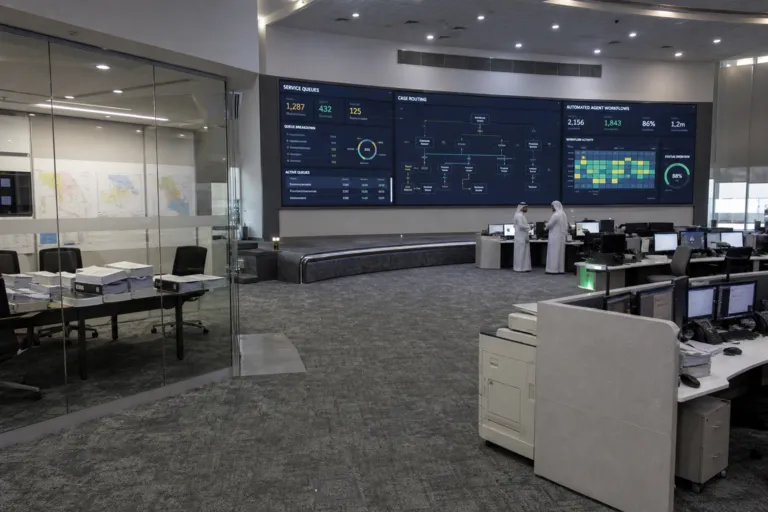
The UAE has announced a landmark plan to run half of its government services and operations using autonomous artificial intelligence, a move described as a global first at this scale. Sheikh Mohammed bin Rashid Al Maktoum said that within two years, 50 per cent of government sectors, services, and operations will run on agentic AI that “analyses, decides, executes and improves in real time”. This ambition builds on earlier digital-government foundations. By 2015, a large proportion of federal services were available through digital channels, supported by electronic payments and a unified digital identity system, most notably the UAE Pass platform with more than 13 million users.
Turning “government by algorithm” into daily reality depends on governance capacity, people, and money. The UAE appointed the world’s first Minister of State for Artificial Intelligence in 2017 and launched its AI Strategy 2031. Inside ministries, AI usage is being pushed as a habit of work: one UAE minister cited in The National asks their team for a weekly report on the latest ways they used AI. The same article says all public officials must do AI training, and it notes aspirations discussed at the World Governments Summit for AI advisers across public sector organisations. This focus signals a shift toward using AI as an executive partner while redesigning workflows around human oversight.
The Budgets, Compute, and Markets Behind the Shift
Several sources point to the capital and infrastructure being assembled to support AI-first public administration. The National reports that Abu Dhabi’s Department of Government Enablement has a Dh13 billion ($3.5 billion) budget for AI transformation through 2025–2027. Separately, Precedence Research cites a planned 5-gigawatt sovereign compute deployment at “Stargate UAE”, and says the first phase is 200MW and scheduled to be completed by 2026. Globe Market Research also describes the UAE advancing a 5 GW Stargate UAE AI data-centre campus with an initial 200 MW phase planned, framed as strengthening domestic computing capacity for large-scale AI models, enterprise applications, and sovereign AI workloads.
Market sizing reports underline how quickly vendors and adopters expect demand to grow as AI moves deeper into operations, including public services. Precedence Research estimates the UAE artificial intelligence market at USD 7.93 billion in 2026 and projects around USD 213.06 billion by 2035, at a CAGR of 44.15%. Globe Market Research estimates USD 8.3 billion in 2026 and forecasts USD 243.2 billion by 2035, at a CAGR of 45.6%. In the same Globe report, the government and public sector is listed at a 25.9% share by end user, and cloud deployment is cited at 55.5%. Those mixes align with the idea that scalable platforms and automation tools will be central to modern UAE AI government services as agencies roll out more AI-driven workflows.
The most direct “operating layer” for this transition is agentic and generative AI. MarketsandMarkets values the UAE agentic AI market at $65.3 million in 2025 and projects $1,021.5 million by 2030, a 48.1% CAGR, describing agentic AI as systems that can maintain state, make decisions within boundaries, interact with digital environments, and take actions toward objectives with governance. MarketsandMarkets also values the UAE generative AI market at $383.4 million in 2025 and projects $5,411.3 million by 2030, a 46.0% CAGR, tying growth to government digitalization programs and enterprise automation initiatives. Together, these trajectories help explain why the UAE is aiming to redesign the state around AI capabilities rather than adding AI as a single tool.
What has the UAE announced about using AI to run government services?
What digital foundation supports AI-first public services in the UAE?
How much budget is allocated for AI transformation in Abu Dhabi government enablement?
What is Stargate UAE, and what capacity is planned?
How fast are agentic and generative AI markets growing in the UAE?