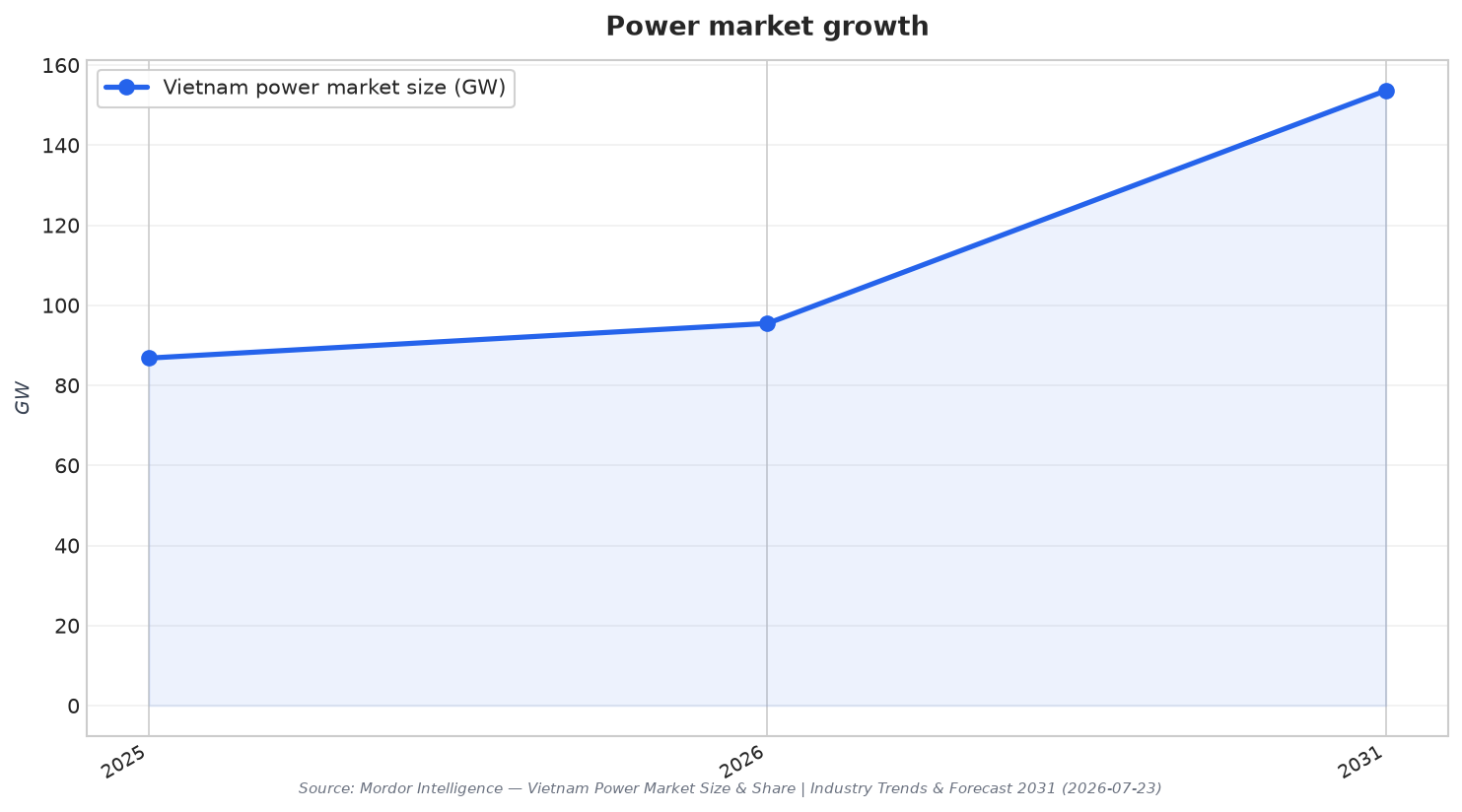
Vietnam is trying to keep the lights on while changing its power mix. The Vietnam power market is expected to grow from 86.81 GW in 2025 to 95.46 GW in 2026, with a forecast of 153.62 GW by 2031. That build-out is tied to a USD 136 billion push under Power Development Plan 8 (PDP-8), which targets 28–36% renewable energy by 2030 and 74–75% by 2050. At the same time, analysts describe LNG-to-power as a practical “bridge” as coal use declines and variable renewables expand.
The pressure comes from demand and reliability. Industrial production jumped 8.4% in 2024, and EVN deployed demand-response programs as electricity use rose. Imports are also part of the reliability story: transmission upgrades, including the 500 kV backbone, are framed as a way to avoid bottlenecks that once stranded capacity and led to 2.56 billion kWh of imports from China in 2024. In this setting, gas-fired generation is positioned as dispatchable capacity that can support grid stability as coal use is reduced.
PDP-8 Sets the LNG Direction, but Execution Is the Test
Vietnam’s PDP8 was approved in May 2023 and revised in April 2025, clearing a policy path for natural gas to replace coal as the primary baseload source by 2030. Multiple sources converge on the LNG scale being planned. PDP-8 is cited as stipulating 22,524 MW of LNG-fired capacity by 2030, while another summary describes an increase from 0.8 GW to 22.5 GW of imported LNG capacity by 2030. This planned wave of Vietnam LNG power plants is also linked to broader market investment momentum, as LNG-to-power investment accelerates under the plan.
Coal, however, remains central today, making the bridge argument politically and operationally important. Zero Carbon Analytics reports coal made up 50.3% of power generation in 2024, with around half sourced from imports, and notes Vietnam led Southeast Asia’s coal import demand growth as coal imports hit a record high in 2025. Looking ahead under the revised PDP8, the same source states Vietnam aims to develop 22.4 GW of LNG-fired power by 2030, describing this as almost 15% of total power generation, while also projecting a 2030 mix that includes 25% from coal (assuming the current split remains the same) and 15% from LNG, with 40% of power coming from imports.
Cost, contracting, and infrastructure risks can decide whether the bridge holds. One analysis warns Vietnam’s access to sufficient LNG volumes in the longer term will likely be price-sensitive and subject to global supply developments in the 2030s, especially since early deliveries came via the spot market; it argues longer-term contracts can improve competitiveness. Vietnam started importing LNG in 2023 and signed its first multi-year supply contract with Shell earlier this year. But as of late 2025, delays in infrastructure and global shortages of gas turbines had already caused significant delays in gas generation capacity. Another note adds that disruptions like the 2026 war in Iran, including closure of the Strait of Hormuz, are likely to further increase LNG import costs in Vietnam.
How much LNG-fired capacity does PDP-8 plan by 2030?
How important is coal in Vietnam’s power generation right now?
What share of power could LNG represent in 2030 under current planning assumptions?
What risks could delay Vietnam LNG power plants coming online?
Why is LNG described as a bridge in Vietnam’s power transition?