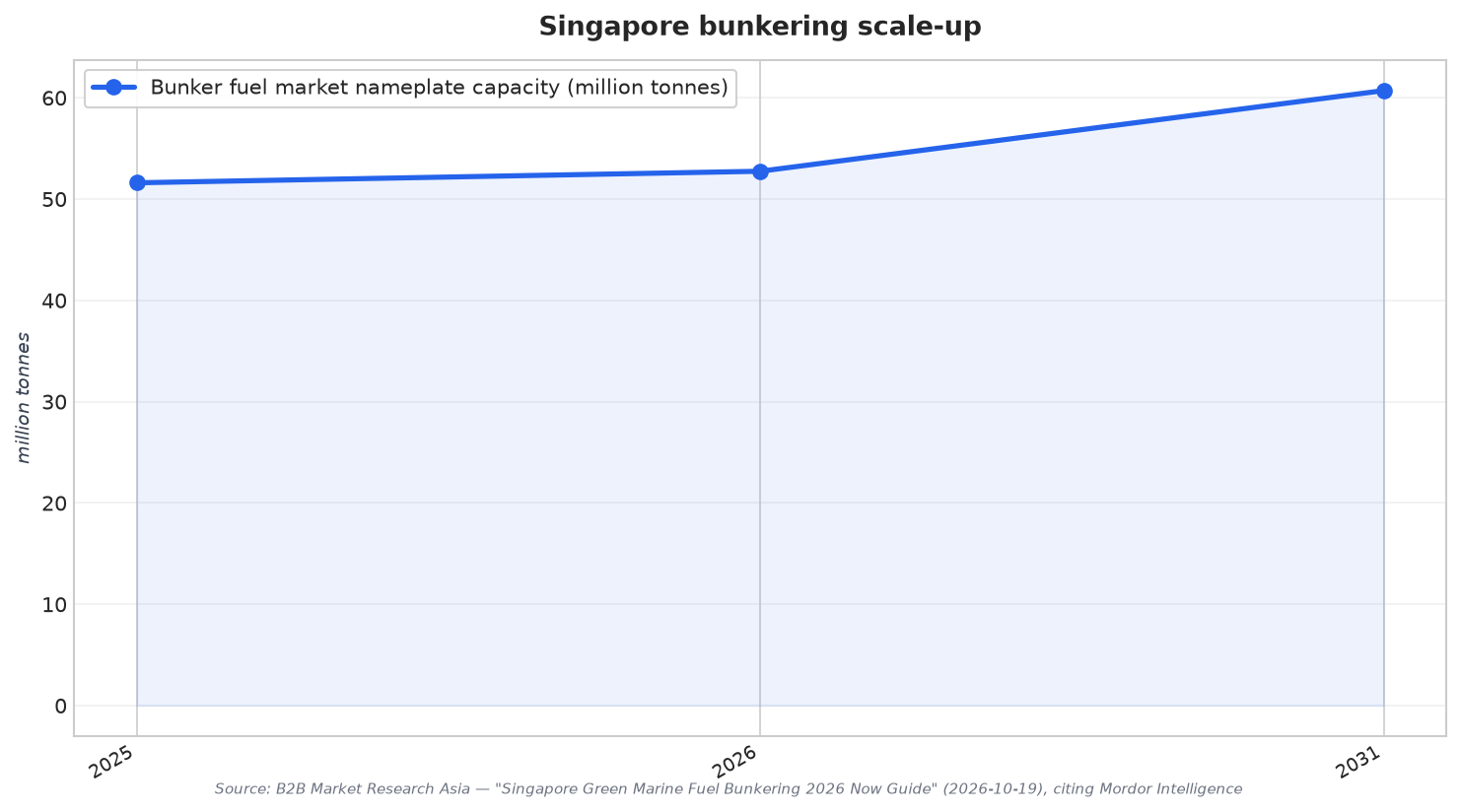
Singapore enters 2026 with a scale advantage that few ports can match. Marine fuel sales reached 56.77 million tonnes in 2025, up 3.4% from 2024, and ships made 42,603 bunker calls at an average conventional stem of 1,319 tonnes. The port also recorded 54.92 million tonnes of bunker sales in 2024. Capacity is rising alongside demand: Singapore’s bunker fuel market nameplate capacity is projected at 51.61 million tonnes in 2025 and 52.75 million tonnes in 2026, with a forecast of 60.71 million tonnes by 2031 at a 2.85% CAGR from 2026 to 2031. That baseline matters because alternative fuels have to scale inside the operational expectations of a mega hub.
Some of the recent uplift has been tied to routing changes rather than long-term structural demand alone. Mordor Intelligence links 2024 bunker sales growth to Red Sea conflict diversions that sent Far East–Europe traffic around the Cape of Good Hope, adding roughly 8,500 nautical miles per voyage and increasing fuel demand. At the same time, Singapore’s approach is not framed as a single-fuel gamble. In 2025, very-low-sulfur fuel oil led with a 55.3% market share, and Ship & Bunker’s analysis of MPA data shows VLSFO at 28.83 million tonnes, HSFO at 21.73 million tonnes, distillates at 4.27 million tonnes, and bio-blended fuels at 1.36 million tonnes, alongside 25,500 tonnes of B100.
From Trials to Licences: Making Methanol Operational
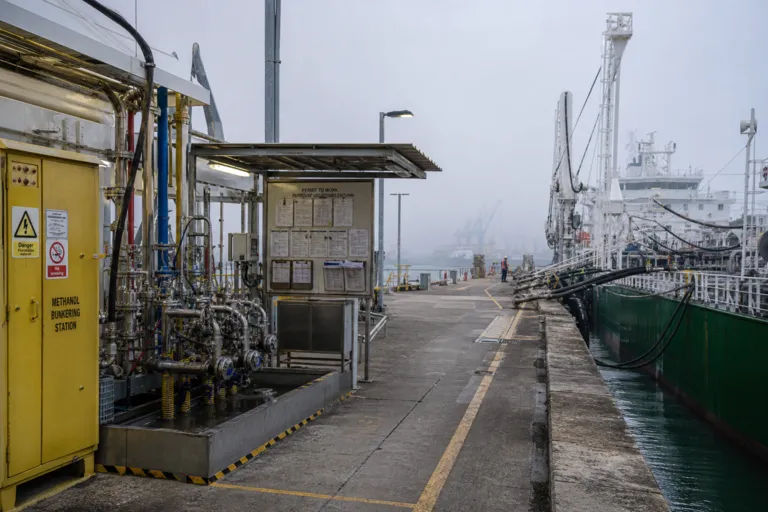
The pivot for Singapore methanol bunkering is the move from one-off demonstrations to a regulated, commercial framework. Singapore decided to introduce what F&L Asia calls the world’s first multi-year commercial licences for methanol bunkering, allowing licensed suppliers to deliver methanol as a marine fuel under a regulated framework from 1 January 2026. MPA launched a call for applications in March 2025 and selected three firms from 13 applicants: Global Energy Trading Pte Ltd, Golden Island Pte Ltd, and PetroChina International (Singapore) Pte Ltd. The licences run from 1 January 2026 to 31 December 2030, following assessments that included supply-chain robustness, safety practices, operational readiness, and sustainability certification of the methanol intended for supply.
Operational proof points are also accumulating. Breakbulk.news reports that on 28 November 2025, MPA worked with Global Energy Trading Pte Ltd and Stellar Shipmanagement Services Pte Ltd to bunker 3,012 metric tonnes of methanol from the MT Kara to the container vessel Antonio Maersk. The same report describes the operation as Singapore’s first TR129 methanol bunkering trial and notes it was conducted after dark as a stress test. F&L Asia adds that the licensing regime requires an end-to-end bunkering solution, where licensees act as both bunker suppliers and bunker craft operators, and that they own and operate at least one IMO Type 2 chemical tanker for safer methanol handling.
What underpins the transition is Singapore’s compliance playbook. From 1 January 2017 every fuel-oil delivery has had to pass through an approved mass-flow meter, extended to distillates from 1 July 2019, and electronic bunker delivery notes became mandatory from April 2025, with MPA reporting every licensed supplier operating digital bunkering by August 2025. This governance is designed to support a multi-fuel reality, not replace conventional operations overnight. A September 2026 market update states Singapore’s strategy includes methanol, LNG, biofuels, and future ammonia infrastructure, while MarkWide Research flags an “ammonia infrastructure gap” requiring specialized storage and handling. For global context, IMARC notes alternative fuel infrastructure remains concentrated at fewer than 50 ports globally, which raises the strategic stakes for major hubs that can combine reliability with credible methanol readiness.
How big is Singapore’s marine-fuel market heading into 2026?
When do Singapore’s methanol bunkering licences start, and how long do they run?
Who received MPA’s methanol bunkering licences?
What was demonstrated in Singapore’s TR129 methanol bunkering trial?
What rules support the credibility of Singapore methanol bunkering alongside conventional fuels?