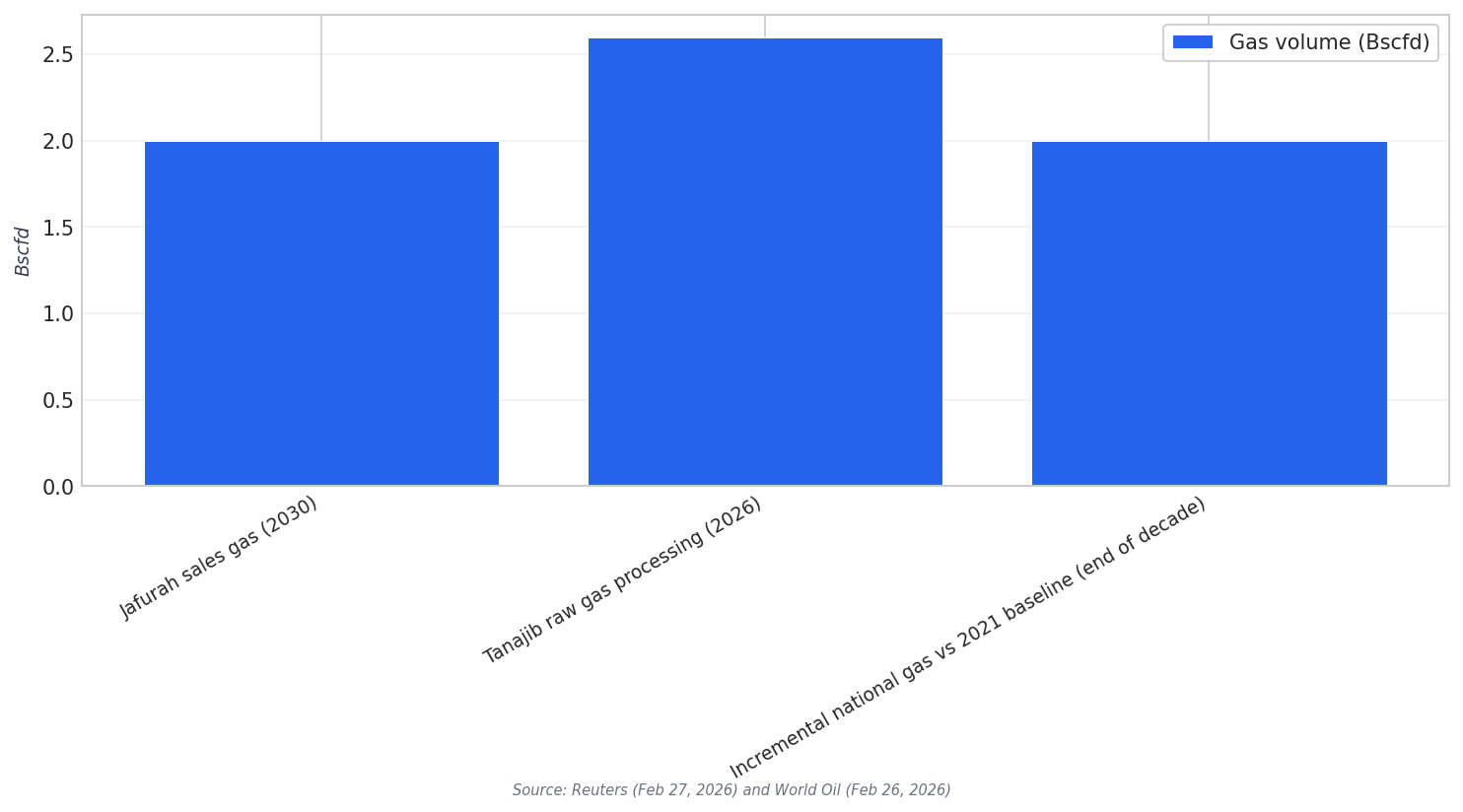
Saudi Aramco’s gas push is reshaping how the Kingdom thinks about energy planning. In March 2024, Aramco signaled a 60% targeted boost in kingdom-wide gas expansion. In November, it raised that goal to 80% above 2021 levels. Reuters calculations, based on a 2021 baseline of 9.2 bcfd, indicate the revised ambition implies nearly 2 bcfd extra by the end of the decade. Aramco has also tied this shift to domestic priorities, including displacing liquid fuels in power generation and strengthening energy security.
The center of this pivot is Jafurah. Aramco confirmed first shale gas production from Jafurah began in December 2025. The field spans about 17,000 sq km and is described as the largest liquids-rich unconventional gas development in the Middle East. It is estimated to contain 229 Tscf of raw gas and 75 Bbbl of condensate and liquids. Aramco is targeting by 2030 up to 2 Bscfd of sales gas from Jafurah, plus 420 MMscfd of ethane and about 630,000 bpd of high-value liquids.
Processing capacity is also being built out alongside production. The Tanajib Gas Plant commenced operations in December 2025 and is expected to reach raw gas processing capacity of 2.6 Bscfd in 2026. Aramco said Jafurah and Tanajib together strengthen its integrated gas portfolio and expand processing capacity. Yet the ramp remains a key question. Aramco had previously said Jafurah was expected to come online in early 2024. An ADCB economist said there is uncertainty around the pace of ramp-up and how much condensates will be exported or used as feedstock.
Why the Strategy Shift Matters Inside Saudi Arabia
The domestic power system is a major driver of the Aramco gas growth strategy. Saudi Arabia uses more than 1 million bpd of crude and fuel oil for domestic power generation. Aramco aims to replace 500,000 bpd of that by 2030 with gas, freeing up crude for export. Reuters cited current prices of around $70 a barrel and estimated that 500,000 bpd of crude would generate nearly $12.8 billion in revenue a year. Aramco also said incremental gas volumes could generate $12 billion to $15 billion in additional operating cash flow in 2030, subject to market conditions.
Aramco is also framing gas as an industrial enabler. Its leadership told Reuters that domestic gas demand is expected to keep rising, driven by industrial growth across manufacturing, mining, and petrochemicals. On the global side, Aramco’s CEO told analysts in August that its long-term ambition is LNG capacity of 20 million tons per annum. The LNG backdrop, however, is uncertain. The International Energy Agency and some market participants expect a surge of new Qatari and U.S. LNG this decade that could create a supply glut and depress prices, increasing the value of captive domestic demand and liquids displacement.
What is the Aramco gas growth strategy aiming for by 2030?
How much gas is Jafurah expected to deliver by 2030?
When did Jafurah start producing shale gas?
How does Aramco plan to reduce oil burning in power generation?
What cash flow uplift does Aramco expect from gas expansion?