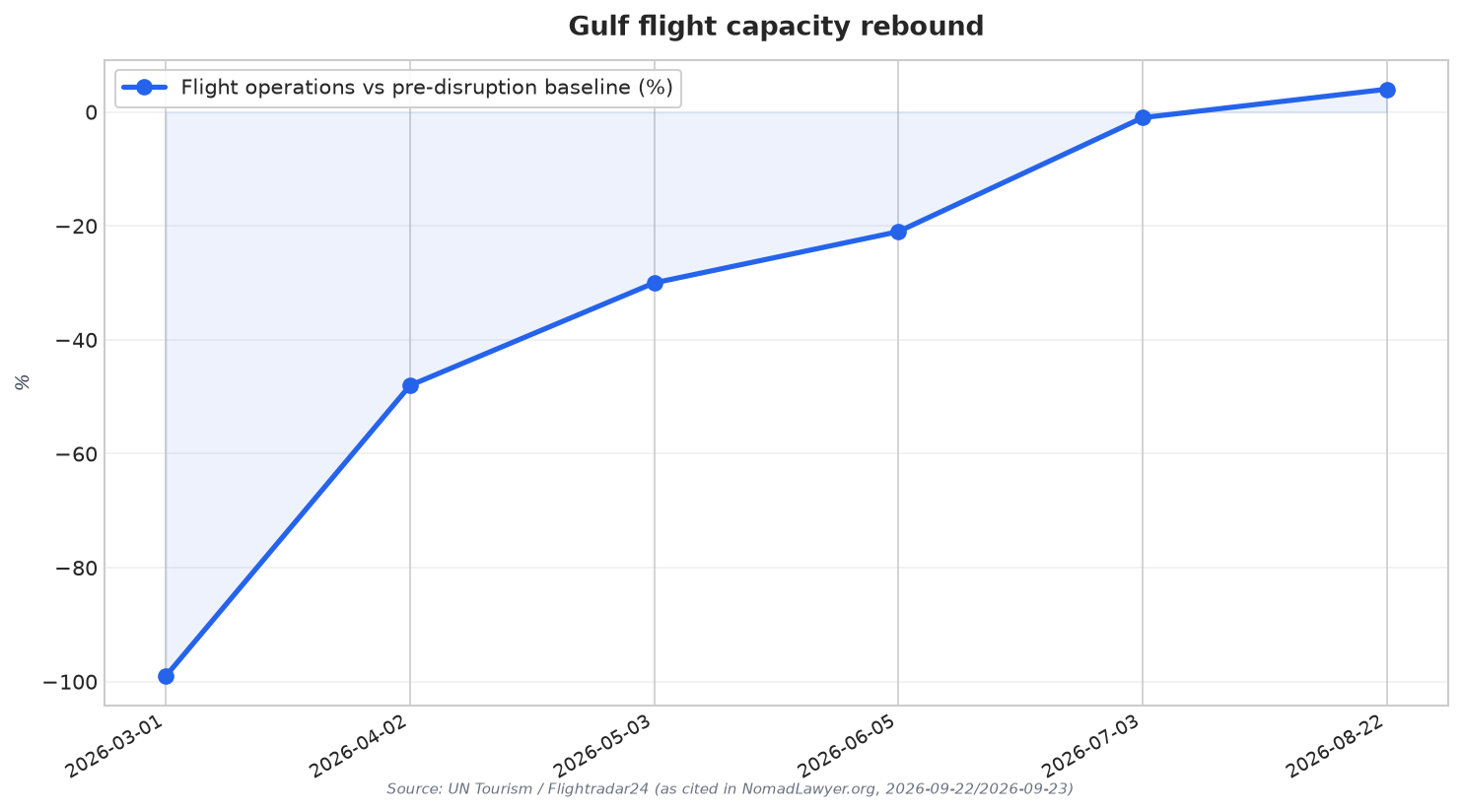
In early 2026, aviation across the Gulf region shifted from normal operations to a near-total stop, then back to growth in a matter of months. Joint analysis using UN Tourism and Flightradar24 data tracked daily flight operations across carriers in Bahrain, Qatar, the United Arab Emirates, and Kuwait. On March 1, 2026, daily flights fell by 99% versus the February average, effectively breaking key transit links that connect Asia, Africa, and Europe via Gulf hubs. By August 22, 2026, the same tracking showed operations moving above baseline, reaching 4% higher than pre-disruption levels. That arc, compressed into five months, offers a clear resilience playbook for airlines and airports.
The timeline matters because it shows how a staged restart can rebuild confidence while limiting operational risk. The Gulf’s tracked operations improved from the March 1 trough of -99% to -48% on April 2, then to -30% on May 3. The deficit narrowed again to -21% by June 5. By July 3, activity was essentially back to parity at -1%, before crossing into expansion by August 22 at +4%. For network planners, the lesson is that recovery is not one switch. It is a ladder of milestones that can be communicated to regulators, partners, and customers, with each step proving the viability of the next.
What the Rebound Shows About Hub Strategy and Carrier Mix
The Gulf rebound also underlines how different carrier types stabilize different parts of the system. Reporting on the capacity rebuild described a multi-carrier approach: in the UAE, Emirates and Etihad Airways restored long-haul corridors, while Flydubai and Air Arabia filled gaps in regional and low-cost connectivity. That mix helped bring back both premium transit and shorter-haul flows. Qatar Airways’ restoration mattered because Doha is positioned as a critical transit point linking the Americas, Europe, and Asia. In Bahrain, Gulf Air’s schedule restoration improved connectivity through Bahrain International Airport, and separate tracking noted restored regional feeds connecting Bahrain (BAH) with Saudi Arabia, Kuwait, and South Asian destinations.
Context from broader regional demand data shows why hubs matter during uneven cycles. For April 2026, global passenger figures cited a 9.5% year-over-year fall in Middle East international passenger demand, alongside a 5.3% fall in international traffic worldwide. Yet the same reporting emphasized that Gulf markets were more resilient on certain corridors, especially routes linking Asia and the Middle East, supported by transfer traffic and diversified networks. For airports, that reinforces the value of being easy to connect through, not just easy to reach. For airlines, it highlights the commercial role of keeping transfer itineraries viable even when point-to-point demand is softer.
Finally, the Gulf case shows that operational normalization and economic impact do not always move at the same pace. One analysis noted that temporary disruption can influence broader growth narratives tied to visitor economies, and that leisure demand often lags operational normalization. It also stressed that Gulf airports are critical nodes in time-sensitive supply chains, so disruption creates wider ripple effects even if airline operations recover quickly. The practical takeaway is to build resilience as a system: safety protocols and regulator collaboration to normalize operations, capacity phasing to restore schedules, and airport readiness to absorb returning volumes once flights climb back from deficit to growth.
How fast did the Gulf aviation recovery progress in 2026?
What were the key recovery milestones between March and August 2026?
Which airlines were included in the Gulf rebound tracking?
What demand backdrop did Gulf hubs face during the recovery period?
What does the Gulf aviation recovery 2026 suggest about resilience planning for airports?