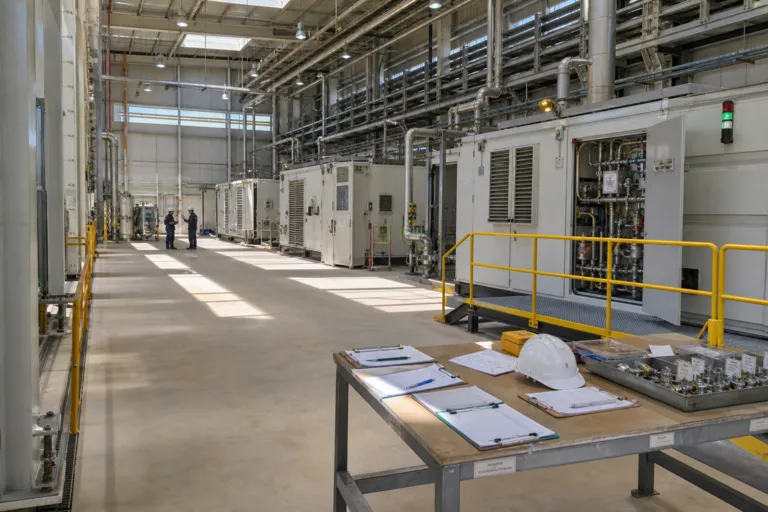
At Oxagon on Saudi Arabia’s Red Sea coast, a hydrogen megaproject has crossed the line that separates ambition from execution. The NEOM Green Hydrogen Company facility is described as an $8.4 billion project that reached financial close on 22 May 2023 and has now entered commissioning after construction was completed in August 2026, with energization underway across the integrated complex. Multiple accounts frame commercial production and first green ammonia availability as planned for 2027, with one analysis also pointing to the facility coming online in December 2026 and first export shipments expected in early 2027. This is why the discussion is shifting from “will it be built?” to “will it run, ramp, and ship on schedule?”
The offtake race is ultimately a contracting race, and NEOM’s structure is unusually explicit. Air Products holds a 30-year exclusive off-take agreement for the plant’s entire ammonia output, and one account specifies this as all 1.2 million metric tonnes of annual ammonia output. A separate report says Yara International finalized a marketing and distribution agreement to handle up to 1.2 million metric tons per year of renewable ammonia from the plant. In parallel, the project’s $6.1 billion in non-recourse financing from 23 banks and institutions is repeatedly tied to the credibility of contracted cash flows. In plain terms, it is harder to dismiss a project when the buyer, the debt, and the route to market are already defined.
Commissioning Changes the Question: Can the System Deliver at Scale?
Commissioning forces the market to judge performance, not press releases. The integrated energy system is described as roughly 4 GW of dedicated solar and wind, including a 2.2-GW solar farm and wind capacity described as 1.6 GW, with reports citing over 250 wind turbines and another account specifying 257 turbines. The build is also quantified as 5.6 million solar panels across more than 300 square kilometres. On the conversion side, coverage describes more-than-2-GW electrolyzer capacity, including more than 2 GW of alkaline electrolysis supplied by thyssenkrupp nucera, and another account describing a 2.2-GW electrolyzer system. The intended output is described as up to 600 tonnes per day of carbon-free hydrogen converted into green ammonia for export, with one report also framing about 661 tons of carbon-free hydrogen produced daily.
What makes this project a reference point for the offtake race is that it is built around ammonia exports rather than shipping hydrogen directly. One source notes that about 22 million tons of ammonia are traded each year, meaning shipping, port infrastructure, and safety procedures are mostly already in place. That matters in a cost-sensitive world. Video-based coverage cited in analysis puts green hydrogen in favorable regions at about $2.04 to $2.72 per pound versus roughly $0.68 to $1.13 per pound for gray hydrogen, and it flags that shipping, chemicals, and fertilizer production are highly price sensitive. Commissioning is where that theory meets operating hours, where reliability, ramp rates, and delivered economics start to dominate the conversation.
The wider lesson for developers is that “scale” is not just a big number; it is a finance-and-contracting package that survives market stress. Commentary comparing projects argues that some consortia did not clear offtake even with a plausible corridor, while NEOM had already solved the offtake variable years before commissioning began. There is also a caution embedded in the milestone: completing construction confirms an $8.4 billion facility exists, but it does not by itself prove the plant can deliver renewable ammonia reliably or reach customers at workable prices. Still, the project’s combination of non-recourse debt, a 30-year buyer commitment, dedicated renewables, and a defined export route is exactly what the offtake race is converging toward as 2027 approaches.
When did the NEOM project move from construction into commissioning?
What makes the offtake structure unusual in the current hydrogen market?
How is the project financed, and why does that matter for the offtake race?
How much renewable power and electrolysis capacity are described for the Oxagon complex?
What role does NEOM Green Hydrogen Company play in the shift from announcement risk to execution risk?