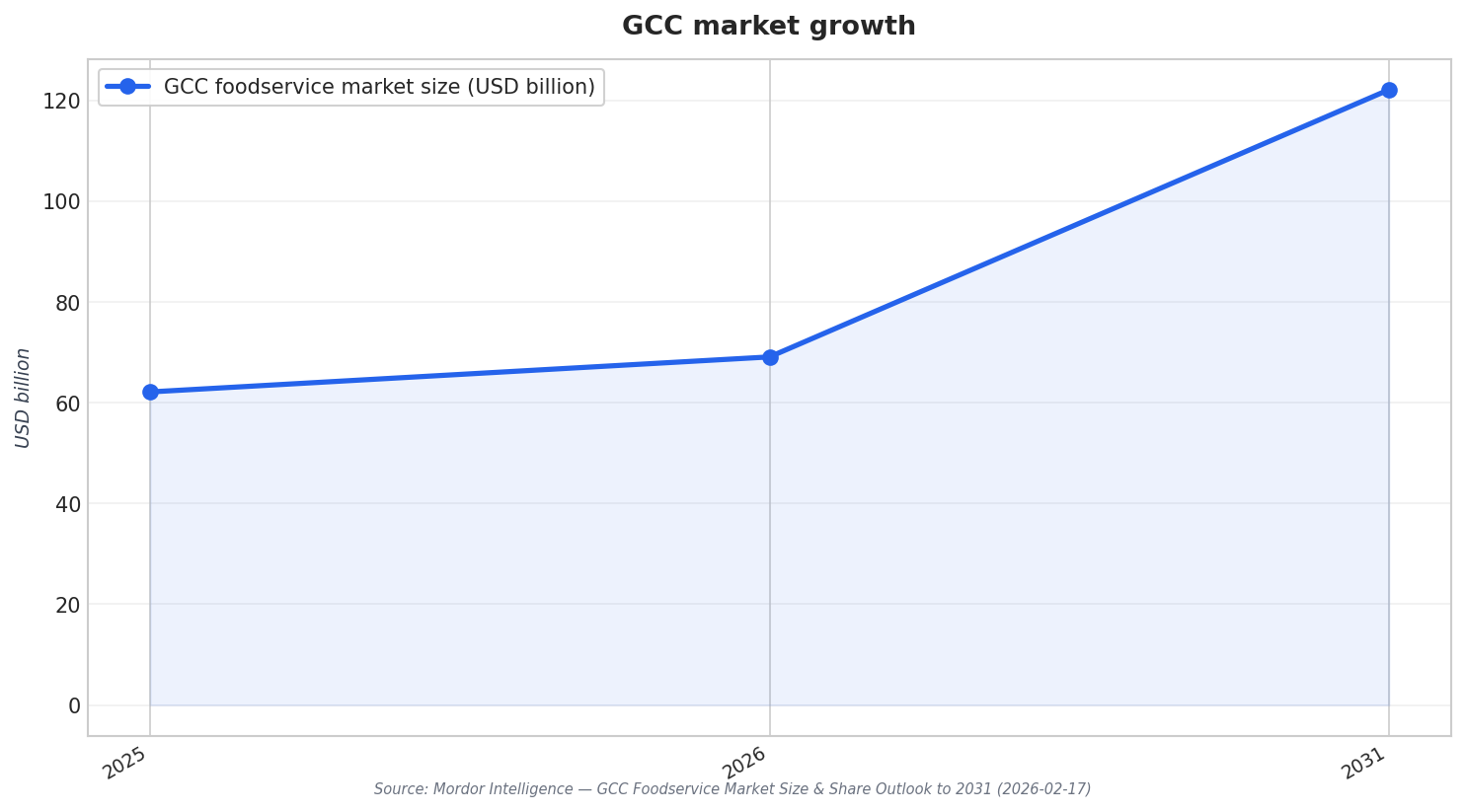
The GCC foodservice market was valued at USD 62.18 billion in 2025 and is estimated at USD 69.13 billion in 2026, with a forecast to reach USD 122.19 billion by 2031 at a CAGR of 12.07% (2026–2031), according to Mordor Intelligence. Another market outlook also projects growth from USD 68.99 billion in 2026 to USD 121.93 billion by 2031 at the same 12.07% CAGR. Within that expansion, quick-service restaurant networks are described as rapidly occupying high-traffic corridors and surpassing full-service concepts in obtaining licenses, creating a competitive “land-grab” dynamic that can favor well-capitalized operators and franchisees.
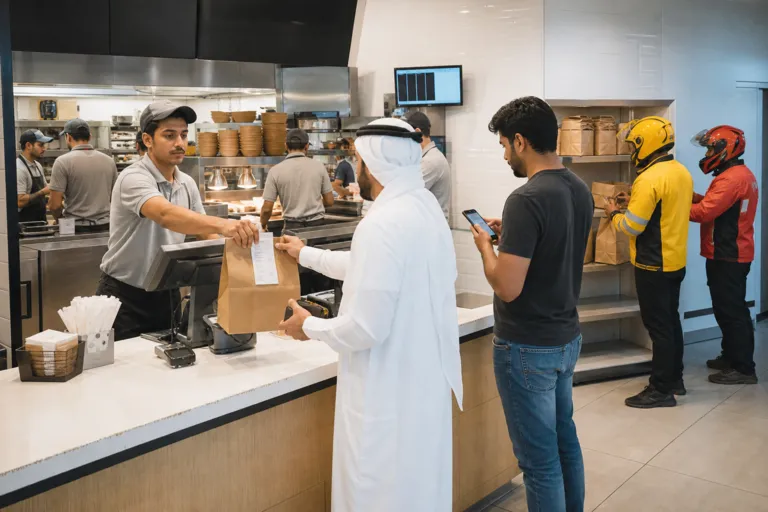
The same GCC reporting highlights how demand is shifting by service type. Dine-in transactions captured 62.24% of spend in 2025, but delivery orders are forecast as the fastest-growing service type at a 13.78% CAGR to 2031. Americana Restaurants, which operates 2,590 outlets including KFC and Pizza Hut, reported that 44% of its revenue now comes from home delivery. Those numbers help explain why scale, consistency, and operational repetition matter: chain operators supported by centralized procurement and real-time loyalty data are said to outperform independent players, even as operators face high rents and import-related cost volatility.
Why QSR Franchises Scale Faster in a High-Rent, Delivery-First GCC
Segment shares show why QSRs are central to the region’s growth story. One GCC outlook states quick service restaurants held a 45.93% market share as of 2025, benefiting from convenience and standardized quality. Mordor Intelligence also notes full-service restaurants led with 46.29% share in 2025, while chained formats are scaling at a 12.84% CAGR, even though independent outlets still represented 58.73% of market size in 2025. For franchise-led models, that mix signals a market where independents remain numerous, but scalable chains are forecast to gain ground as the growth cycle continues.
Cost pressure and location strategy are pushing operators toward formats that can be replicated with tighter control. Retail rents in Dubai increased by 10.5% in 2024, and Abu Dhabi saw a 14.7% rise, according to the GCC outlook. Standalone locations accounted for 72.24% of revenue share in 2025, while leisure-anchored venues are forecast to expand at a 13.69% CAGR to 2031. At the same time, cloud kitchens are gaining traction: one GCC dataset cites a 13.24% CAGR through 2031, while another cites a 12.28% CAGR. Both position delivery-optimized kitchens as a response to real estate costs and evolving consumer habits.
Tourism and mega-project investment provide the demand backdrop that makes rapid rollout valuable. The GCC outlook links QSR expansion with Vision 2030 objectives, including an aim of reaching 150 million annual visitors for Saudi Arabia, and points to mega-projects such as NEOM and developments at Sindalah that prioritize scalable dining concepts. It also reports the UAE recorded 17.15 million international visitors in 2023. Within the GCC, Saudi Arabia commanded 47.27% of regional sales in 2025, and Kuwait is forecast as the quickest riser with a 13.89% CAGR through 2031. For GCC quick service restaurant franchising, these figures reinforce why operators target repeatable formats that can open across new consumption hubs.
How fast is the GCC foodservice market forecast to grow through 2031?
What share of GCC foodservice spend is dine-in vs. delivery?
How important are QSRs in the GCC market mix?
What signals the rise of cloud kitchens in the GCC?
What does GCC quick service restaurant franchising have to do with delivery growth?