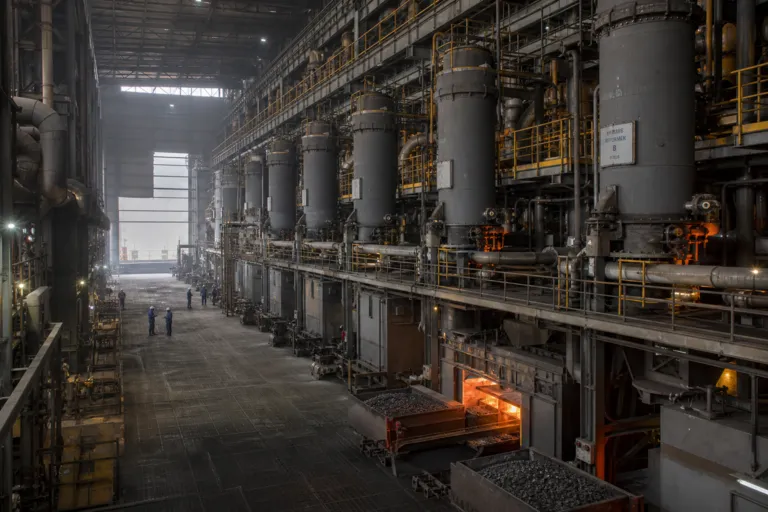
The Middle East steel market is getting bigger, and that scale is driving a new race around lower-carbon material. One industry view projects the region’s steel market to expand from USD 43,512 million in 2025 to USD 60,337 million by 2031, alongside apparent steel use rising from an estimated 60.1 million tonnes in 2025 to 77.4 million tonnes. Construction and infrastructure already absorb about 61% of finished-steel demand, tying steel output and utilization to public capital expenditure, transport networks, housing delivery, and energy-project execution. In that context, the push to qualify “certified low-carbon material” is no longer only a climate story. It is also a procurement and competitiveness story, especially for exporters looking to protect market access.
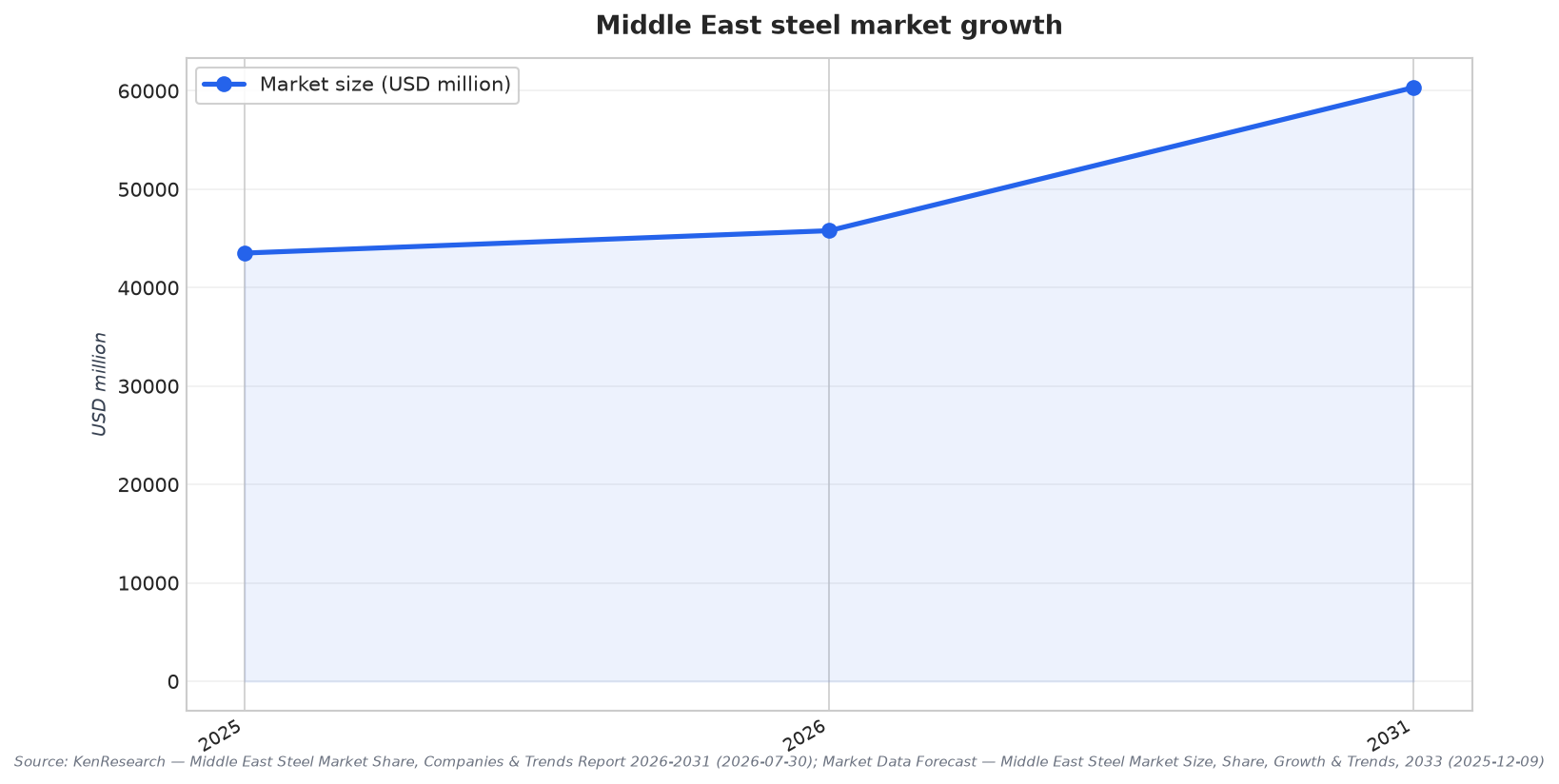
Saudi Arabia sits at the center of regional steel momentum because it is part of the region’s principal production and consumption corridor. Iran and Saudi Arabia together recorded 42.6 million tonnes of crude-steel output in 2025, which the same source describes as nearly three-quarters of reported Middle Eastern production. A separate market source values the Middle East steel market at USD 44,438.9 million in 2025 and anticipates USD 45,785.4 million in 2026, with a forecast of USD 56,425.18 million by 2034. That report also cites large, steel-intensive investment plans across the GCC, including a figure of over USD 500 billion in infrastructure projects by 2030 and more than USD 180 billion allocated by Saudi Arabia for Vision 2030-related initiatives. Demand-heavy megaproject pipelines reinforce why producers want low-emission pathways, not just more tonnage.
Oman’s Export Play: From Gas-Based DRI to Hydrogen-Ready Iron
Oman’s strategy is increasingly framed as export-oriented, with one market outlook saying Oman is strengthening its position as a “green-iron hub.” IEEFA notes that the Integrated Gas Company has signed contracts allocating 18.614 million standard cubic metres per day of gas for industrial consumers in Duqm, described as the highest allocation among Oman’s regions and industrial hubs. But the same analysis warns that without transitioning from gas to green hydrogen, gas-based DRI projects will not attract a “green premium,” because emissions would still exceed the threshold for near-zero iron classification, even when equipped with carbon capture. It also cites Midrex—accounting for nearly 80% of global DRI production via shaft furnaces—stating that carbon capture and storage is unlikely to play a significant role in reducing emissions from DR technologies. Players named in Oman include Vale and Jindal Steel, alongside entrants such as Meranti Green Steel, Mitsui and Kobe Steel, and Jinnan Steel.
This race is also shaped by global market pull and policy pressure. One green-steel market forecast estimates USD 11.20 billion in 2026, rising to USD 307.57 billion by 2033, at a CAGR of 60.6%, and projects the Electric Arc Furnace (EAF) segment at 43.9% of the global market in 2026. Another report says the EU’s Carbon Border Adjustment Mechanism entered its definitive phase in 2026 and requires importers of steel to account for embedded emissions, effectively raising the cost of high-carbon steel entering the EU. For producers in the Gulf and Oman targeting export markets, that type of rule elevates the importance of documented emissions, hydrogen-based DRI, and renewable-powered EAF options. It also helps explain why the “green steel Middle East” conversation is increasingly anchored in trade readiness as much as technology ambition.
Over the next several years, the Middle East’s steel expansion is expected to be about mix and qualification, not just volume. One regional forecast attributes future growth to a 4.3% volume CAGR and an average 1.3% annual increase in the regional steel selling-price mix, with higher-value flat products, coated steel, certified low-carbon material, and specialized pipe progressively increasing their revenue share. Long steel products are identified as the fastest growing segment for 2025–2031, while capacity additions are expected across plate, flat steel, DRI, HBI, and low-carbon steelmaking. Saudi Arabia is expected to remain the largest incremental demand contributor, while Oman positions itself for export. In practice, the race will reward producers that can secure reliable energy contracts, scale modern processes, and provide credible product emissions documentation.
Why are Oman and Saudi Arabia pushing low-carbon iron and steel now?
What do the sources say about Oman’s gas supply for Duqm industry?
How dominant are Iran and Saudi Arabia in Middle East steel output?
What’s the market outlook for green steel globally, and why does it matter to the region?
What does “green steel in the Middle East” depend on, according to the sources?