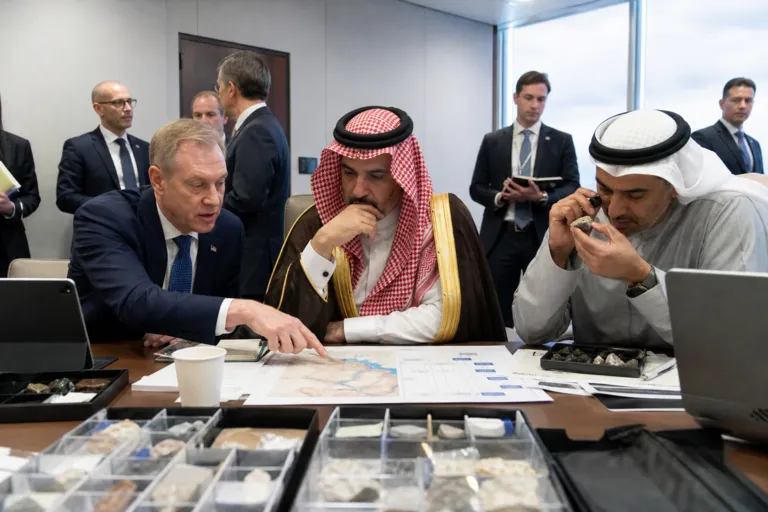
The emerging US Gulf critical minerals defense deal is being built around a simple logic: mineral security is national security. During Saudi Crown Prince Mohammed bin Salman’s visit to Washington, D.C., the United States and Saudi Arabia discussed a wide-ranging agenda that included arms and defense cooperation and expanded critical minerals cooperation, alongside economic and investment ties and regional security challenges. A CSIS analysis says the two countries established a Strategic Framework for Cooperation on securing uranium, metals, permanent magnets, and critical mineral supply chains. The framework is designed to facilitate two-way investment and is described as a “cornerstone” of the bilateral strategic partnership.
Saudi Arabia’s geology is central to the pitch. CSIS reports that estimates received from Saudi Arabia’s Ministry of Industry and Mineral Resources say the Jabal Sayid deposit, about 350 kilometers northeast of Jeddah, is believed to hold the fourth most valuable reserves of rare earth elements globally. The same source cites an estimated 552,000 tons of heavy rare earths, including dysprosium and terbium, plus an additional 355,000 tons of light rare earths such as neodymium and praseodymium. CSIS also notes that unexplored adjacent deposits could yield even greater supplies. For the United States, heavy rare earth access matters because CSIS says the US primarily produces light rare earths and remains dependent on imports for heavy rare earths.
From Diplomacy to Deal Structures: Refineries, Funds, and Feedstocks
Several mechanisms now connect mineral supply chains to defense-linked outcomes. ORF Middle East reports that MP Materials, the US Department of Defense, and Saudi mining company Maaden signed an agreement to develop a rare earth refinery in the kingdom, with MP Materials and the Pentagon holding 49 percent and Maaden 51 percent stakes, respectively. CSIS separately says the US Department of Defense, recently renamed the Department of War, announced it will finance a 49 percent equity stake in a new rare earths refinery in Saudi Arabia, describing the partnership between the department, Maaden, and MP Materials as important for reducing dependence on China after a year of pronounced volatility in global access to heavy rare earths. CSIS also links heavy rare earth inputs to advanced US defense capabilities, including F-35 fighter jets, Virginia- and Columbia-class submarines, Tomahawk missiles, radar systems, Predator drones, and the Joint Direct Attack Munition series.
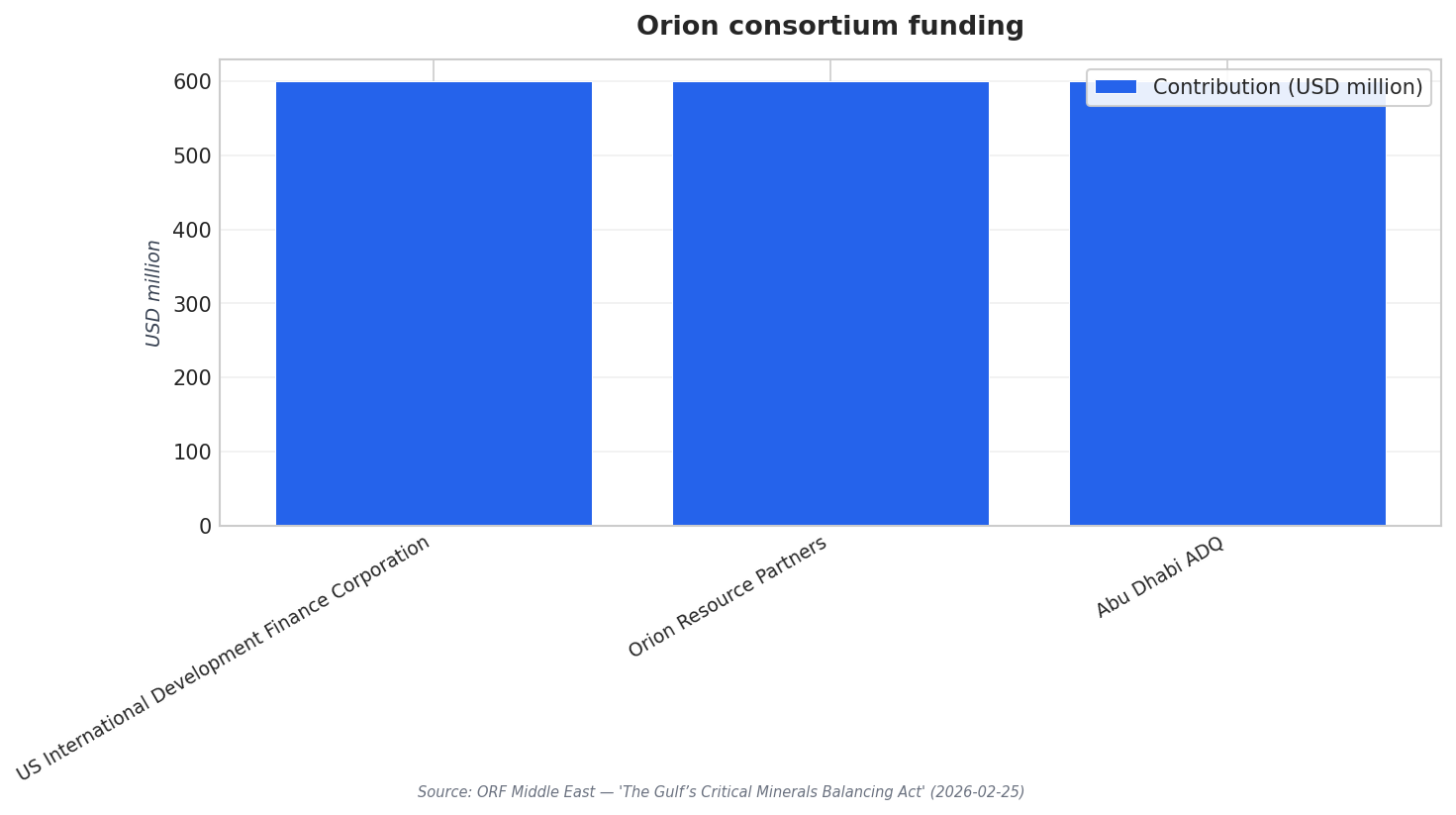
On the UAE track, financing vehicles are also taking shape. Azure Strategy reports that on October 23 the US and the UAE launched a $1.8bn Orion Critical Minerals Consortium, a joint venture between the US International Development Finance Corporation, Abu Dhabi’s ADQ, and Orion Resource Partners. ORF Middle East adds that the three partners contributed US$ 600 million each and that the consortium is targeting a corpus of US$ 5 billion. Azure Strategy says the fund will prioritize financing or operating near-term mining and processing projects to boost supplies of lithium, copper, and rare earths for the US and its allies, describing these inputs as vital to EVs, renewables, defense, AI, and data centers. ORF Middle East also reports that the UAE joined the US-led Pax Silica Initiative last December, followed by Qatar soon after.
Saudi Arabia is also pursuing additional processing pathways that could feed US-aligned supply chains. US Strategic Metals says it formed an alliance with the National Industrial Development Center on critical minerals processing in the kingdom, stating the initiative will accept feedstocks from Africa, Pakistan, and other regional sources, with processed materials ultimately destined for the United States and its allies. The same release says that by investing in projects up to $1 trillion, the MOU underscores the U.S.-Saudi alliance and will help fulfill agreements mutually reached at the U.S.-Saudi Investment Forum held in Washington, D.C., in November 2025. Taken together, these moves reflect the broader point made by Carnegie Endowment research: critical minerals have dual use applications in the defense sector, and US goals can only be realized through collaboration with allies and partners.
What is driving the US Gulf critical minerals defense deal?
What rare earth reserves are cited for Saudi Arabia’s Jabal Sayid deposit?
How is the Saudi rare earth refinery structured between Maaden, MP Materials, and the US Department of Defense?
How much funding is tied to the US-UAE Orion Critical Minerals Consortium?
Which minerals does the Orion consortium prioritize, and who are the intended beneficiaries?