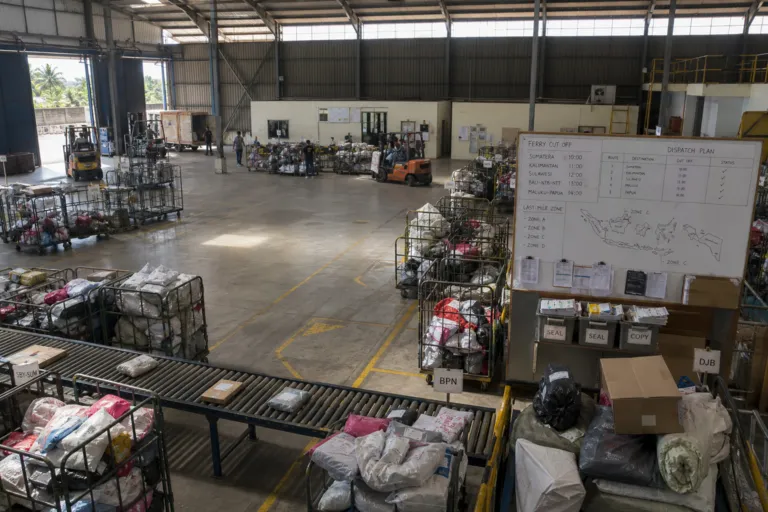
Indonesia’s fulfilment challenge starts with geography. The country spans an archipelago of over 17,000 islands, so e-commerce logistics must coordinate sea freight, air cargo, and motorcycle-based last-mile delivery to keep orders moving. In this environment, last-mile delivery takes the largest structural share of operational expenditure, driven by fragmented routes and urban congestion patterns. As delivery friction drops, platforms protect conversion rates and repeat purchases in a mobile-first retail environment. That pressure is now accelerating a logistics “arms race” where speed, reliability, and network coverage matter as much as price.
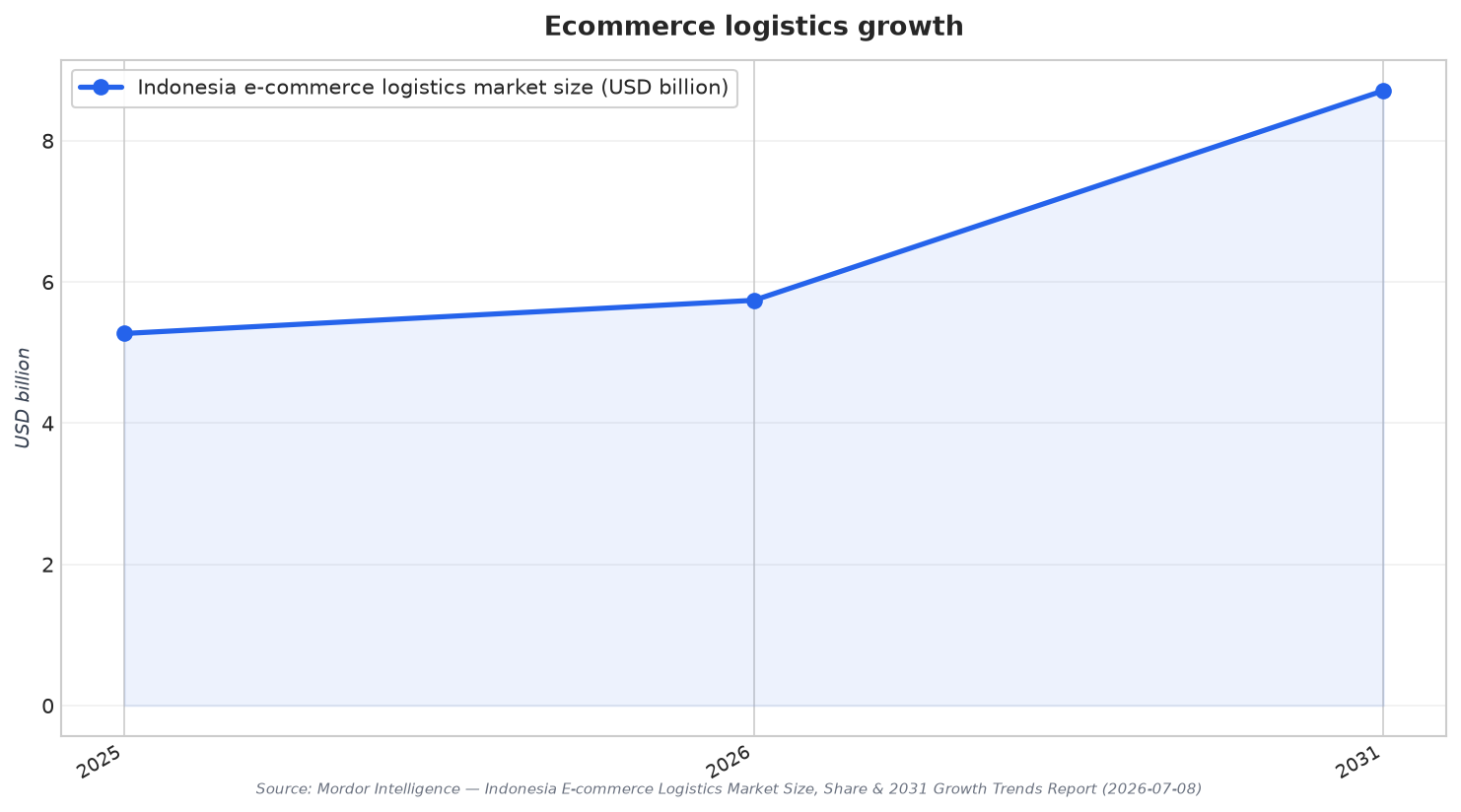
Market trackers also point to strong expansion in the logistics layer supporting online commerce. Mordor Intelligence estimates the Indonesia e-commerce logistics market will grow from USD 5.27 billion in 2025 to USD 5.74 billion in 2026, reaching USD 8.71 billion by 2031, at an 8.71% CAGR over 2026–2031. In 2025, transportation captured 72.78% of market share, while value-added services are forecast to expand at a 10.39% CAGR to 2031. Domestic shipments accounted for 86.90% of the market in 2025, with cross-border logistics advancing at a 9.39% CAGR to 2031.
Same-Day Expectations, Platform Fleets, and Micro-Fulfillment
Delivery speed is splitting service models. MarkWide Research describes a bifurcation in same-day delivery that is pushing the industry into premium and standard tiers. Mordor Intelligence quantifies the split: standard services held 51.28% share in 2025, while same-day delivery is projected to grow at a 9.12% CAGR over the forecast period. To hit tighter windows, providers are leaning on micro-fulfillment hubs and two-wheeler fleets for final-kilometer delivery. Fashion and electronics retailers are deploying hyperlocal warehouse networks across Surabaya and Bandung to compress last-mile distances and support same-day promises in tier-two corridors.
Control is also moving closer to platforms. Mordor Intelligence notes that platform-owned fleets already cover nearly two-fifths of marketplace parcels, while platform-captive delivery networks reshape competitive dynamics. MarkWide highlights how operators compete with infrastructure: J&T Express uses automated sorting to sustain cost leadership across tier-two cities, and Shopee Express anchors demand through its parent marketplace ecosystem. At the same time, fulfilment services are described as the fastest-growing segment as marketplace operators and brands internalize warehouse operations to control inventory velocity and customer experience.
Regulation and operational reality now decide whether growth translates into completed deliveries. MarkWide says Indonesia’s Ministry of Communication and Informatics is tightening enforcement around delivery accountability, forcing platforms to maintain service-level agreements or face operational restrictions. Mordor Intelligence adds that mandates for electronic proof of delivery (e-POD) are tightening compliance requirements. Meanwhile, congestion can turn marketing success into delivery cost: Mordor Intelligence notes Jakarta traffic restrictions can raise distribution costs, and failed cash-on-delivery handoffs add return handling. Even so, the broader demand engine is clear. Mordor Intelligence values Indonesia’s e-commerce market at USD 104.2 billion in 2026, forecast to reach USD 239.4 billion by 2032, reinforcing why fulfilment execution has become a defining competitive capability.
Why is fulfilment so complex across Indonesia’s archipelago?
How fast is the Indonesia e-commerce logistics market growing?
What share of shipments are domestic versus cross-border?
What is changing about delivery speed expectations?
How are platforms tightening control over delivery performance?