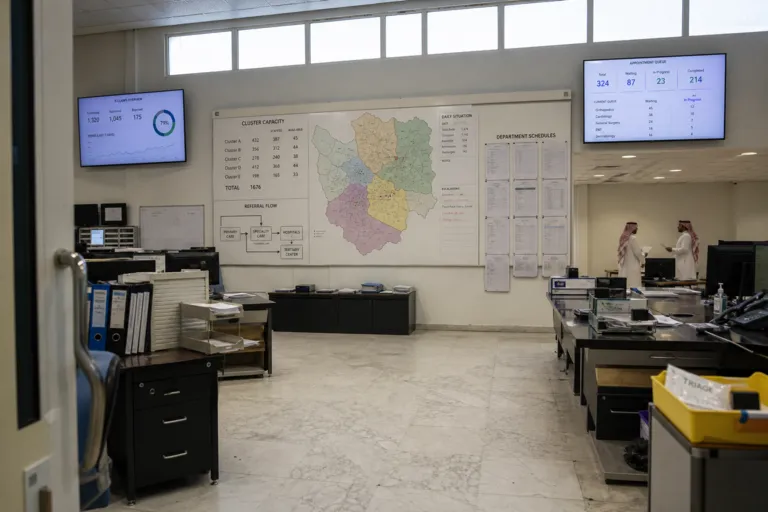
Saudi Arabia’s Health Sector Transformation Program is rebuilding how public healthcare is run by separating roles that were once concentrated inside one ministry. The Ministry of Health remains the central steward and is shifting toward regulation, supervision, and policymaking under Vision 2030. In the operating model described in current reform analysis, care delivery moves to geographically organized health clusters, while insurance and purchasing mechanisms are intended to finance services with clearer payor rules than annual line-item budgeting alone. Digital platforms sit across the system to connect patients, providers, and payers, creating a more integrated flow of clinical and financial activity.
Service delivery is increasingly described as a “cluster” story rather than a “ministry” story. Under the Saudi Health Holding Company, 20 health clusters were created by converting previously dispersed Ministry of Health facilities into accountable care organizations tasked with meeting the health needs of defined populations. Another national description of the reform highlights the establishment of semi-autonomous health holding companies at the regional level to manage hospitals and primary care facilities, while the Ministry of Health retains its role as the sector’s policy and regulatory authority. The same separation-of-functions logic appears in sector briefings that place delivery with clusters under the holding structure and oversight with the ministry.
Financing and Digital Layers Make the Cluster Model Work
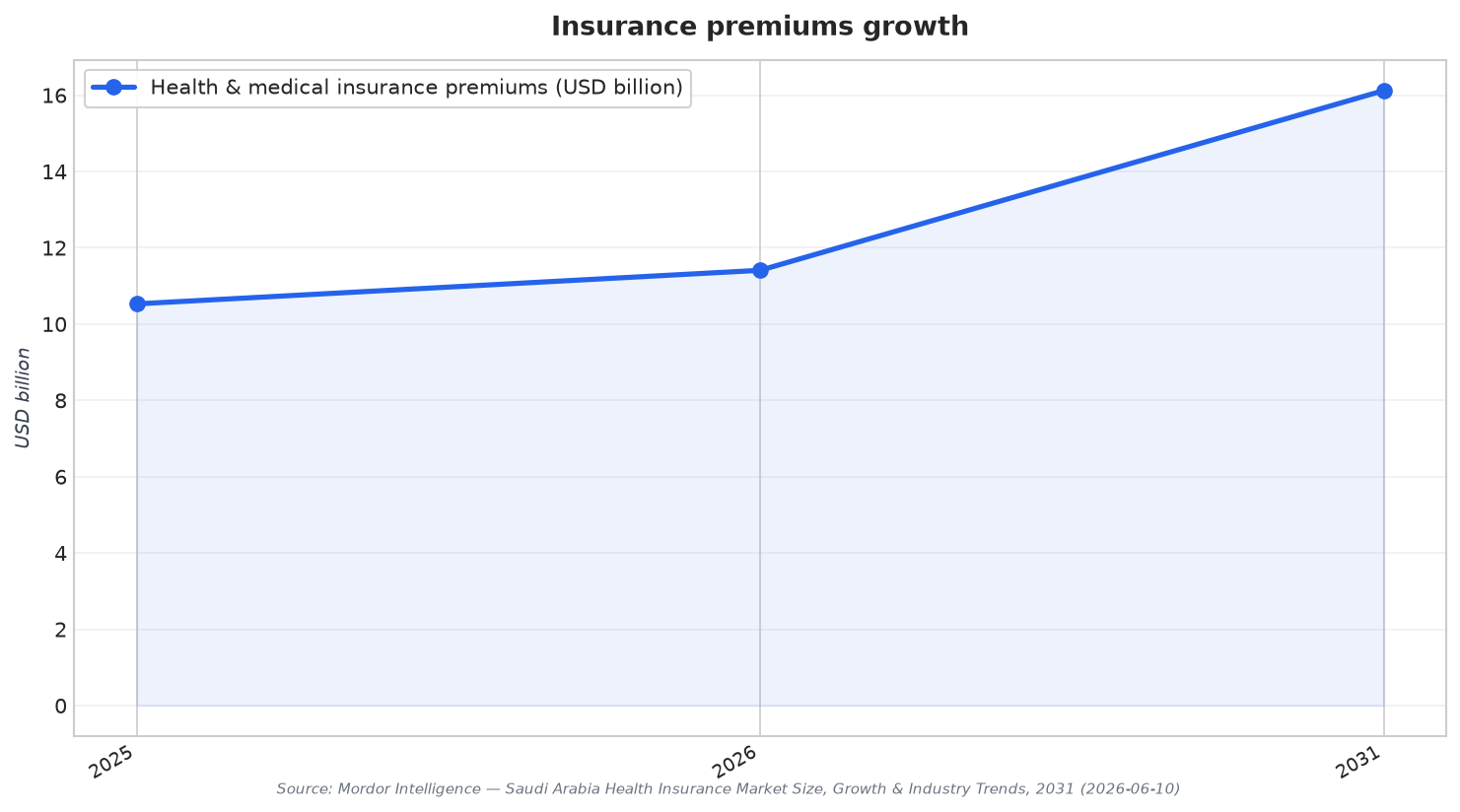
Financing is evolving in parallel, which matters because cluster accountability depends on how money and claims move. The health and medical insurance market in Saudi Arabia, measured by premium value, was valued at USD 10.53 billion in 2025. It is estimated to grow from USD 11.41 billion in 2026 to USD 16.12 billion by 2031 at a CAGR of 7.16%. Sector reporting also points to public-private partnership models that use capitated contracts with stop-loss protection for complex cases, while real-time e-claims through the NPHIES platform are described as improving settlement speeds, lowering denial rates, and reducing working-capital pressure for providers.
Digitization is not positioned as an add-on; it is a lever for shifting how patients access care. Official reporting cited in sector coverage says virtual appointments at Ministry of Health facilities nearly doubled year over year to 9.3 million in 2024. In the broader digital ecosystem, the Sehhaty mobile health application is described as providing appointment scheduling, teleconsultations, prescription management, and health tracking, with over 24 million users—about 68.5% of the population—indicating wide comfort with mobile-first pathways. Alongside these tools, the Ministry of Health is also described as launching Seha Virtual, reinforcing the shift away from physical visits where appropriate.
The structural shift can also be seen in how national care frameworks are organized around clusters and standardized pathways. Saudi Arabia’s Model of Care is described as a prevention-focused framework built to deliver integrated, equitable, high-quality care across the Kingdom’s 20 health clusters. It is anchored around six pillars: Wellness, Planned Care, Chronic Care, Urgent Care, Safe Birth, and Palliative Care. For system builders, the direction emphasizes governance and execution capacity, echoed by the Health Holding Company’s Memorandum of Understanding with Mass General Brigham established in 2023 and a 2025 milestone framed around accelerating nationwide adoption, building national capacity, and strengthening clinical governance.
How is Saudi Arabia separating the roles of regulator, funder, and provider in healthcare?
What changed under the Saudi Health Holding Company in care delivery?
What are the key pillars of Saudi Arabia’s national Model of Care?
What evidence shows rising use of digital care in the public system?
How large is Saudi Arabia’s health and medical insurance market, based on premium value?