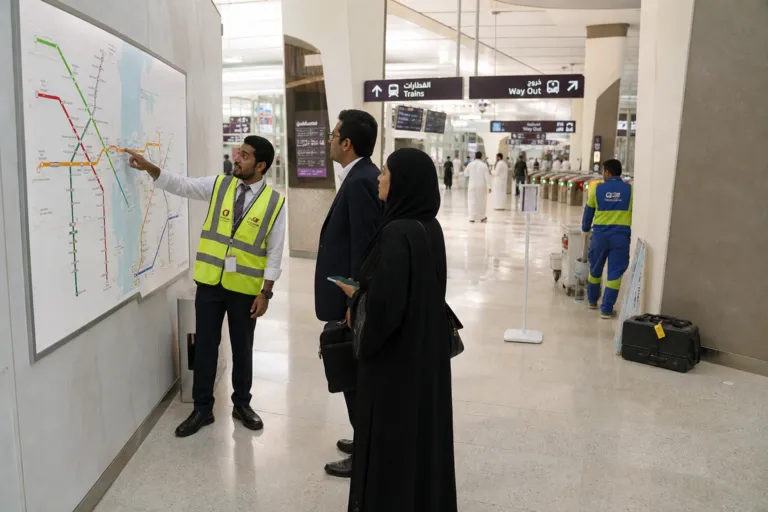
The Doha Metro is a rapid transit system serving the Doha Metropolitan Area, including Qatar’s capital city Doha. It became operational on 8 May 2019. The system has three lines with an approximate overall length of 76 km and 37 stations, and it is built around a central interchange at Msheireb in downtown Doha. Trains are described as capable of reaching 100 km/h, supporting fast cross-city trips within a driverless operating model. Doha Metro also sits inside the wider Qatar Rail network vision, which includes longer-distance rail for passengers and freight and a future link to the GCC, framing the metro as city transport with national connectivity ambitions.
The next step is about closing gaps. Planning references an eventual completion date of 2026 for the metro’s phased opening and network buildout. In parallel, Phase Two is described as including the Blue Line and additional station expansions, with completion targeted between 2025 and 2026 and a stated aim for full integration and operational readiness by 2026, even if minor extensions continue beyond that date. The Blue Line is positioned as the fourth major metro line and an interconnector for new districts as Doha expands. One projection states the total network length is expected to reach around 93 kilometres once finalized, while also noting a longer-term ambition of nearly 300 kilometres across all four lines.
Integration Is the Real “Ring” Being Closed
Blue Line delivery lands in a broader integration story rather than a single corridor story. A market analysis notes that the opening of the Lusail Tram Turquoise Line in January 2025 closed the loop on a 19 km, 25-station network that “synchronises seamlessly” with the 37-station Doha Metro. The same source states that together these systems give 91.7% of residents convenient public-transport access, described as the highest rate in MENA, and position Doha among global leaders in network density. Within that context, future metro extensions, including the Blue Line, are framed as requiring deep-tunnel know-how and station overhauls, highlighting that the work is as much about network performance as it is about new track.
Funding signals show why timing matters. One regional analysis says Qatar invested roughly USD 36 billion in the three-line Doha Metro and associated Lusail Tram, describing the network as a foundation for the country’s next economic phase. In construction-market forecasts, roadways still dominate near-term share, but railways are projected to expand at more than 6% CAGR through 2031 in separate estimates. Another Qatar-focused infrastructure market outlook states transport works generated 37.2% of the Qatar infrastructure construction market size in 2024 and adds that the Doha Metro’s phase-two extension adds 72 km of track to link new residential clusters. These figures underline why the Doha Metro Blue Line 2026 narrative is often discussed as a system-level upgrade tied to wider transport investment cycles.
The urban impact is already being interpreted through land use and development decisions. A Qatar real estate analysis links planned metro extensions to shifting investment strategies, with buyers targeting areas along current or planned metro lines and landlords in less-connected neighborhoods facing stronger competition. It also frames stations as more than transit points, emphasizing their role as landmarks that shape districts. Operationally, the metro is run under an arrangement in which RKH Qitarat operates and maintains the system for a duration of 20 years on behalf of Qatar Rail, connecting day-to-day reliability with long-term expansion. As the Blue Line moves toward the 2025–2026 window, the story is less about a single opening date and more about completing a more legible, integrated city network.
When did the Doha Metro become operational, and what is its current size?
What is the targeted timeframe for the Blue Line within Phase Two?
How does the metro integrate with the Lusail Tram network?
What does the Doha Metro Blue Line 2026 topic imply for overall network length?
Who operates and maintains the Doha Metro system?