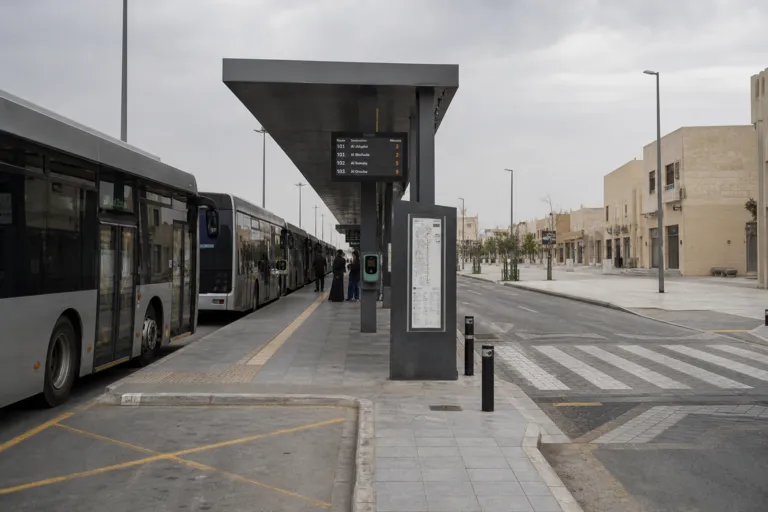
Riyadh is testing whether a car-oriented city will use high-capacity public transport at scale. The metro opened in phases from 1 December 2024, with the final line entering service on 5 January 2025, adding a six-line network of 176 km with 85 stations. Operating evidence suggests demand exists: Riyadh Metro recorded 60.7 million passenger journeys in the first half of 2026, about 335,000 a day. Still, the city entered this transition with commonly cited, though dated, estimates that more than 85% of daily trips are made by private car and about 2% by bus. That is why buses matter: they are the practical bridge between stations and the places people actually go.
The bus layer is already sizable. A bus system launched in 2023 operates 54 routes with 672 buses and 2,145 stations and stops, and it is positioned to complement rail rather than compete with it. Policy-focused research on Riyadh’s mobility transition describes early indications of a slight shift away from private cars, alongside expectations of reduced fuel consumption and CO2 emissions, as capacity and coverage increase. But the same research framing makes the challenge clear: if buses do not deliver reliable access to more neighborhoods and trip types, metro ridership can grow without changing the wider travel market. In that sense, buses are not a secondary add-on; they are the day-to-day distribution system for rail demand.
Design Transfers and Walk Access Around Real Streets
In Riyadh, the “last mile” is not a small detail. Analysis of the metro launch argues that the gap between stations and final destinations is particularly pronounced because many destinations sit beyond comfortable walking distance, and integration measures such as bus feeders, ride-hailing connections, and micromobility are “not yet comprehensive.” Interchange quality also varies. Some locations offer seamless, weather-protected transfers, while others require outdoor walks between bus stops and metro stations. A network-based walk-access study underscores why this matters: most transit journeys include a walk at each end, so access conditions shape the effective catchment more than a map of lines alone. The practical takeaway is simple: making transfers consistent, direct, and comfortable is a core bus strategy, not just a station design issue.
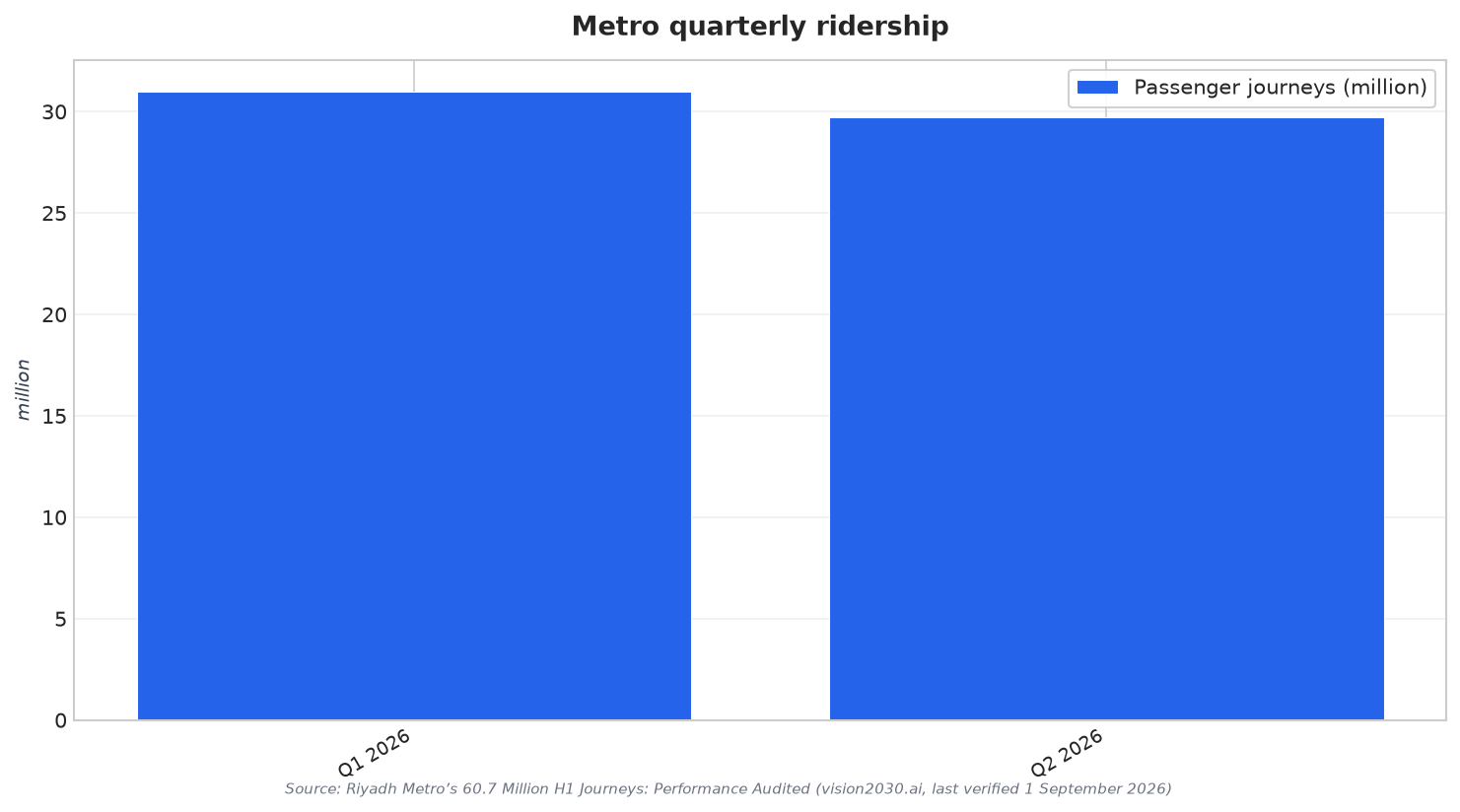
Riyadh also needs to plan with humility about data limits. The walk-access research notes that small-area statistics on income or nationality are not openly published for Riyadh, and Saudi Arabia has no nationally representative household travel survey, meaning distributional analysis must rely on proxies. That constraint raises the value of operational indicators and on-the-ground experience. The metro’s H1 2026 figure of 60.7 million passenger journeys proves demand, but it does not diagnose performance without fields such as transfers, station entries, or crowding. This is where buses can be managed as a flexible, observable service: stop placement, feeder routing to rail, and event overlays can be adjusted faster than rail infrastructure, including during peak seasons when supplementary services are deployed for major events.
Finally, the bus program sits inside a broader investment and target-setting story that can shape expectations. One market report describes Riyadh’s metro and bus network project as part of a $23 billion public transport plan and says it aimed to have 1,000 buses operational by 2024. The same report states that, as part of Vision 2030, the government aims to increase public transit usage from 2% to 20% by 2030. Those targets will not be achieved by rail alone. They depend on whether everyday riders can complete end-to-end trips without friction—especially in a city where, according to CNN reporting cited elsewhere, traffic remains heavy and some journeys can take twice as long by metro because of urban layout. The bus network is the lever that can make the integrated system feel faster, simpler, and more relevant to daily life.
How big is Riyadh’s bus system today?
What role does the Riyadh public bus network play alongside the metro?
What early usage signals are visible for Riyadh Metro?
Why is walk access treated as a critical factor for the integrated system?
What public-transit usage goal is cited for Vision 2030?