“Beyond oil contracts” is not a slogan. It is a security-and-transition requirement shaped by shocks, chokepoints, and growing electricity demand. The Atlantic Council argues there is no silver bullet for energy security, “not even bypassing the Strait of Hormuz,” and points to how supply routes can become limited or closed during conflict. In parallel, demand keeps rising. The International Energy Agency expects global electricity consumption required for data centers to reach 945 TWh by 2030 in a base-case scenario. That combination makes a more structured Gulf Europe energy partnership less about diplomacy and more about system resilience.
The starting point is realism about hydrocarbons and trade. The Atlantic Council notes the Middle East accounts for approximately 30% of global oil production and nearly 20% of global gas production. It also highlights that Europe is a major importer of hydrocarbons from the Gulf region, while European technology is helping drive the energy transition. In other words, the relationship already spans molecules and technology. A shared agenda can broaden what “energy security” means so it includes not only supply access, but also investment in clean power, storage, hydrogen, and modern grids—without assuming one solution will cover every risk.
From Buyer-Seller Deals to a Transition Portfolio
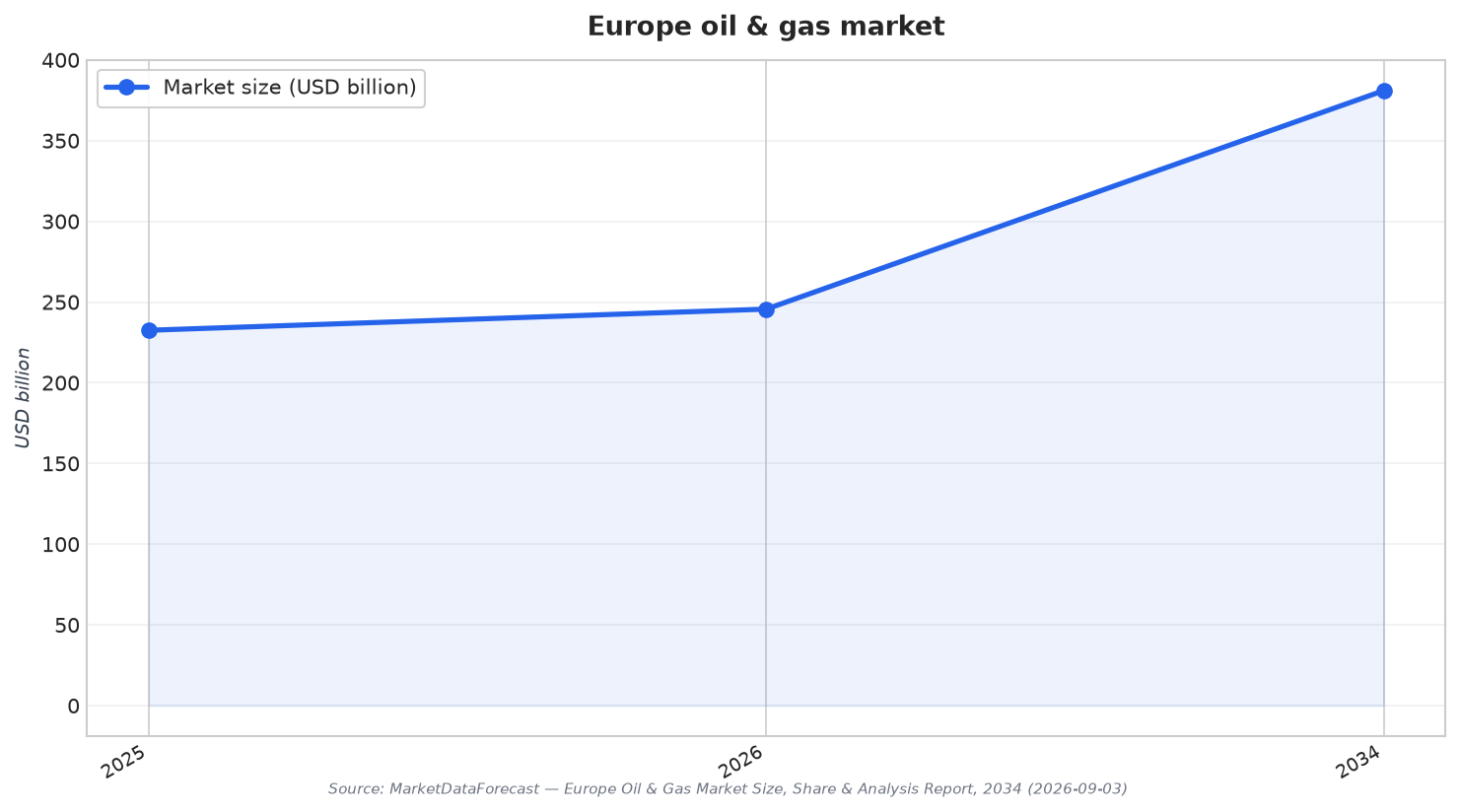
Europe’s own market signals show why “transition plus security” is likely to define near-term strategy. Market Data Forecast values the Europe oil and gas market at USD 232.52 billion in 2025, estimates USD 245.63 billion in 2026, and forecasts USD 380.99 billion by 2034, with a 5.64% CAGR from 2026–2034. In that same report, oil and gas storage is the dominant type segment at 29.2% market share in 2025, while export terminals are the fastest-growing type segment with a projected 13.3% CAGR. For a Gulf–Europe agenda, those figures underline two tracks: maintaining reliable supply and infrastructure, while using that stability to scale a broader clean-energy portfolio.
The scale of the global transition investment story also matters for joint planning. DataM Intelligence estimates the global energy transition market will reach USD 2.36 trillion in 2026 and grow to USD 7.20 trillion by 2035, at a 13.59% CAGR from 2026 to 2035. In that view, renewables hold about 42.6% of market share, and North America accounts for around 35.7% of global market share. Even though those are global and regional context figures—not Europe-Gulf specifics—they still signal where competition and opportunity will concentrate. A joint agenda can prioritize bankable areas the Atlantic Council lists, including solar PV, wind, hydrogen, nuclear, energy storage, and emerging space-based energy technologies such as space-based solar power.
A credible program should also focus on operational capabilities, not only megaproject announcements. DataM Intelligence notes that artificial intelligence and advanced analytics are transforming energy systems through predictive maintenance, real-time optimization, and demand forecasting, while smart grid technologies and digital energy management platforms are gaining adoption as utilities modernize infrastructure and improve efficiency. The Atlantic Council similarly points to AI’s potential to optimize electricity grid efficiency across consumer, prosumer, and producer levels, even as demand grows. Practical Gulf–Europe cooperation can therefore combine European technology strengths with Gulf clean-energy investment momentum, while learning from Europe’s experience reducing dependence on Russian gas to manage disruption risks tied to constrained supply routes.
What problem is a Gulf–Europe energy partnership trying to solve beyond oil trade?
How large could data-center electricity demand become, according to the IEA figure cited?
What does the Atlantic Council say about the Middle East’s role in global oil and gas production?
What do recent projections suggest about Europe’s oil and gas market trajectory?
Which areas can anchor cooperation on systems and grids, not just generation?