Saudi Arabia is trying to move lithium from import dependence toward domestic production, using brines and new processing routes as the bridge. A Ken Research overview values the Saudi lithium market at USD 1.2 billion, based on a five-year historical analysis, and ties growth to lithium-ion batteries in automotive and electronics, plus a policy push toward renewable energy and electric vehicles. In 2023, Saudi Arabia implemented a regulatory framework aimed at boosting domestic lithium production, including incentives for local mining companies and foreign investments, with a focus on sustainable practices and environmental protection. Riyadh and Jeddah are presented as industrial hubs that connect activity to supply-chain access and international markets.
The most discussed feedstocks sit outside classic hard-rock mining. Reporting tied to the Aramco–Ma’aden joint venture describes zones with lithium concentrations up to 400 parts per million on existing operational lands, and separate coverage frames oilfield brines as a byproduct now being reinterpreted as a resource. Another estimate describes oilfield brines as containing elevated lithium concentrations of 50–200 mg/L. Desalination brine is also positioned as a potential resource stream: the Saline Water Conversion Corporation (SWCC) operates facilities that generate over 4 billion cubic meters of brine annually, and the same source states that 7 of the world’s 10 largest desalination plants are located in Saudi Arabia. The pitch is multi-mineral, since that brine is described as also containing bromine, potassium, magnesium, and calcium.
From Lab Claims to Pilots: The Proof Point for Scale
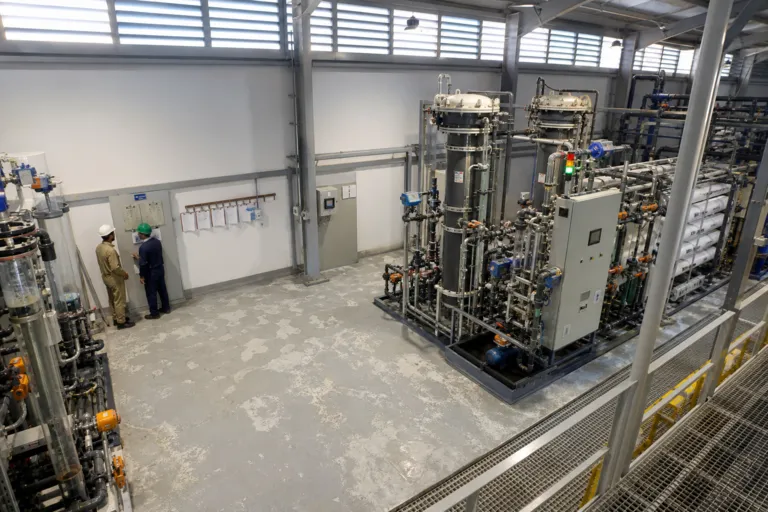
Turning brine into battery-grade supply depends on direct lithium extraction (DLE) proving itself beyond the lab. A Saudi-focused DLE analysis says commercialization timelines are measured in years and hinge on discovery, permitting, infrastructure rollout, and market conditions, even as early studies suggest commercial production could begin as soon as 2027, described as an aggressive timeline. Because local pilots are still emerging, external pilot benchmarks show what “ready” can look like. Reuters reported Albemarle completed validation of its DLE pilot plant in Chile, where lithium recovery exceeded 94% during stable operation, the pilot ran for over 3,000 hours (more than 90 consecutive days), and water reuse reached up to 85%. Reuters also reported $30 million allocated to the pilot plant and $216 million to a salt recovery plant in the Atacama salt flat.
Other pilot-style results illustrate the engineering language Saudi projects may be judged against. One cited pilot-scale electrochemical cell used an electrode surface area of 33.75 square meters to extract lithium from Dead Sea brine with a recovery rate of 84.0%, along with energy savings of up to ~21.5% by harvesting osmotic energy of brines. Mining.com also reported that Albemarle’s “Transition to Direct Lithium Extraction (TED)” project in Chile is a $3.1 billion project under environmental review that would integrate DLE alongside existing solar evaporation methods, “nearly doubling lithium recovery,” and could return roughly 90% of processed brine to the salt flat. For Saudi Arabia, these numbers are not local results, but they define the performance claims that can help financiers and regulators assess pilots.
A lithium industry also needs downstream pull and local materials capacity, not only upstream extraction. IndexBox describes domestic production of lithium-ion battery powders in Saudi Arabia as in an early-stage development phase, even as the Kingdom is positioned as a demand center for specialized materials driven by grid-scale BESS deployment and domestic cell manufacturing facilities under a localization roadmap. Regionally, Precedence Research says the Middle East is building the ability to extract lithium from unconventional sources such as oilfield brines and pegmatite deposits, and notes that the automotive segment holds a 43.0% share of the Middle East market. A separate brine-mining view adds a capital signal: SWCC expects investments in brine mining to exceed $2.1 billion by 2030 and estimates an annual contribution of $400 million to Saudi GDP. Together, policy, pilots, and localized battery materials will decide whether Saudi lithium extraction becomes repeatable industry rather than isolated projects.
What is pushing Saudi Arabia to build a lithium industry now?
Where could Saudi Arabia source lithium besides hard-rock mining?
What pilot benchmarks matter for Saudi lithium extraction projects?
How soon could commercial lithium production start in Saudi Arabia?
Is Saudi Arabia building downstream battery-material capacity too?