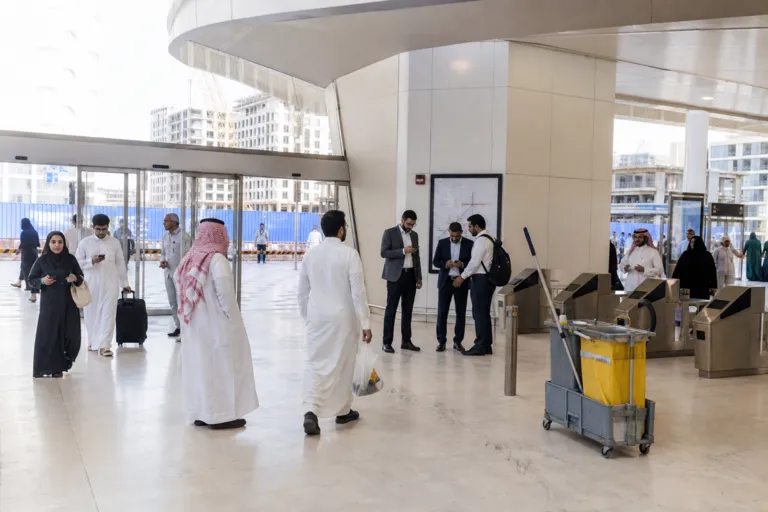
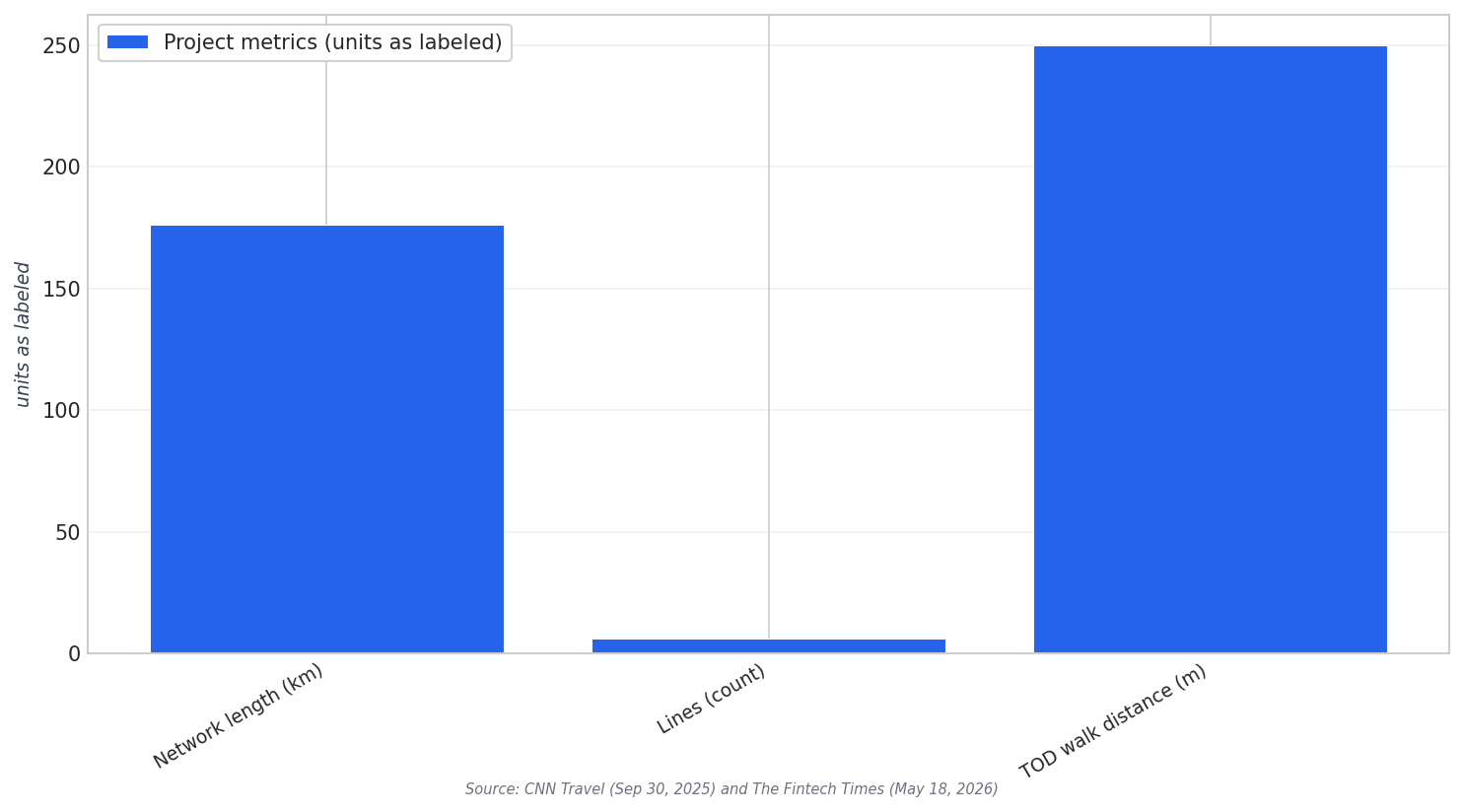
Riyadh Metro is no longer a promise. It launched in December 2024 as an automated rapid transit system. It spans over 176 kilometers across six lines. It links key points across the capital, including King Khalid International Airport and the King Abdullah Financial District (KAFD). That scale matters after the ribbon. It creates new expectations for how people move, where they spend time, and which addresses become easier to reach. In a city with huge stations like KAFD and Qasr Al-Hokm, the network is also being positioned as part of the journey, not only a commute tool.
Official messaging frames this as more than transport. Ibrahim bin Mohammed Al Sultan, Minister of State and CEO of the Royal Commission for Riyadh City, said Riyadh is “reaping the benefits” of a project that will “reshape the capital’s image and redefine mobility.” He also said the network aligns with economic, social, environmental, and urban development objectives. Those statements are now being tested in the market. Expansion signals are already visible. In September, Hassan bin Thabet Street Station was added to the Orange Line. There are also proposed plans for a seventh line to connect Qiddiya Entertainment City, King Abdullah International Gardens, and Diriyah Gate.
The clearest real estate story tied to the Riyadh metro economic impact is transit-oriented development. Riyad Capital launched a fund with a value of about $400 million (SAR 1.5 billion) linked to a 32,000-square-meter land plot on Al-Takhassusi Road. The plan is a mixed-use destination with hospitality, office, residential, and retail assets. The development is classified as a Transit-Oriented Development (TOD). A standout detail is distance. It sits just 250 meters from the Al-Takhassusi Metro Station. The proximity is not a branding detail. It is a design choice that prioritizes mobility and high-density living.
Mobility-Led Leasing: Why Retail and Offices Follow Stations
Transit access becomes a leasing argument when office demand is already tight. Across Saudi Arabia’s three major cities, office stock is projected to grow from 9.7 million sq. meters in 2025 to 15 million sq. meters by 2028, with Riyadh accounting for nearly half of this pipeline. Yet Knight Frank expects near-term conditions to remain tight due to persistent supply shortages. In Riyadh, a five-year rent freeze policy followed an 86% increase in grade-A rents since 2019. Knight Frank also noted grade-A rents saw a 10% to 15% surge in some prime locations immediately before the announcement, reflecting market anticipation.
Retail planning fits inside this same station-first logic. The Riyad Capital TOD plan explicitly combines retail with hospitality, offices, and housing on the same 32,000-square-meter plot. That mix is designed to capture footfall across the day, not only at peak commute hours. It also fits the institutional direction of the market. Riyad Capital reported assets under management of about $26 billion as of December 2025, and assets under custody over $279 billion, with a real estate portfolio spanning three continents valued at more than $6 billion. For Riyad Capital, this TOD fund is also its fourth TOD venture, reinforcing a repeatable playbook.
What comes next is a wider mobility ecosystem that adds more nodes to the network effect. Autonomous vehicle services have begun first-phase rollout in selected locations across the capital, including real-world testing around King Khalid International Airport, key highways, and selected areas in central Riyadh, with a safety operator on board. These pieces can complement metro access rather than replace it. Together, they strengthen the case for station-area projects that bundle living, working, and shopping into one trip chain. After the ribbon, the Riyadh metro economic impact shows up in where capital concentrates, and how destinations are designed to be reached.
What does the Riyadh metro economic impact look like in real estate?
When did Riyadh Metro launch and what is its scale?
What expansion signals have already been reported for the metro?
Why do offices and retailers care about station proximity in Riyadh?