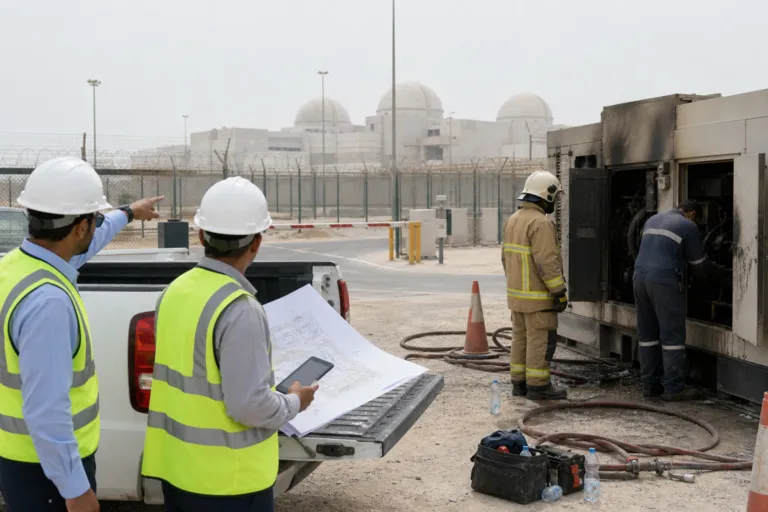
On May 17, 2026, a drone strike hit an electrical generator outside the inner perimeter of the Barakah Nuclear Energy Plant in Abu Dhabi’s Al Dhafra region. Reports described a contained fire, no injuries, normal radiation readings, and no damage to the plant itself. Two additional drones were intercepted before reaching their targets. The International Atomic Energy Agency (IAEA) said the strike caused a fire in an electrical generator and that one reactor was being powered by emergency diesel generators. UAE authorities classified the incident as terrorism and later stated that technical tracking traced the drones to Iraqi territory.
The incident matters because Barakah is not a marginal asset. Multiple sources describe it as a $20 billion facility built by the UAE with help from South Korea. NPR reported it is a four-reactor plant that went online in 2020, while another account described commercial operations around 2020–2021. Another source said it supplies around a quarter of the UAE’s electricity, framing the target as strategically meaningful even when the reactor buildings are not hit. Reuters also captured how quickly markets react to perceived escalation, reporting Gulf equities fell after the UAE said drones targeted an area near Barakah, alongside reports that Saudi Arabia intercepted drones.
What the Generator Fire Reveals About Nuclear Site Vulnerabilities
The May 2026 strike was not described as a breach of reactor containment, and officials said there was no radiological release. But it still highlights a security planning problem: auxiliary infrastructure outside the inner perimeter can be attacked to create operational stress and political leverage. The episode also exposed a “last-drone” gap. Air defenses stopped two drones, yet a third penetrated and struck a generator. That kind of partial success changes how planners should think about layered defenses, because a small external hit can still trigger emergency power arrangements and public alarm, even if core nuclear safety systems remain intact.
Stimson’s analysis places the Barakah incident in a wider Gulf environment where drones, missiles, air-defense systems, proxy networks, external military operations, and surrounding energy infrastructure can intersect in the same escalatory space. It warns that repeated strikes could gradually degrade the conditions that make nuclear safety possible and turn a local incident into a broader regional concern. It also argues that recent incidents around facilities in the Persian Gulf make visible a risk that has often been secondary in regional security debates: civilian nuclear infrastructure under international safeguards becoming increasingly intertwined with conflict dynamics.
For forward-looking Barakah nuclear plant security planning, the May 2026 incident points to a practical agenda that goes beyond hardening the fence line. First, planners can treat off-site power and external generators as high-consequence targets, since the Barakah event centered on a generator outside the inner perimeter and required emergency diesel generators for one reactor during the incident. Second, the attack’s attribution disputes and proxy context suggest a need for clear crisis communications and coordination channels with international bodies such as the IAEA, which reported on power arrangements and radiation monitoring. Finally, Stimson emphasizes that nuclear emergency preparedness can be connected to the Gulf’s shared ecological reality, creating practical channels of cooperation even in a politically divided region.
What happened in the May 2026 drone strike near Barakah?
Did the Barakah incident cause a radiation release or reactor damage?
Why is Barakah treated as a high-stakes target in the UAE?
What does the incident suggest for Barakah nuclear plant security planning?