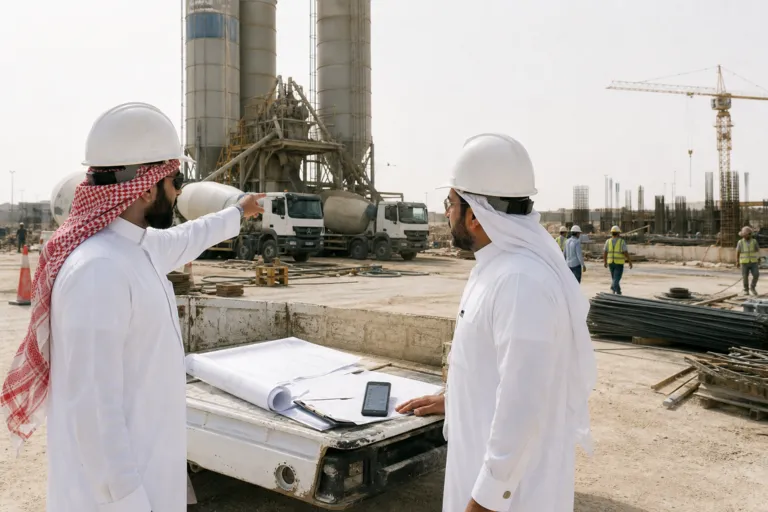
Saudi Arabia’s Vision 2030 is built around giga-projects. These include new cities and tourist destinations meant to be sustainable and innovative. They are backed by the Saudi Public Investment Fund and are designed to reshape the economy beyond oil. But project economics are tightening. Reports describe a slowdown. Several developments are being reevaluated or extended. Neom is undergoing revisions to its blueprint due to escalating costs and economic considerations. The result is a more cautious construction market, where every major input cost matters more than before.
That is where the “cement shortage Saudi Arabia construction” conversation intensifies. Even without a single, official cement-volume figure in the sources, the cost side is clear. Saudi Aramco’s 2026 adjustments include a 35% spike in diesel and HFO costs, a change expected to pressure cement-sector players like Qassim Cement and Yanbu Cement. Analysts expect cost pass-through attempts, meaning higher retail prices that can cool construction demand. Reuters-linked disclosures also show how quickly energy moves can hit production. Northern Region Cement estimated the direct financial impact of amending fuel prices at almost 11%, while Riyadh Cement said the adjustment would increase production costs by 6%.
Why Giga-Project Budgets Are Becoming Harder to Defend
Contracting momentum remains enormous, which makes cost pressure more consequential. Knight Frank said the value of annual contract awards in Saudi Arabia rose to $196bn, up 20% from 2024. It also described a western seaboard pipeline where $57bn of contracts had already been awarded and $187.2bn worth were in the pipeline. Within Neom-linked work, contract values cited include $470m for Magna, $3.31bn for Trojena, $8.9bn for The Line, and $9.3bn for Oxagon. When energy-driven manufacturing and logistics costs jump, these headline budgets can face renewed scrutiny, value engineering, or timeline resets.
Developers and consultants are responding with more measured procurement behavior. Industry commentary described “more calculated tendering,” with bids increasingly focused on return on investment and value. At the same time, other reports point to projects being scaled back, timeframes readjusted, or moved into financial and strategic reviews. A New York Times report said several major projects have recently been scaled back, mothballed, or scrapped amid mounting expenses and lower oil revenue. Together, these signals suggest that input-cost shocks do not land in isolation. They interact with governance decisions, financing conditions, and changing risk appetite.
In this environment, giga-project economics hinge on sequencing and affordability. The IMF upgraded its 2025 GDP forecast to 4.0%, while reporting that the drop in oil prices “has led to a decrease in revenue and widening fiscal deficits, as well as a scaling back of some projects.” Finance Ministry messaging still points to continued expansionary spending in the 2026 budget. Yet construction pipelines are so large that trade-offs become unavoidable when costs rise. Even outside cement, cost pressure is spreading, and analysts have flagged a shift from “ultra-cheap energy” toward a more competitive, market-driven environment.
Over the longer term, supply chains and local capacity matter as much as megaproject ambition. A regional view underscores the scale of the opportunity and challenge. One consultancy report described a GCC pipeline of more than $2 trillion in mega projects through 2035, and estimated about $1.5 trillion would be in the planning phase over the next decade. For Saudi Arabia, that means procurement, local supplier development, and cost control will be central to keeping projects bankable. When fuel-linked costs push cement prices up, the practical outcome can be design revisions, phased delivery, and tougher contracting terms across the construction ecosystem.
What is driving the cement shortage Saudi Arabia construction narrative in giga projects?
Are Saudi giga-projects slowing down or continuing?
What do fuel price changes mean for cement producers in Saudi Arabia?
How large is the construction contract pipeline tied to giga projects?
What macro factors are influencing project economics under Vision 2030?