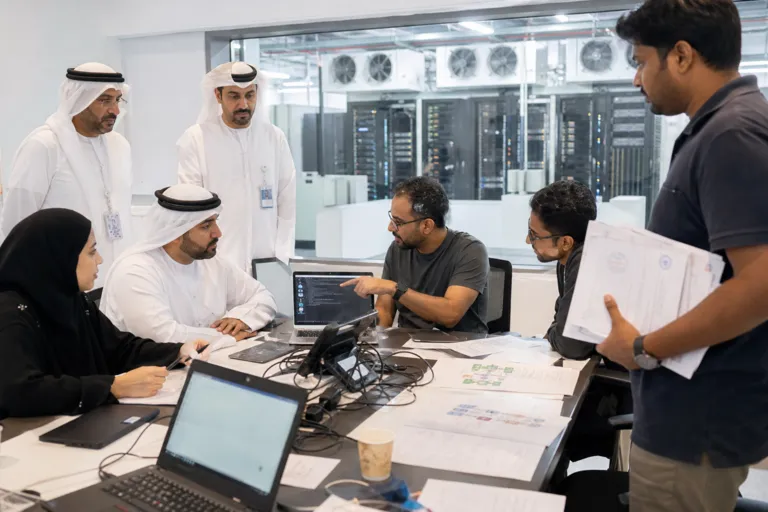
Governments are pushing for sovereign AI and building national cloud capabilities so they can retain control over critical data, model access, and compute. One definition frames sovereign AI as a nation’s ability to develop, deploy, and govern AI systems under its own laws and strategic priorities, with reduced dependence on foreign infrastructure. Another view stresses that true sovereignty spans layers beyond location. It includes where data and computing infrastructure sit, who operates and secures systems, who owns underlying technology and intellectual property, and which legal jurisdiction governs access. In the Gulf, this direction is visible as AI moves from experimentation to scale and as agentic systems proliferate.
A key driver is simple capacity pressure. Strategy& experts note that the Gulf’s AI ambitions hinge on securing hundreds of thousands of GPUs and building sovereign compute ecosystems. At the same time, data sovereignty mandates require that much of the Gulf’s compute demand be met locally, particularly across government, regulated industries, and critical infrastructure. That mandate turns compute into policy, not just IT. It also shapes procurement choices. Gulf governments can mitigate risk by securing supply chains with GPU reserves, diversifying global vendors, and deepening partnerships with chipmakers through long-term contracts and strategic investments.
Why Local Models Matter as Much as Local Compute
Sovereign AI is also about what runs on that infrastructure. Gulf nations are building AI ecosystems that include homegrown champions and local models such as KSA’s Allam, UAE’s Falcon, and Qatar’s Fanar. A separate report notes that trust and cultural fit are emerging as key criteria. Decision-makers are prioritising AI platforms that align with local values, regulatory frameworks, and user expectations over those with the largest training datasets. It also states that localised models deliver more contextual value, and that regional large language models can outperform global models in applications such as education, legal compliance, and public services, especially in non-English languages.
Gulf governments are backing this with domestic infrastructure projects. Initiatives such as KSA’s HUMAIN AI data center and the UAE’s Stargate project aim to build hyperscale capacity on domestic soil. HUMAIN and G42, in collaboration with their governments, have continued to develop partnerships with chipmakers such as NVIDIA, AMD, and Cerebras to enhance access resilience. The goal is not only to satisfy domestic needs. Strategy& notes the region is on track not only to meet local GPU demand, but also export compute power. This is a strategic posture built around jurisdictional control and supply resilience.
Real-world deployments show how sovereignty is operationalised. RCR Wireless reported that Humain and AI start-up Groq deployed OpenAI’s new open-source models, gpt-oss-120B and gpt-oss-20B, in Humain’s sovereign data centers in Saudi Arabia. Humain said the models run on Groq’s high-speed inference platform and are fully hosted within the country. It also said hosting within Saudi Arabia ensures compliance with the Kingdom’s data sovereignty and regulatory requirements, allowing enterprises, public institutions, and developers to use the models without transferring data abroad. This is the “sovereign AI Gulf” logic applied to day-to-day usage.
The final reason is national competitiveness and security framing. One Gulf minister quoted by The Jerusalem Post said, “AI is a state of sovereignty,” adding that budgets spent on defense and cyber must also be spent on AI. A Nature study similarly places HPC, cybersecurity, and Arabic-oriented natural language processing at the top of importance for GCC governments, tying sovereign compute and trusted data protection to meaningful AI deployment. Outside the Gulf, Gartner predicts nations establishing a sovereign AI stack will need to spend at least 1% of their GDP on AI infrastructure by 2029. Together, these signals explain why Gulf governments are building their own models and compute, even while navigating global hardware dependencies.
What does “sovereign AI” mean in the sovereign AI Gulf context?
Why are Gulf governments focusing so heavily on domestic compute?
Which local AI models are being developed in the Gulf?
How do partnerships help with compute sovereignty?
Why are culturally aligned and localised models emphasized?