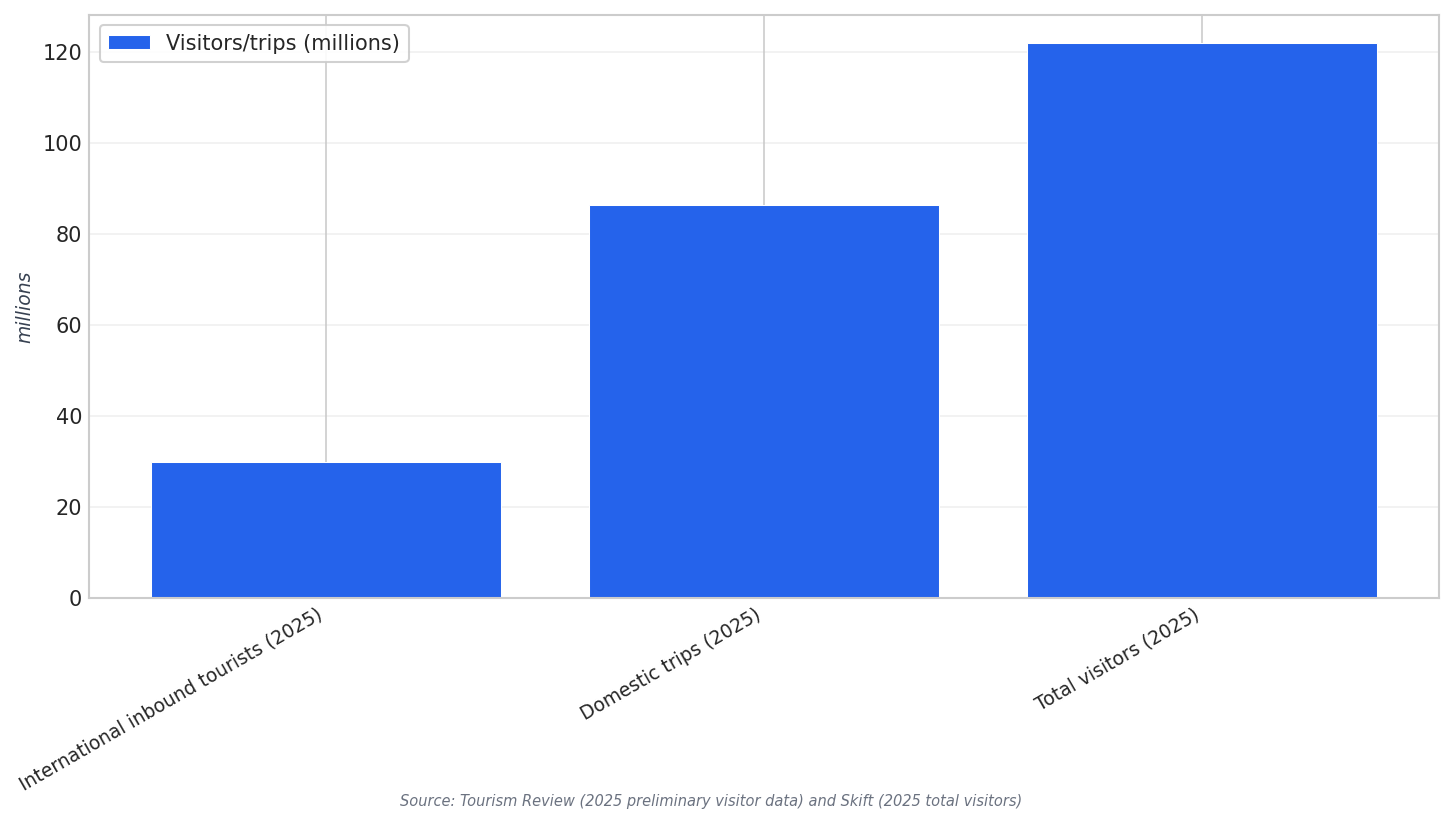
Medical tourism Saudi Arabia is not a standalone campaign. It sits inside Vision 2030 tourism expansion and the systems being built to host more visitors, more often, across more trip types. In 2025, Saudi Arabia had 122 million domestic and international visitors, a 5% increase year over year, according to figures released by the Ministry of Tourism. Preliminary 2025 data also described roughly 29.7 million inbound international tourists and 86.2 million domestic trips, with international numbers up 8% and domestic trips up 5%. That scale matters for healthcare travel, because medical trips depend on flights, hotels, ground access, and predictable service standards.
The tourism economy is already sizable. Tourism spending reached nearly SR300 billion in 2025, a 6% increase, as confirmed by Tourism Minister Ahmed Al Khateeb. Tourism currently accounts for 5% of the country’s gross domestic product, and the kingdom aims to double this figure by 2030, reaching a 10% contribution as part of broader diversification. The Vision 2030 visitor goal is 150 million visitors, with a target mix of 80 million domestic and 70 million international. Saudi did not release a breakdown of the mix of visitors in 2025, but the preliminary trip counts still show domestic volume as the base while inbound travel grows.
One way to judge readiness for medical tourism is to look at the travel supply being added. Saudi Arabia is poised to deliver 362,000 new hotel rooms by 2030, with global groups like Marriott International, Accor, IHG, Hilton, and Radisson dominating existing supply and set to control the largest share of the upcoming pipeline, according to a Knight Frank report cited by Skift. At the same time, 78% of the upcoming hotel supply is concentrated in luxury and upscale tiers, creating a structural gap for mid-scale and budget travelers. For cross-border care, that gap can matter, since many patients travel with families and need practical, longer-stay accommodation.
Healthcare Credibility and Regional Investment Signals
Clinical credibility is another pillar for a regional healthcare destination. King Faisal Specialist Hospital and Research Centre (KFSHRC) has been ranked first in the Middle East and North Africa and fifteenth globally among the world’s top 250 academic medical centers for 2025. At the Global Health Exhibition 2025 in Riyadh, the hospital showcased a new manufacturing complex for gene and cell therapy alongside advances in robotic surgery, genetic diagnostics, and augmented-reality medical training. Brand Finance 2025 also recognized KFSHRC as the most valuable healthcare brand in the Middle East, and it was listed in Newsweek’s World’s Best Hospitals 2025, Best Smart Hospitals 2026, and Best Specialized Hospitals 2026. These signals support a narrative of care quality and innovation that medical travelers weigh heavily.
Cross-border provider interest is also forming. Akdital Holding, Morocco’s largest private healthcare provider, plans a $1.6 billion expansion into Saudi Arabia and the UAE by 2030. The plan includes opening up to eight new clinics and investing $200 million in diagnostic centres, with Mecca identified as a strategic priority alongside Dubai. The company also described financing via raising equity from Gulf wealth managers and family offices, and issuing domestic bonds worth $86 million, while aiming to utilize its property subsidiary to raise $700 million for land and hospital construction. For medical tourism Saudi Arabia, that kind of inbound private healthcare capital can expand capacity and diagnostics aimed at mobile regional demand.
Finally, medical travel depends on movement, not just medicine. Saudi Arabia is pursuing easier entry via e-Visas, and it is launching Riyadh Air, with commercial passenger flights for the public expected to start in early 2026 after initial operations. The airline plans to fly to over 100 destinations by 2030. Meanwhile, Saudi’s broader tourism strategy includes marquee destination builds and year-round demand systems, while also drawing attention to the need for realism and execution. One Skift analysis argued Saudi should build from strengths like Muslim families and visiting friends and relatives traffic, rather than over-focusing on narratives that can outpace delivery. In medical tourism, that same discipline can help convert ambition into repeatable patient experiences.
What does “medical tourism Saudi Arabia” mean in the context of Vision 2030?
How many visitors did Saudi Arabia report in 2025?
What are the 2025 domestic and international travel figures mentioned in the sources?
Which hospital rankings and recognitions were cited for KFSHRC?
What healthcare investment move signals growing regional interest in Saudi Arabia?