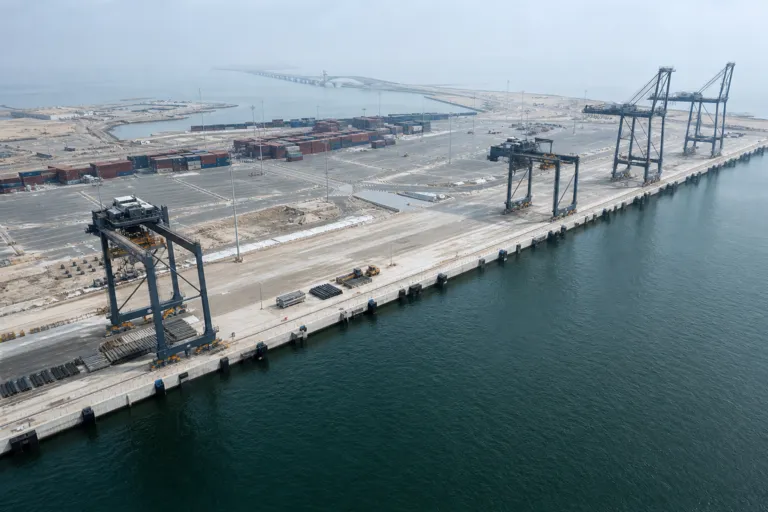
Kuwait’s “Northern Gateway” narrative is increasingly tied to a container port rising on Bubiyan Island, at the northern tip of the Arabian Gulf. Multiple reports frame the development as a trade and logistics platform aimed at strengthening non-oil growth and lifting the country’s relevance in regional shipping networks. The port’s location is repeatedly described as strategic for serving Kuwait’s domestic market while also reaching northern Gulf corridors, including cargo linked to Iraq and potentially parts of Iran. In this positioning, Kuwait is not only adding infrastructure; it is trying to shape new trade flows that are less centered on older, more central routes.
Execution is anchored by Kuwait-China cooperation. China Communications Construction Company is identified as leading Engineering, Procurement, and Construction work for Phase 1, and the State Audit Bureau of Kuwait is cited with an EPC contract cost of approximately 1.3 billion Kuwaiti dinars, described as more than USD 4.1 billion. Another report places the Phase 1 EPC contract near USD 3.97 billion, around 1.219 billion Kuwaiti dinars, after approval by Kuwait’s Central Agency for Public Tenders, with officials later formalizing the deal. While contract figures vary slightly by source, the common signal is that Kuwait is committing multi-billion-dollar capital to move from planning into delivery.
What the Build-Out Looks Like—and What It Needs to Prove
The construction plan is presented in three phases, with Phase 1 calling for a 1,200-metre-long container terminal designed for 2.7 million TEUs annually. In the second and third phases, 14 additional box berths are scheduled, taking total capacity to over 8 million TEUs, with completion expectations described as 2026. A separate reference notes Phase 1 completion in April 2021 with four berths, alongside enabling works such as power plants and substations on Bubiyan and a road project connecting the first phase to the island’s existing road network. In logistics terms, the question is not only “how much capacity,” but whether throughput can be translated into dependable service levels and repeatable supply chain choices.
Connectivity is where the hub ambition either becomes real or remains a headline. One industry commentary says the port is being linked via a new 265km railway network intended to connect Kuwait City to the broader GCC rail project. That same view argues the gateway could offer a shorter, more efficient route for goods heading toward Iraq and Central Asia, particularly when shippers want options beyond congestion at older ports. It also highlights specialized handling for heavy-lift and oversized cargo common in oil, gas, and construction. These are operational differentiators, but they only matter if the inland links, procedures, and day-to-day execution keep pace with the marine-side investment.
Competition is the final test. Analysts describe a “highly competitive” Gulf logistics market, pointing to established hubs such as Jebel Ali Port and Hamad Port, which already operate at significant scale with advanced automation and strong liner connectivity. One report adds that Kuwait’s parliamentary oversight can be beset by delays on capital expenditure projects, and characterizes the port as launching after other GCC countries have already delivered strategic hub projects and captured market share. Still, the case for Kuwait’s northern gateway is not strictly about replacing mega-hubs. It is about capturing transshipment flows and cargo destined for southern Iraq, strengthening feeder roles, and building a trade platform aligned with Kuwait Vision 2035 and Belt-and-road linkages. Whether it becomes a logistics hub will be decided by efficiency and connectivity as much as by the headline capacity of the Mubarak Al Kabeer Port.
How big is the planned capacity for the Mubarak Al Kabeer Port project?
What is the reported value of the Phase 1 EPC contract?
Why is Bubiyan Island positioned as a “Northern Gateway” for Gulf trade?
What connectivity projects are linked to the new port plans?
What are the main competitive pressures on Kuwait’s hub ambition?