
Humain is the Saudi Arabia Public Investment Fund (PIF)-owned AI company unveiled in May ahead of President Donald Trump’s state visit to Riyadh. At the Future Investment Initiative, Humain CEO Tareq Amin said he wants Saudi Arabia to become the world’s third-largest AI market, after the United States and China. He argues the Kingdom’s edge is abundant, cheap energy and an established power grid. Amin said that not needing to build substations and power delivery for data centers saved Humain 18 months of time. This urgency also links to Vision 2030 headwinds, including declining oil prices and delays in giga-projects like Neom.
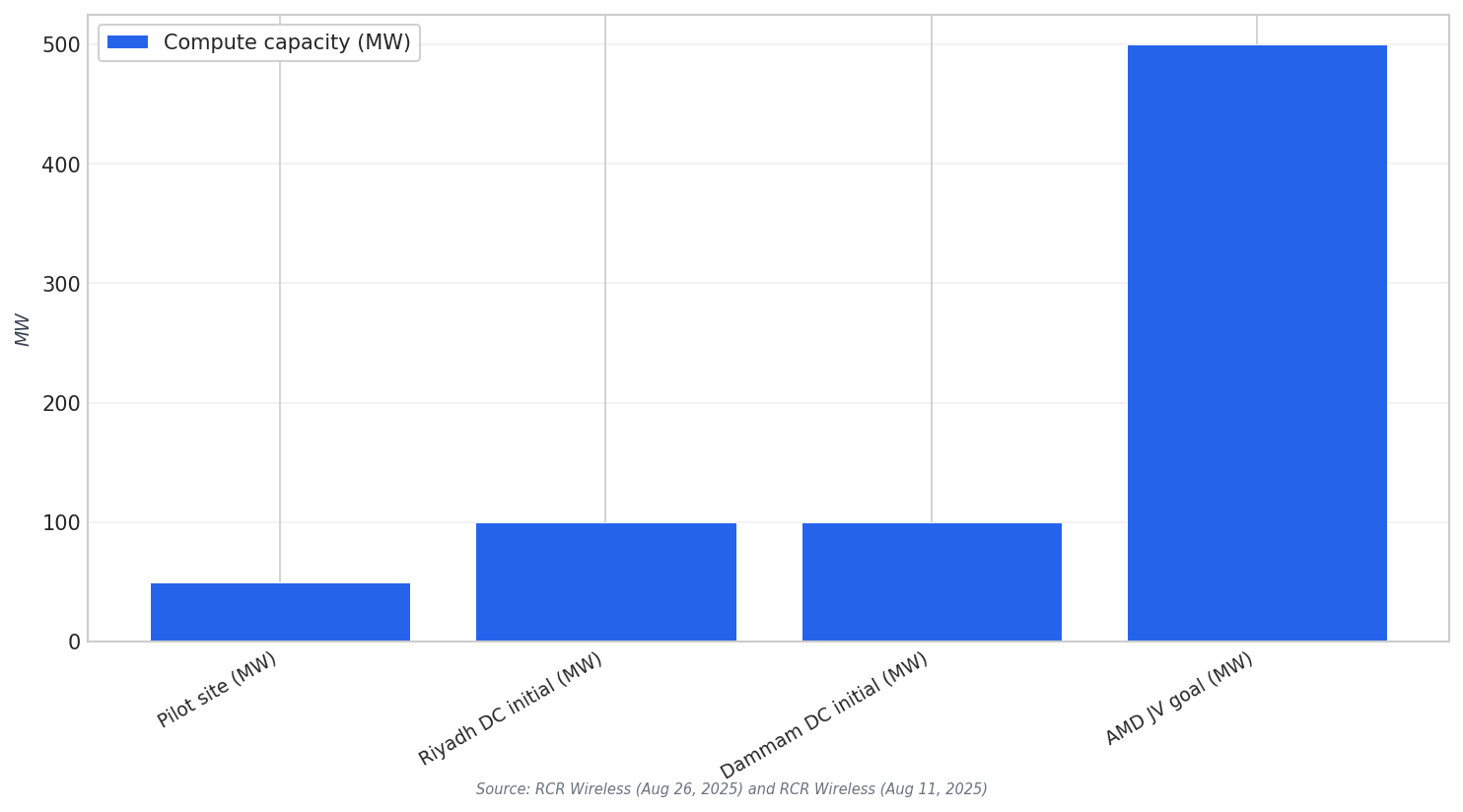
The company’s compute story is built around explicit capacity targets and projects that are already being formed. Humain plans to build up to six gigawatts in data center capability across Saudi Arabia by 2034. Separately, its broader roadmap includes developing up to 1.9 gigawatts of AI-focused data center capacity by 2030, with plans to scale to 6.6 gigawatts over the next four years. It has also started building first data centers in Riyadh and Dammam, expected to launch in the second quarter of 2026, each with an initial capacity of up to 100 megawatts.
Partnerships, Chips, and the New Gulf Compute Geometry
Humain is tying its buildout to a roster of U.S. and global partners. Amin has cited key partners including Nvidia, AMD, Amazon Web Services, Qualcomm, and Cisco. In August 2025, Humain said it was forming a $10 billion joint venture with AMD to deliver 500 megawatts in AI compute capacity over five years. In a separate $2 billion partnership with Qualcomm, it will build a chipset design center in Riyadh employing 500 engineers. Humain has also signed $23 billion worth of agreements with Nvidia, AMD, Amazon Web Services, and Qualcomm, and Amin said the full project cost could reach $77 billion based on current valuations.
Chips and accelerators are a central part of the HUMAIN Saudi AI strategy and its compute race positioning. Humain is sourcing semiconductors from U.S. suppliers, including Nvidia’s most advanced AI chips, for which it has secured local regulatory approval. Nvidia previously announced plans to deliver hundreds of thousands of chips to Saudi Arabia, with an initial batch of 18,000 Blackwell processors allocated to Humain. In November 2025, AWS also said it plans to provide, deploy, and manage up to 150,000 AI accelerators in Riyadh. These moves sit alongside data sovereignty mandates in the Gulf that require much compute demand, especially in government and regulated industries, to be met locally.
The compute race is not only about buildings and chips; it is also about platforms and daily deployment. Humain publicly launched Humain One, an AI-powered operating system where users speak or type to tell a computer to perform tasks rather than clicking on icons as in Windows or iOS. Internally, Humain has used AI to run much of its HR, finance, legal, operational, and IT departments, and Amin said there is now only one employee in the payroll department, with AI agents handling the rest. Regionally, Saudi Arabia also faces competition from the UAE’s G42 and its “Stargate UAE,” a $500 billion data center project billed as the largest outside the United States.
What is the HUMAIN Saudi AI strategy trying to achieve?
How much data center capacity is Humain planning?
Which partners are tied to Humain’s compute push?
What is Humain One?