Delivering giga-projects in a tighter-budget era is less about squeezing bids and more about governing uncertainty. Multiple pressures are converging. Material costs for steel, concrete, lumber, and key mechanical and electrical components are projected to stay elevated or rise again due to tariffs and supply volatility. That keeps bids and change orders high, and it can increase contract disputes, legal expenses, and insurance premiums. At the same time, lenders are demanding increased scrutiny and documentation, larger contingency reserves, and higher equity contributions. This is the backdrop for giga-project delivery risk.
Owners and EPCs are reacting by rethinking who carries risk and when. Under traditional lump-sum contracts, EPCs assumed nearly all financial risk. Owners locked scope, schedule, and price, while contractors either delivered or absorbed losses. But that model is looking less attractive in a market where equipment lead times can exceed project timelines by years, and where labor scarcity and supply volatility are described as structural realities. EPC leadership has publicly acknowledged a shift away from fixed-price delivery toward collaborative, transparent cost-sharing models.
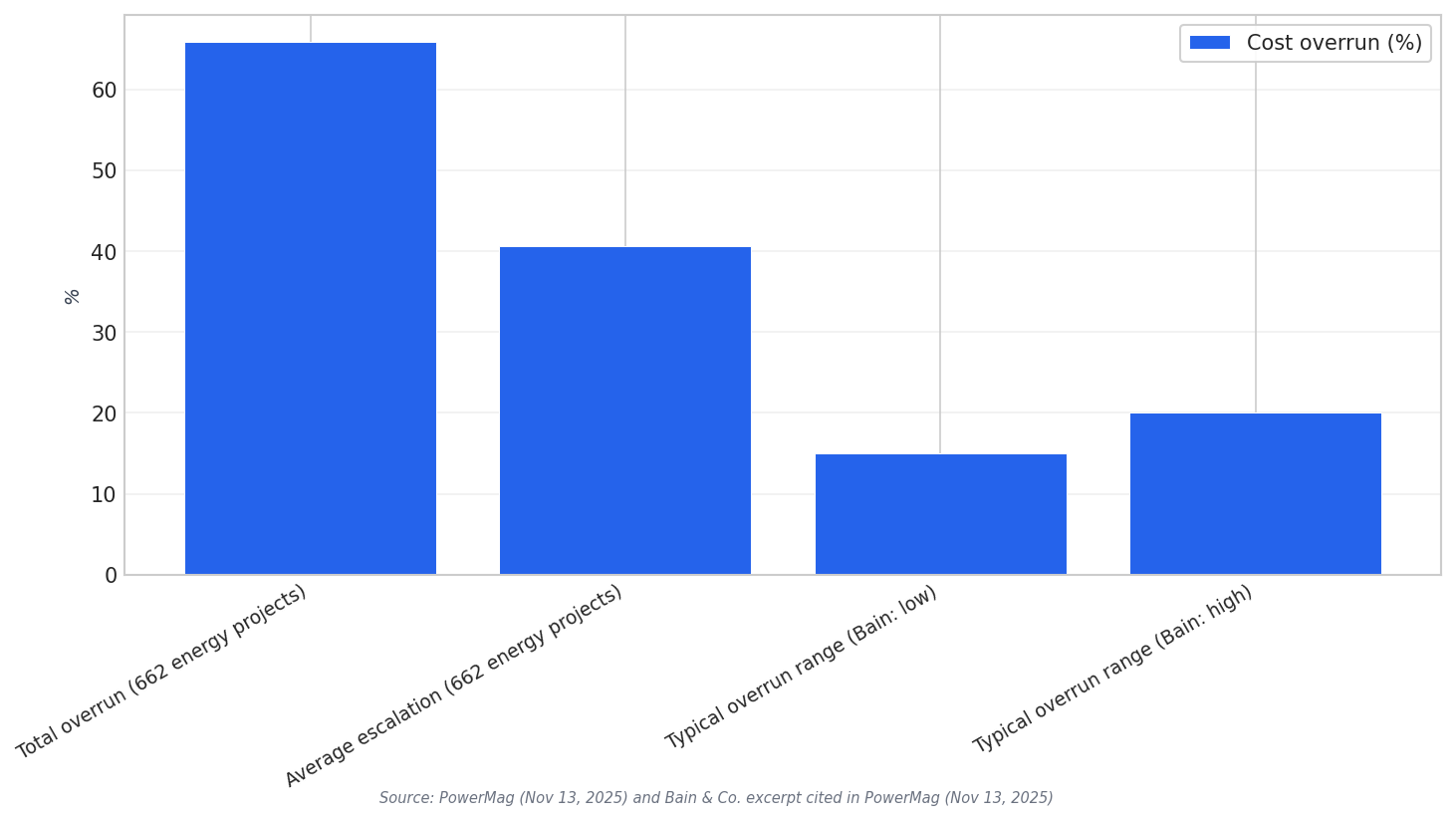
Portfolio-scale evidence shows why the conversation is changing. An analysis of 662 energy projects across 83 countries built between 1936 and 2024, representing more than 400 GW, found actual costs of $1.358 trillion against $812 billion budgeted. That is a 66% overrun. More than three-fifths of projects exceeded budget, and the average escalation was 40.6%. In parallel, Bain & Co. noted that large projects often run 15% to 20% over budget, exposing utilities to $1.5 billion of capital risk annually through 2030. These figures are a warning signal, not a rounding error.
A Practical Risk Playbook for Owners and Contractors
Start earlier than the bid. Preconstruction input helps make designs “crystal clear,” reducing the need for contractors to price uncertainty with cushions or to recover later through change orders. The most consequential cost decisions are typically made well before construction begins, when scope assumptions, delivery strategies, procurement approaches, and risk posture are set under incomplete information. Owners can reduce giga-project delivery risk by locking in better decisions at that early point, not by blaming late jobsite errors after flexibility is gone.
Then, quantify uncertainty instead of arguing about it. One EPC advisory approach is to define clear procurement and hedging objectives and use probabilistic modeling to quantify both price and volume risks. That provides a data-driven basis for conversations with regulators about prudent risk management and allows teams to test hedge strategies and adapt to changing market conditions. Finally, design the commercial model and execution system to fit the new reality. P3 lessons emphasize that unclear risk, not risk itself, drives premiums and timeline impacts. Deepwater contractors likewise highlight early engagement, standardized execution, and collaborative contracting with shared risk or performance incentives tied to schedule and cost outcomes. Digital tools, including BIM, drones, data analytics, and AI, are also cited as levers to control costs and mitigate disputes.
What is giga-project delivery risk in today’s tighter-budget era?
Why are owners and EPCs moving away from fixed-price lump-sum models?
What hard evidence shows the scale of cost overrun risk?
How can early-phase decisions reduce late-stage overruns?
Which practices help mitigate disputes and improve execution discipline?