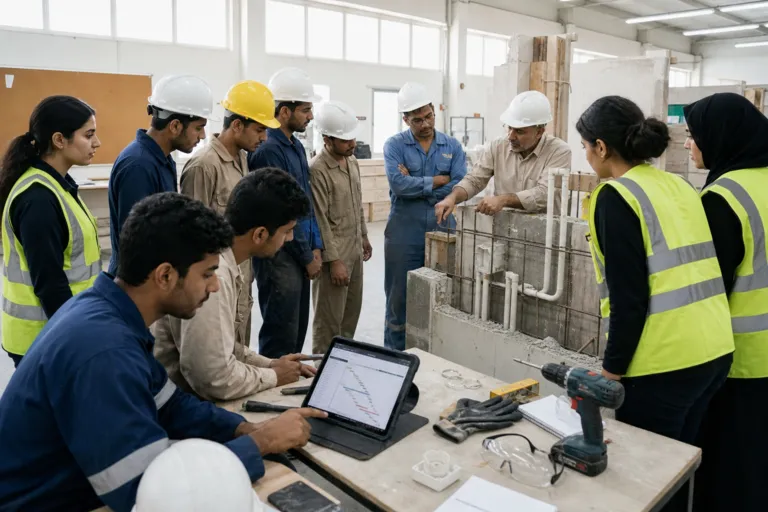
The construction skilled labor shortage GCC is not an abstract risk. It is a day-to-day constraint that shapes how contractors plan projects, price work, and schedule crews. Across the wider industry, sources describe a workforce pipeline under strain as experienced workers near retirement and fewer young people enter the trades. One report notes the average age of laborers is in the early 40s, and in some skilled trades it is in the mid-50s. Another source adds that roughly one in five construction workers is now over the age of 55. Contractors also report that candidates often lack the skills, certifications, or licenses needed to step into open roles.
Contractors feel the shortage in project delivery and business performance. A source focused on contractor impacts describes timelines that stretch too far, missed deadlines that frustrate clients and investors, rising costs tied to labor premiums or late-delivery penalties, and reduced capacity that forces some firms to turn down work. It also highlights turnover risk, noting that even when workers enter construction, many do not last longer than a few months, which triggers retraining and reduces job productivity. Another source reports that 92% of contractors are struggling to fill open positions, and nearly half have delayed projects due to a lack of workers.
What GCC Contractors Can Borrow: Partnerships, Pathways, and Tech
Sources point to a multi-front response that maps well to the construction skilled labor shortage GCC conversation: invest in people, partnerships, and technology at the same time. One workforce article stresses that association partnerships matter, citing collaboration across groups such as AGC, ABC, and AEM to pool resources and create more effective training programs and career pathways. It also emphasizes consistent engagement with education, including teaching classes on a quarterly basis, participating in Skills USA events, and providing internship opportunities. Major contractors are described as building clearer pathways from education to employment, offering technology training to current employees, and even developing internal training academies that blend craftsmanship with advanced technology competencies.
For GCC contractors, technology is not positioned as a silver bullet in the sources, but it is a productivity lever when paired with training. PMI’s MENA-focused findings highlight a lag in technology adoption, even as tools such as Artificial Intelligence (AI), Building Information Modeling (BIM), and Digital Twins are described as having massive potential to enhance workforce productivity. The same PMI summary points to training limitations, including a lack of structured career pathways, professional development, and access to certifications, which can prevent entry-level and mid-career professionals from contributing fully. Another source frames training as a strategic investment as job sites become more digital and data-driven.
Looking at the scale of need helps explain why contractors are broadening solutions beyond hiring. In the United States, ABC estimated a need for 439,000 net new workers in 2025 alone, and another source notes ABC predicts nearly 500,000 new construction workers will be needed in 2026 to keep up with rising project demand. Over the next decade, one report projects a need for 1.9 million new workers. In MENA, PMI’s research says that under a high-growth scenario, demand will increase by nearly 97,359 professionals by 2035, while a low-growth scenario still leaves the region short by over 88,561 professionals. The common thread is that proactive recruiting, skills development, and inclusion are presented as essential.
The practical takeaway for the construction skilled labor shortage GCC is a disciplined, repeatable playbook. Sources argue that firms that move decisively will build an advantage in a labor market that “shows no signs of easing.” That means building pipelines early through apprenticeships, mentorship, and internships, while strengthening career pathways that keep people in the industry. It also means equipping crews for digital workflows, so technology adoption actually lifts output rather than adding friction. Contractors that invest in workforce development alongside modern tools are positioned to stabilize delivery, protect margins, and reduce the risk of delays tied to missing skilled workers.
What does “construction skilled labor shortage GCC” mean in practice for contractors?
What workforce demographics are cited as drivers of the shortage?
What training actions do the sources describe contractors taking?
What does PMI say is holding back MENA construction talent capacity?
How large is the talent need in the sources’ examples?