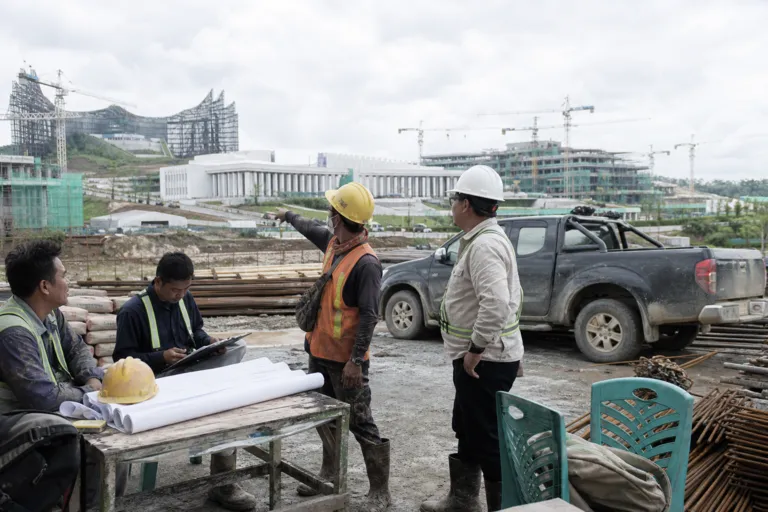
Nusantara is rising deep in Borneo’s forest, about a two-hour drive from Balikpapan. Indonesia announced the plan in 2019 and began construction in 2022. By 2026, the core government district is described as nearly complete, with a sprawling green park, white office buildings, and a Garuda-themed centerpiece near the presidential palace. The Garuda Palace is also described as complete, while other national institutions remain works in progress. Yet even with visible progress, the broader narrative is mixed. NPR reports concerns that a project described as more than $30 billion has moved slowly due to logistics, funding challenges, and political timing.
The most immediate shift is financial. NPR reports that state funding was cut in half for 2026 compared with the previous year. Another account frames the drop in sharper terms, reporting state funding falling from $2 billion in 2024 to $300 million allocated for 2026, described as an 85% cut. These figures matter because the financing model has long depended on private and foreign capital for most of the buildout. Asia News Network notes the 2022 Capital City Law mandates that no more than 20% of Nusantara’s financing is to come from the state budget. Against that backdrop, doubts grow when investors hesitate and when Nusantara is notably absent from the “top five” priorities in the 2025–2029 RPJMN.
Core-District Completion vs. The Next Mile of Relocation
Core-district progress does not automatically translate into a thriving administrative city. NPR reports that the broader metro area includes around 150,000 people, but the new city’s core has only about 10,000 residents, including roughly a thousand civil servants. Looking at 2026 activity, two sources describe a similar near-term relocation push: NPR cites plans to move 4,100 more civil servants this year, while Linos NEWS says four thousand civil servants are scheduled to relocate this year. The gap between a constructed civic core and a functioning population center remains a key tension for Nusantara IKN construction 2026, because relocation needs services, housing, and day-to-day activity—not only landmark buildings.
The government’s messaging has also evolved. NPR reports that President Prabowo Subianto signed a presidential regulation designating Nusantara as Indonesia’s “political capital” by 2028, which differs from earlier language calling it the “national capital.” Linos NEWS likewise describes a formal reclassification that frames Nusantara as a political capital, with Jakarta retaining economic dominance. Basuki Hadimuljono, head of the Nusantara Capital City Authority, says legislative and judicial buildings will be completed by next year, and that the president plans to move to Nusantara in 2028 once those buildings are finished. That sequence puts institutional completion ahead of full-scale migration, and it raises the stakes for whether funding and investor appetite can sustain momentum through the next construction phases.
Investor confidence is the other hinge point. Linos NEWS reports Rp 225 trillion ($13.8 billion) in total investment commitments from 42 companies, but says only about $4 billion has been realized in practice. The Guardian also notes criticism that the project has struggled to attract the private foreign investment needed for 80% of the estimated bill. Construction limits are visible in land-use progress too: The Guardian reports that by mid-2025, only 800 hectares of the planned 6,600-hectare core government area had been developed. Meanwhile, the South China Morning Post describes Chinese investors and construction firms clearing jungle for Nusantara, highlighting how external capital is already shaping what gets built and when. Together, these signals suggest that the core district can look close to finished while the larger city remains an open question tied to funding, priorities, and delivery of the next layers of infrastructure.
What does it mean that Nusantara will be a “political capital” by 2028?
How far along is the core government district in Nusantara?
How is Nusantara IKN construction 2026 affected by the state budget cut?
How many people live in Nusantara today, and how many civil servants are there?
Are private investment commitments translating into real spending on the ground?